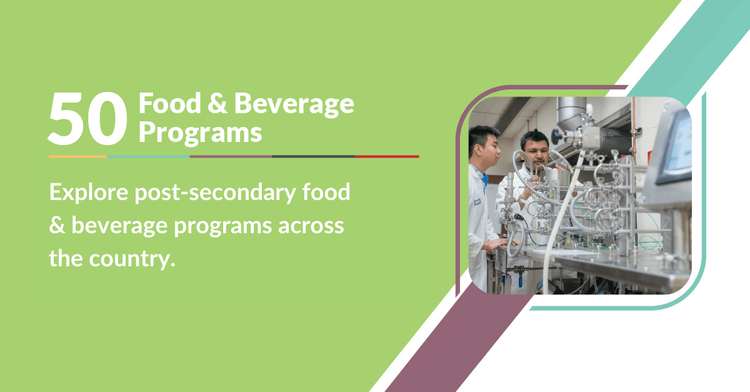
Canada is home to a diverse and dynamic food and beverage industry, supported by educational programs that train the next generation of chefs, brewers, entrepreneurs, and innovators. This roundup highlights 50 standout programs across the country, from top culinary schools and hospitality management courses to cutting-edge research initiatives and sustainability-focused training. Whether you're an aspiring professional, educator, or industry enthusiast, these programs provide valuable insights into the evolving world of food and drink in Canada. BC & Yukon Vancouver Community College UBC BCIT LaSalle College (Vancouver) UBC: Food, Nutrition, and Health Okanagan College Vancouver Island University University of Fraser Valley Northern Lights College North Island College Yukon University Selkirk College Thompson Rivers University Kwantlen Polytechnic University Prairies Saskatchewan Polytechnic University of Alberta University of Saskatchewan University of Manitoba SAIT NAIT Manitoba Institute of Trades & Technology International College of Manitoba Ontario Niagara College Humber College Le Cordon Bleu Ottawa George Brown College Fanshawe College Brock University University of Guelph Toronto Metropolitan University Loyalist College Georgian College Conestoga College Durham College Centennial College Canadore College Algonquin College Trent University St. Lawrence College St. Clair College Sault College Lambton College Confederation College Quebec McGill University LaSalle College Bishop's University Atlantic Canada University of PEI Memorial University Cape Breton University
Community Manager-
50 Food & Beverage Programs - Vancouver Island University
Crafting a Career in BC ’ s Wine Industry: VIU ’ s Wine Business Program The Wine Business program at Vancouver Island University is a comprehensive one-year certificate course designed for those passionate about pursuing a career in the BC wine industry. The program combines practical experience with academic learning in viticulture, wine business practices, marketing, and tourism. Program Highlights: As a student, you ’ ll have the chance to immerse yourself in hands-on experiences at local vineyards and wineries, gaining insights into the entire winemaking process. This practical foundation is then complemented by academic courses in viticulture, wine business practices, marketing, and tourism. A standout feature of this program is its flexibility. Whether you ’ re looking to study full-time for a year or prefer a part-time option spread over two years, VIU has you covered. Located in picturesque Nanaimo, BC, VIU provides an ideal setting for your wine education journey. With a curriculum designed to integrate viticulture essentials with business acumen, VIU ’ s Wine Business program offers a holistic understanding of the wine industry. Students can also earn credits that can be applied toward a Bachelor of Business or a Hospitality and Tourism Management program, opening doors to a wide range of future career prospects. The program includes seven courses and focuses on the broader aspects of the wine industry. In addition to viticulture and winemaking, students delve into wine marketing, exporting, and the vital role of wine tourism. C ourses cover a wide spectrum, from wine marketing and appreciation to beverage theory and the management of wine tourism. The program also offers elective courses in consumer behavio u r, entrepreneurship, and festival management . What You’ll Leave With: Upon graduation, a world of opportunities awaits you in BC ’ s wine industry. Whether you dream of managing a vineyard, excelling in wine s ales and marketing, or even opening your own restaurant, VIU ’ s Wine Business program provides the knowledge and skills to make your wine-related ambitions come true. Career options span winery/vineyard management, retail sales, wine marketing representation, hotel management, culinary arts, a gri - tourism development, and s pecial events coordination. V ideo/Social / Media : VIU YouTube Video
Community Manager-
Cellular Food in Canada
The past few years have proven how susceptible Canada’s food industry is to world events, supply chain disruptions and climate changes. New food production technology, such as cellular agriculture, has the potential to alleviate some of these challenges, while creating commercial opportunities and building a more sustainable, resilient food system. What is it? Cellular food – also known as engineering biology, synthetic biology or cell-cultivated products – is the production of food and textile products without using animals or land. Cell cultures harvested from animals, plants or micro-organisms are grown in the lab through tissue engineering or precision fermentation to produce: Cultivated proteins such as chicken, beef and seafood Fermented products like dairy, eggs, honey and chocolate Ingredients to add to products to create hybrid foods including proteins, enzymes, flavour molecules, vitamins, pigments and fats Textiles such as leather, silk and wool Why you should care As global population continues to grow, so does demand for protein, while access to land and other resource inputs become more scarce. Alternative agriculture could be an answer to food scarcity, concerns about animal and environmental welfare, cost inflation and resource challenges due to climate change. Compared to conventional agriculture, cellular agriculture production, is much less energy intensive, produces less greenhouse gas emissions, and has a much lower overall carbon footprint. With our strong food infrastructure, reputation for food safety, biotechnical expertise, and federal support for alternative protein production, Canada is well positioned to become a leader in cellular agriculture. The 2021 report Cellular Agriculture: Canada’s $12.5 Billion Opportunity in Food Innovation from Ontario Genomics and the Food and Agriculture Institute at the University of the Fraser Valley found that the international cellular agriculture market will reach US$100 billion by 2032. Canada’s food industry has the potential to take $12.5 billion that market, while creating up to 142,000 high-paying jobs. Opportunities in Canada Engineered plant proteins are already in the Canadian market, and by all estimates, precision fermented products are expected to appear before cultured meat products. Current Canadian regulations consider food produced through cellular agriculture as a novel food, and products are approved on a case-by-case basis. Here are a few Canadian start-ups making headlines: Because Animals – This Toronto-based pet food company uses cultured ingredients such as probiotics and nutritional yeast to create nutrient-rich cat and dog food designed to help digestive issues. Future Fields – Edmonton, AB-based Future Fields is a R&D producing growth media products that can be used to create commercialized cultivated proteins in a safe and sustainable manner. Cell-Ag Tech – Toronto’s Cell-Ag Tech is doing R&D on cell-cultured fish and seafood. New Harvest International non-profit research institute New Harvest , which promotes the science behind cultured meat through research, funding and a conference , now has a Canadian branch.
Community Manager-
Other Articles
CFIN Joins Global Innovators at Web Summit Vancouver 2026
Last week, CFIN was thrilled to be on the ground at Web Summit Vancouver 2026 where the energy was on point ⚡ National Senior Innovation Director , @Lavina Gully and Director of Communications, @Jamil Karim spent an incredible few days connecting, learning, and celebrating the growing momentum behind innovation in BC and beyond! We were especially excited to reconnect with several CFIN members like Maia Farms, Arbia, and BetterTable, and to spend time with many local partners at the BC Pavilion . It was fantastic to see Canada’s food innovation ecosystem showing up in force on a truly global stage. Looking for more analysis on Web Summit Vancouver? Read @Lavina Gully 's reflections on the Scaling Agritech: From Pilot to Profitable Growth panel, exploring what it takes to turn emerging foodtech innovation into scalable commercial success: https://www.linkedin.com/posts/lavinagully_food-and-agritech-had-a-much-stronger-share-7460811935018618881-s2Ux?utm_source=share&utm_medium=member_desktop&rcm=ACoAACLLGdwBiNeeaewRFuSJeGYvGgDoyT0DExs With 20,000+ attendees, 768 investors, and companies that have collectively raised $77B, this year’s summit made one thing clear: food systems innovation is gaining real traction on the global tech stage. We left energized by the conversations, proud to see so many CFIN grant recipients represented, and more motivated than ever to keep building Canada’s food future.
Community Manager-
Inside SIAL Canada 2026: Driving Food Innovation Through Connection and Collaboration
CFIN had the honour of taking a bite out of SIAL Canada 2026 in Montréal 🍎—connecting with partners, members, and industry leaders shaping the future of food innovation across Canada and beyond. Representing CFIN on site were CEO @Dana McCauley and @Julie Daigle , Regional Innovation Director (Quebec), who engaged with the ecosystem throughout the event. Their presence reflected CFIN’s ongoing commitment to strengthening Canada’s food innovation ecosystem and supporting high-potential foodtech ventures. Attendees could also catch Julie as a Foodtech Focus expert at the SIAL Canada Expert Hub, where she connected directly with innovators and shared insights with the community. Dana also took the stage as part of the Dairy Talks program, contributing to a forward-looking discussion on innovation as a driver of market leadership in the Canadian dairy sector. Her session explored the shift from incremental product development toward a broader innovation mindset—highlighting next-generation ingredients, value-added dairy formats, new go-to-market strategies, and the role of Industry 4.0 technologies like AI, robotics, automation, and digital supply chains in strengthening productivity and global competitiveness. A key highlight of the week was CFIN’s involvement in the 7th edition of the Startup Pitch Competition, held on April 30 on the Food & Bev Connect stage. Julie Daigle participated as the President of the Foodtech jury, joining a panel of industry experts evaluating promising entrepreneurs from the Startup Village. Beyond the competition, the Startup Pitch stage served as a strategic platform connecting entrepreneurs with buyers, investors, and key decision-makers across the agri-food ecosystem. A standout moment for the CFIN community was the recognition of Maia Farms, a CFIN member and funding recipient, which earned the Gold Prize in the foodtec h competition 🍄🏆 CFIN’s presence at SIAL Canada underscored the momentum of Canada’s food innovation sector and the value of convening the ecosystem to accelerate ideas from concept to commercialization. 📖 Explore more from SIAL Canada 2026 R elive the stories, innovations, and key moments captured throughout the show in the official SIAL Canada Daily: SIAL Canada Daily – 2026 Edition (Photos Courtesy of SIAL)
Community Manager-
Five Years of CFIN: A Letter to the Network
Thirty years ago, I worked as a chef in the kitchen of one of Canada’s top restaurants standing should er to shoulder with people who ca red about the sensory experience of food above all else . Our tech stack was al most all analog and , to be honest, we didn’t give our ordering system or the way we did inventory a lot of thought. My career broadened over time , and I ’ ve also held roles where I developed recipes at Canadian Living and wrote about food trends; built innovation strategies and products for national brands, founded a business incubator, and ran a venture creation office at a prestigious Canadian u niversity . Food was always the thread , and technology was always present but in most of the food focused businesses I’ve worked for, it was taken for granted, and creativity and hard work were what drove the businesses forward. While smart people with great ideas are essential to food business success, it’s not enough to be competitive in today’s world. Old ways of running restaurants, innovation labs and food and beverage processi ng businesses can’t compete internationally or absorb the trade shocks that have become commonpla ce in recent history. That’s why I feel l ik e CFIN is the perfect place for me to be today and why we’re adding dozens of new members per week. When CFIN was created in 2021, the mandate was intentionally broad : cata lyze Canadian food innovation with funding , build community, connect an ecosystem that had been operating in silos for decades. The funding programs took shape quickly. Since 2022, we’ve awar ded $23.3 million to 133 projects across six program s. For every $1 CFIN invested, our members committed $7.65 of their own capital toward innovation. This leverage ratio of nearly 8-to-1 has unlocked over $140 m illion in private sector spending on R&D and capital infrastructure. The other work was harder to define . What do "build community" and "connect an ecosystem" mean in practice for a sector span ning startups, processors, researchers, investors, policymakers, and operators spread across this vast country ? Th at question didn't have a tidy answer. As a result , fostering and serving this network was (and remains ) an exercise in innovation itself : something new to be built , and then tested, adjusted, and iterated upon , ad infinitum . I’m immensely proud of what we’ve built so far . A team of Regional Innovation Directors who've supported more than 2,200 organizations, brokering the introductions that became commercial partnerships, strategic investments, leadership hires, and research collaborations. A digital platform , YODL, connecting Canada's food sector across industry silos and bridging interprovincial barriers . The first comprehensive analysis of Canadian foodtech . A network of 8,500 members from every province, every part of the food value chain, every stage of business . On any given week, our community is discussing topics ranging from precision fermentation bioreactor designs and funding stacks to food packaging labeling regulations and export strategies, all in the same space. Members benefit from purpose-built tools and resources — like our Funding Finder that aggregates food and beverage funding opportunities across the country and a growing library of original sector research and analysis — alongside direct access to our Regional Innovation Directors. Canada has strong regional funders, accelerators, trade associations, and tech transfer offices, each doing necessary work in a defined lane. What this sector didn't have was a place where the conversation s , the tools, and the connections all showed up at once — where the range of problems and the range of capabilities were dense enough that the right solutions could emerge . That's what CFIN has built. That foundation is important because the next five years will be even more dynamic, and often more challenging, than the last five . To keep pace and flourish in an increasingly volatile world, Canada's food sector needs to modernize faster and more strategic ally than ever before . Trade disruption is dramaticall y reshaping supply chains . L abour constraints are compounding a productivity gap that was widening long before tariffs became front-page news. Climate pressures are intensifying. Food 4.0 — a tech-enabled food s ector that's more collaborative, productive, resilient, and competitive — is the framework CFIN is building toward, and the case for it gets more urgent by the quarter. I ’m confident that we’re up to the task . Five years ago, Canada's food innovation ecosystem was fragmented, underleveraged, and often invisible to the investors, operators, policymakers, and media who needed to see it. That's no longer true. The capacity to respond to the challenges ahead is here. Not in any single program or policy, but in the breadth of this network — the founders , processors , researchers , and investo rs who are hungry to innovate and build a better Canadian food sector . My own wide-ranging path through the food sector taught me that no single role ever showed me the full picture. It took working across kitchens, labs, newsrooms, boardrooms, and startups to understand how innovation really moves through this industry — and where it get s stuck. CFIN was built on the same insight. A sector this complex, facing challenges this urgent, needs more than funding or advice or connections in isolation. It needs all of them in the same room. That's what we've spent five years building, and I'm betting the next five will prove its value at a scale none of us can yet imagine. Thank you for being part of it. Dana McCauley, CEO, Canadian Food Innovation Network
Community Manager-
Food 4.0 in Action
Canada's food sector contributes over $150 billion to the national GDP and employs more than two million people. It's also a sector that has been slow to modernize. The vast majority of businesses are SMEs operating on thin margins, manual processes, and limited access to the technologies that could make them more productive and competitive. CFIN has spent five years funding food tech projects , with a particular focus on helping innovators pilot and commercialize new technologies with industry partners. Across funded projects , 53 of 86 reporting companies confirmed their solutions have been adopted by end users. More than 21,000 of them. CFIN's network features even more adoption stories from across the broader sector. Here are five of those stories. Mode40 & Nonsuch Brewing: Bringing Data-Driven Precision to the Craft of Brewing Nonsuch Brewing, a majority Indigenous-owned craft brewery in Winnipeg, faced operational bottlenecks using a manual scheduling system built from spreadsheets and intuition. This system was limited . Only the founder knew how it worked, and it couldn’t adapt to fluctuating beer demand or optimize production across existing resources. Partnering with Mode40, Nonsuch transitioned to an agentic AI platform that automates scheduling based on real-time demand and capacity. The solution streamlined production, increased output without new investment, and eliminated guesswork. Watch more. RFINE Biomass Solutions & Java Blend Coffee: Redefining Sustainability in the Roasting Process Java Blend has been roasting coffee in Halifax for over 85 years and supplies more than 400 businesses across Atlantic Canada. Spent coffee grounds were one of their largest waste streams — heavy, wet, expensive to dispose of. RFINE's drying technology converts those grounds into Kaffika , a food-grade cocoa extender that replaces imported cocoa products whose prices have surged in recent years. The waste from brewing becomes a saleable ingredient , and a former disposal cost becomes a revenue line. Watch more. Arbia & Jasmine Foods: Scaling Innovation in Traditional Food Sectors Jasmine Foods has been importing Mediterranean products to Western Canada since 1975 — the first halal meat store in the region. When they decided to expand into wholesale, the legacy systems couldn't follow. They offered n o real visibility into margins or cost of goods sold and relied heavily on manual processes. Arbia's AI operating system, developed with CFIN Innovation Booster funding, replaced the handwritten workflows with structured digital operations. Jasmine is now expanding into a new region without hiring additional staff. Watch more. DeepSight & St-Hubert: Pushing the Boundaries of AI-Driven Training Excellence St-Hubert is one of Quebec's most recognized food brands . It operates a chain of resta urants , along with two manufacturing plants and a distribution centre . Employees move consta ntly across the com pany’s different operations, and the team discovered that t raining was inconsistent across all of them . Crucially, they were missing a system to document the expertis e of their workforce. Montreal-based startup DeepSight helped St-Hubert captures that technical knowledge and deliver it as digital step-by-step instructions on tablets or AR headsets — giving every employee in every location access to the same information, on demand. Watch more. Kitchen Hub & Bowld: Revolutionizing the Food Hall and Multi-Brand Experience Opening a second restaurant location is expensive. Lease, buildout, equipment, staff — it typically adds up to hundreds of thousands in expenses before even serv ing a single customer. Kitchen Hub's shared kitchen infrastructure offer s QSRs like Bowld a different path: test new markets using physical kitchen space combined with integrated digital ordering and multi-brand fulfilment platform , all without the traditional overhead of a full new location. Watch more. The Beginning of Canada’s Food 4.0 Future Each of these projects offers a look at what Food 4.0 looks like in practice. From an AI-enabled Winnipeg brewery to a Quebec food manufacturer armed with augmented reality training capabilities, Food 4.0 is a Canadian food sector that's more productive, more competitive, and more resilient — driven by the adoption of smart technology across manufacturing, foodservice, distribution, and retail. It is innovation n ot just in lab s or pilot facili ties , but on commercial production lines, in kitchens, and across the operations of thousands of Canadian food businesses . That's the future CFIN is building. And it's already underway.
Community Manager-
Five Years of Showing Up: Putting Canadian Foodtech on the Map
From the beginning, CFIN's strategy has been to give Canadian food innovators opportunities that were previously absent. Five years in , that approach has built a substantial events footprint and media presence — both of which have been critical to connecting innovators with the visibility, relationships, and credibility they need to grow. CFIN E vents by the Numbers Since 2021, CFIN has hosted 20 in-person live events, gathering over 1,600 attendees. The traje ctory tells the story of a growing platform: The Food t ech Next showcase started with over 150 attendees in 2023 and 2024, and grew to nearly 300 attendees in February 2026 — becoming a key moment for CFIN-funded companies to present their pilots and results to investors, government funders, and industry partners.
Community Manager-
The Network Effect: How CFIN Built Canada's Most Active Food Innovation Community
CFIN was founded in 2021 on a specific premise: Canada's food sector needed a national network to connect an industry that had been operating in siloes for decades. The premise turned out to be right. The community now stands at more than 8,500 members — adding 150+ every month — with representation from every province, every part of the value chain, and every stage of business from pre-revenue startups to billion-dollar processors. Here's a closer look at what that network looks like five years in. The N etwork by the Numbers CFIN’s membership spans the full food value chain: manufacturers, processors, distributors, operators, tech companies, funders, researchers , and innovators . YODL, CFIN's community platform, has quietly become one of the most active food business hubs in the country. It sees over f our hundred thousand unique page views per year , up to 1,500 unique member logins per month , and m ore than 8,000 individual posts and contributions since 2022 . For a growing number of Canadian food businesses , YODL is the first place they go when they need a collaborator, a co-packer, or a second opinion on a new idea. Supporting Member O rganizations by Building C onnections The connective tissue of the CFIN community is our team of Regional Innovation Directors, who have supported more than 2,200 organizations since 2021. The ir work defies tidy summarization: it can look like a call with a founder in Halifax who needs a co-packer, a warm intro between a scaling startup and the senior hire who ends up running their go-to-market, or connecting two companies in different provinces solving adjacent problems who should probably know each other. RIDs broker the relationships that lead to commercial partnerships and new customers. Crush Dynamics got an introduction to A&W for a formulation opportunity. Supply chain software firm Owl Solutions met RDJ Bakeries, one of the country's largest commercial cracker manufacturers. Innodal and Index Biosystems, two companies in entirely different corners of food safety innovation , formed a strategic partnership after CFIN brought them together. When Laplace Robotics needed experienced leadership for their go-to-market strategy, CFIN sourced the advisor who became their Head of Project Development. CFIN also helps connect companies to capital. For example, Food Cycle Science met Power Sustainable Lios through CFIN — a relationship that led to one of the most significant strategic investments we've seen in Canadian foodtech . The academic connections run deep as well — Holland College's Smart Kitchen, Niagara College's Food and Beverage Innovation Centre, NAIT, UBC Food Science, Conestoga's Food Research and Innovation Lab, and many others have been connected to industry partners across the country, advancing partnerships and helping researchers commercialize made-in Canada IP. These aren't the connections that make press releases. But they a re the ones that end up shaping the trajectory of a business. What Comes Next Canada's food and beverage sector is a $150-billion industry built overwhelmingly on small and mid-sized businesses. Most of them don't have an R&D department. Many don't have a network beyond their region or their immediate supply chain. For decades, that isolation was just how the industry worked — everybody solving the same problems independently, often without knowing someone three provinces had the solution they needed . That's the capacity gap that CFIN was created to fill. Five years an d 8,500 members later, the question isn't whether the network was needed. It's how much further we can go together .
Community Manager-
What You Told Us: Highlights from CFIN's Latest Membership Survey
Between November 2025 and January 2026, 439 CFIN members across every region weighed in on where the network is delivering and what they need most heading into the year ahead. The responses point to a membership that's actively using CFIN's core services and hungry for more , particularly when it comes to industry insights , funding support, and opportunities to connect. Where CFIN is Delivering – 60% of Members Use YODL Monthly More of you are using YODL , and using it differently than a year ago . Eighty-two percent of respondents use the platform, with roughly six in ten logging in at least monthly. Use of YODL for asking questions and seeking advice jumped 39 percent year over year, which tells us the platform is becoming a genuine working resource and active community. Funding programs remain the single highest-rated activity, scoring 4.16 out of 5 for importance. That held true across nearly every industry and region. Perhaps most meaningfully, 76 percent of members said that CFIN membership has helped them overcome innovation barriers. The top three barriers cited were sourcing partners and production facilities, securing funding and investment, and finding customers and adopters. O ne survey response captured the general member consensus on what is working and where CFIN is delivering value : "Carry on with the focus on innovation . Keep facilitating connections to service providers, partner organizations, and leveraging the network of knowledge that surrounds CFIN to push producers to the next level." What you Want More of — Industry Insights, Funding N avigation and Events The survey asked which topics and themes members want to see CFIN focus on going forward, and the answers were clear. Market trends and industry insights topped the list at 62 percent, followed closely by funding navigation and investment readiness at 60 percent. Nearly half of respondents also flagged SME productivity and technology adoption, practical how-to content for innovators, and case studies featuring behind-the-scenes innovation stories. Regulatory and compliance navigation came in at 43 percent, and 40 percent of members want more content on AI and digital transformation — a signal that the sector is beginning to grapple seriously with how these tools fit into food production and business operations. One Ontario-based member echoed a theme we heard across multiple responses: the desire for "diversity of articles and content to cover all aspects of the food industry, including service providers to producers," along with "a greater focus on changes to the regulatory aspect and improving relationships with regulators." Members also told us they want more connectivity. Requests for networking, matchmaking between members, and events that bring together startups and established players came through consistently. Member S atisfaction Grows with Time One pattern worth highlighting: members who have been with CFIN for three or more years reported significantly higher satisfaction than those in their first year, and that trend held across regions and industries. The longer members stay engaged, the more value they tend to find — which suggests the network compounds over time in ways that perhaps aren't always obvious early on. What's Coming in 2026 Your feedback is already shaping what we're building. Next week, we're launching something new: CFIN Sightline, a quarterly brief designed to provide members with market trends, industry insights, and strategic context that 62 percent of survey respondents told us they want more of. The first edition covers supply chain resilience, physical AI adoption in food manufacturing , commercialization strategies for novel ingredients, and more. On the events and programming side, we're building an expanded calendar of webinars and in-person events throughout 2026 — more than we've ever run before. Next up is Tech Adoption in Action on May 28, a live webinar going inside Mode40 and Nonsuch Brewing's rollout of AI-driven production scheduling on the brewery floor. It's the kind of practical, behind-the-scenes session that many of you wanted to see. Expect more webinars like this, alongside more opportunities to gather in person through the coming year. Finally, YODL is getting a significant update later this year to make the platform more intuitive , engaging, and useful for members . That’s about all we can share for now, but we think you’re going to love it. Stay tuned for more. To the 439 members who took the time to respond to this survey — thank you. Every event, program, publication, and platform improvement we have in the works is being informed by what you shared. We' re incredibly excited about what’s coming next for CFIN , and we're looking forward to building it alongside you.
Community Manager-
Five Years of Funding the Future of Food
Five years ago, CFIN set out to do something that hadn’t been done in Canada: build a national engine for food innovation that connects startups with funding, processors with new technology , and an entire sector with the tools to compete globally. Half a decade later, the results speak for themselves. Since 2021, CFIN has received more than 700 applications across its funding programs, awarded over $23.3 million to 133 projects through five program streams, and watched those investments help unlock nearly $100 million in follow-on private capital—a four-to-one multiplier that demonstrates how targeted public funding can catalyze market confidence and commercial growth. But the numbers only tell part of the story. Behind every funded project is a company tackling a real problem: a robotics startup building autonomous kitchens to address labour shortages, a biosensor company making food safety testing faster and cheaper, a fermentation venture turning winery waste into functional ingredients. These startups are building what we call Food 4.0 : a tech-enabled Canadian food system that’s smarter, more productive, more sustainable, and more resilient. What matters more than the numbers is what they represent : a national pipeline that takes promising food technology from concept to commercial traction, and an ecosystem of companies proving that Canadian innovation can compete globally. Six Programs, One Food Innovation Pipeline Each of CFIN's funding streams targets a different stage of the innovation journey : I nnovation Boosters ($ 6.2 M across 77 projects) are the workhorse of CFIN’s program portfolio. These grants help companies develop, test, and refine specific technology applications — Cronometer's AI food suggestions engine, Freshr's packaging-integrated shelf life system, Fresh Prep's AI-powered virtual nutrition advisor. They're small er bets with fast er project timelines, designed to generate commercial proof points that help companies attrac t customers and investors . The Food Innovation Challenge ($11.1M across 8 projects) goes bigger. These are large-scale collaborative investments — up to $4 million per project — in transformative ideas that bring together multiple partners. From Gastronomous Technologies' autonomous ChronoGrill charbroiler to Innodal's natural antimicrobial platform for food preservation , t he scale of funding matches the scale of ambition. FoodTech Next ($4. 1 M across 18 projects) funds early-stage tech companies that need to demonstrate and pilot their solutions in real operational environments. This is where Relocalize's autonomous microfactories got their first commercial pilot with Southeastern Grocers and where CanDry Technologies customized its dehydration system for berry and spent grain applications Ontario Food Technology Pilot ($ 1.7M across 18 projects) is CFIN's newest program, funded in part by FedDev Ontario. It supports southern Ontario-based startups piloting food technologies in commercial settings — companies like Jitto , Biofect Innovations, Truely Foods, Otolabs , Sustainable Biosecurity Solutions, and Mindlab . Unpuzzling Green ($130K across 7 projects) is an Atlantic Canada-focused program, delivered in partnership with ACOA, that provides rapid support to food and beverage manufacturers looking to analyze and improve the sustainability of their operations. NextGen Food Innovators ($49K across 5 projects) supports student entrepreneurs at Canadian colleges and universities who are developing IP-driven food technologies. One funded venture from each of CFIN's five regions — Atlantic, Quebec, Ontario, Prairies, and BC/ Yukon — working on everything from seaweed-based bio-coatings to AI- enabled cultivated fat product development . Where the Funding Flows — and What It Grows That funding spans eight technology domains — from next-generation ingredients and kitchen automation to digital supply chains, food waste circularity, packaging, food safety, and consumer platforms. NextGen Food & Ingredients leads at 22% of all submissions and nearly $7.7 million awarded, followed by Kitchen & Restaurant Tech and Food Manufacturing Technologies at 14% each. The distribution tells us where the sector sees its biggest opportunities and its most urgent needs. The momentum that companies build coming out of these programs are proving the model: Relocalize built off a FoodTech Next pilot with Southeastern Grocers to close a $5.8 million seed round. ThisFish expanded its traceability platform with CFIN support and now earns 90% of its revenue from international clients across Asia and Latin America. Fresh Prep used an Innovation Booster to develop AI-powered nutrition tools — the company has since grown into a $100-million national meal kit brand. Innodal used C FIN funding to optimize its antimicrobial platform and went on to secure FDA GRAS approval in the United States We recently documented these program success stories , along with many others, through our Canada's Foodtech Frontiers article series — profiling the companies, investments, and opportunities across all eight of CFIN’s innovation domains : NextGen Food & Ingredients — Fueling the Future Kitchen & Restaurant Tech — Automating the Back of House Food Manufacturing Technologies — Building the Factory of the Future Digital Supply Chain Solutions — From Static to Smart Food Waste & Circularity — Creating Circular Value Food Safety & Traceability — Gaining Global Traction Food Packaging — Reinventing the Wrapper Consumer Apps & Services — Meeting Canadians Where They Eat What Five Years Have Taught Us Looking back on our first five years of funding program, t hree lessons stand out. First, the demand is real and it's growing . More than 700 applications tell us that Canadian food innovators are actively seeking the kind of support CFIN provides — not just dollars, but validation, structure, and a pathway to commercial traction. Second, the challenges that CFIN’s programs address are structural . Across every technology domain, the same friction points surface among applicants : a capital gap between pilot and scale, fragmented regulation, workforce skills shortages, and an SME-dominated sector with limited capacity t o absorb new t echnolog y . The se aren't problems any single program solves . They're problems an ecosystem addresses — which is why CFIN's role as a connector matters as much as its role as a funder. Third, the program pipeline works . Companies enter CFIN programs with promising technology. They leave with proof points, commercial relationships, and investor confidence. The four-to-one ratio of follow-on capital is the outcome of that progression . What Comes Next Five years in, CFIN has helped create a growing pool of homegrown food technology solutions, connected a national community increasingly united around shared challenges, and built a cohort of tech adopters ready to make Canada's food system more productive and resilient. That's the foundation we’ve built . What gets built on top of it over the next five years will be even more exciting .
Community Manager-
How BC is Becoming a National Foodtech Hub
Editor's Note: This article was o riginally published in the Vancouver Tech Journal on March 13, 2026 The province has a diverse food processing industry, world-class research facilities, and a deep bench of tech talent — everything a foodtech ecosystem needs to thrive. Foodtech builds the software, automation, and applied science for how food gets processed, manufactured, packaged, distributed, and sold. The industry behind it is enormous — food and beverage processing alone is Canada's largest manufacturing sub-sector , bigger than automotive, bigger than aerospace. It's a serious market, and in British Columbia, it's growing fast. But if you work in the province's broader tech ecosystem, you might not even know that. Foodtech hasn't traditionally drawn the same attention as sectors like cleantech or enterprise SaaS despite being a comparable market in scale and complexity — and one where demand for new technology is accelerating fast. What BC brings to the table BC's food processing sector is substantial — over 3,200 companies producing roughly $12.6 billion in value-added products annually. And it's being treated as a strategic priority. The province has funded a network of shared food processing hubs, UBC just opened a Food and Beverage Innovation Centre with pilot-scale production labs that processors and startups previously had to leave BC to access, and SFU's BC Centre for Agritech Innovation is partnering directly with SMEs on cost-shared R&D. At the same time, much of what the food industry needs is already being built in BC for other thriving tech sectors. Process automation, energy management, supply chain software, safety and traceability systems, data-driven quality control — these are cleantech and software problems applied to production floors and distribution networks. The talent, research base, and trade infrastructure to support a serious foodtech cluster are all here. A different kind of tech sector Foodtech doesn't work like enterprise SaaS or consumer tech. Processors and manufacturers adopt slowly and carefully, because failure is expensive in ways that go beyond lost revenue — a food safety issue, a botched line integration, a regulatory problem. Sales cycles run in quarters. The investor community that understands food is small and specialized. And the industry's own networks run through trade associations, existing supply relationships, and sector-specific events that sit well outside the broader tech community's orbit. None of this means foodtech is closed off. It means that if you want in — as a founder, investor, developer, or potential partner — you need a way to access the conversations, the deal flow, and the operating knowledge that don't surface through the usual channels. The Canadian Food Innovation Network The Canadian Food Innovation Network is a national not-for-profit, established in 2021 that functions as the operating infrastructure for Canada's foodtech sector. CFIN runs cost-shared funding programs that help companies de-risk R&D and move technology into commercial settings. Since launch , the organization has awarded over $22 million to 122 Canadian foodtech projects, matched by $25 million in industry co-investment. Those funded companies have generated $90 million in economic impact, created over 355 jobs and co-op placements, and attracted more than $82 million in follow-on investment. The network's 8,000-plus members include food processors, technology companies, ingredient suppliers, retailers, researchers, and investors — connected through YODL, CFIN's member platform, and supported by Regional Innovation Directors embedded across the country, who work directly with members to broker introductions, navigate funding, and connect emerging technology with the processors and buyers who need it. CFIN also produces the sector's most detailed intelligence . The Foodtech in Canada 2025 Ecosystem Report mapped investment flows, identified sector strengths, and gave both companies and investors a clearer picture of where the Canadian foodtech market stands. And then there's Foodtech Frontier , CFIN's annual program identifying the country's highest-potential foodtech companies. The inaugural cohort of 35 winners included eight BC companies. For investors, it works as curated, vetted deal flow in a sector where sourcing is otherwise hard. For the companies, it's structured national visibility. Plug into Canada’s foodtech ecosystem If you work in technology or investment and you've been curious about the food sector, then signing up for a free CFIN membership is the best place to start. Members get access to funding programs, sector intelligence, a national innovation community, and regional team members that know the BC landscape specifically.
Community Manager-
How Traceability and Logistics Tech Create Stronger Food Supply Chains
Canada's food sector can build all the domestic processing capacity and operational efficiency it wants. None of it matters much if, when a disruption hits, the answer to "what do we have, where is it, and how fast can we reroute?" is a shrug and a spreadsheet. That's roughly where most of the sector is today. Small and mid-sized food distributors, processors, and retailers still run procurement, inventory, and logistics through manual coordination, legacy software, and phone-based ordering. These aren't systems built for visibility, they're workarounds that persist because nothing better was available at the right price point. The result is a supply chain that can move product but can't see itself clearly enough to respond when conditions change. In addition to providing pragmatic, day-to- days benefits for operators, traceability is also becoming a prerequisite for international trade . Countries that can verify where their food comes from, how it moved, and what happened along the way will have market access that countries relying on paper trails won't . Canadian innovators building supply chain visibility The visibility problem starts well before product reaches a store shelf, and it shows up differently depending on where you sit in the chain. When contamination occurs, conventional traceability systems track documents, not the physical product, so retailers issue blanket recalls instead of targeted ones — costing millions per incident and destroying product that may be perfectly safe. Index Biosystems turns inactive baker's yeast into microscopic barcodes ( BioTags ) that create a physical link between a product and its supply chain data. Applied to grain in a CFIN-funded pilot, the tags move with the commodity through the supply chain, providing origin verification and contamination tracing that digital-only systems can't replicate. ThisFish is replacing manual tracking in seafood processing, where handwritten records and spreadsheets still can't keep pace with dynamic costing, variable yields, and real-time inventory demands. The company's Tally platform tracks every tote and pallet through inventory, production, and shipment at processors like Orca Specialty Foods, running a dynamic costing model that calculates blended raw material costs in real time — something standard ERP software can't do. Small food businesses in rural and northern communities face the sharpest version of the problem — the least access to real-time pricing, the weakest purchasing leverage, and the longest exposure to brokerage markups. Jitto connects growers to independent buyers through a digital marketplace with real-time pricing from source, AI-driven buyer profiles, and direct procurement that cuts out layers of intermediary markup. Visibility is resilience EU-wide research spanning all 27 member states found that technological progress across the food sector — including digital tools, real-time market information, and logistics systems — significantly reduces both food price levels and food price inflation. But the same research found a critical constraint: supply chain technology doesn't deliver sector-wide resilience on its own. The benefits only materialize when innovation is embedded in collaborative structures — validation programs, deployment support, knowledge-sharing networks — that ensure solutions reach the firms that need them. Canada's traceability and logistics innovators are proving the technology works. Whether it reaches the thousands of distributors, processors, and small food businesses whose visibility gaps cost the whole system money is a question of ecosystem support — and sustained investment in the infrastructure that connects innovation to adoption. Find the right traceability and logistics tools for your operation Our latest CFIN+ report, Building Resilient Food Supply Chains Through Canadian Innovation, gives the full picture of Canada’s food supply chain vulnerabilities : which technologies are reducing costs across processing, operations, and logistics , how companies are deploying them, and what it will take to build a more resilient food sector. But figuring out which visibility or traceability platform fits your operation, whether it integrates with what you're already running, and how to fund the switch is exactly the process most small and mid-sized food businesses can't resource on their own. That's what CFIN+ is built for. A CFIN+ membership unlocks our full report library, access to exclusive NielsenIQ data across 30+ CPG categories, and over $3,000 in partner offers, including discounts on food sector traceability and logistics solutions like : 50% off Tracktile for traceability and inventory management 60%+ off Icicle's food manufacturing ERP Up to 70% off shipping and logistics through Freightcom Learn more about CFIN+.
Community Manager-
How Automation Lowers Costs for Food Processors and Consumers
Most of Canada's roughly 6,900 food and beverage processors are small and mid-sized businesses operating with manual inspection, fixed- labour packaging lines, and minimal production data. These are operations where costs stay flat or rise with volume instead of falling. When input prices spike, demand shifts, or a new tariff lands , there's no operational buffer. The pressure passes straight through to the price tag , and eventually to the grocery bill. That matters because these operators aren't a niche segment of the food s ector . In many ways, t hey are the food s ector . Ninety-two percent of Canada's food and beverage processors have fewer than 100 employees. Their cost structures flow most directly to consumer prices. And right now, those cost structures are getting worse, not better . A productivity gap that's widening Canadian business productivity fell 0.6 percent from 2019 to 2024. Over the same period, U.S. productivity rose 10.1 percent. Capital investment in machinery and equipment across Canadian SMEs has declined 16 percent over the past decade. The food sector reflects these trends acutely — thin margins and manual processes r emain the norm. This isn't a technology awareness problem. The barriers are more practical and self-reinforcing: high equipment costs, constrained cash flow, lack of digital skills, and difficulty finding solutions that fit specific operations. Without support for validating whether a given technology works in their facility, most processors can't justify the capital risk. Canadian innovators closing the operational efficiency gap The companies building solutions for this space are proving the economics work — when processors can access the right technology and validate it in their specific operating environment s. uDesign Solutions is piloting a next-generation pick-and-place automation system for dairy packaging with Laiterie de l'Outaouais through CFIN's Foodtech Next program. The system automates crate packing at the end of the bottling line — a stage that scales linearly with labour cost in most small and mid-sized dairy operations. It handles multiple bottle sizes and crate configurations with minimal changeover, integrates sensors and adaptive AI for real-time optimization and predictive maintenance, and gives operators a live dashboard with production analytics and proactive alerts. Relocalize takes a different approach to the same cost problem. The company builds autonomous micro-factories that produce food and beverage products directly at retailer distribution centres , removing costly cold chain middle-mile transportation from the supply chain entirely. The first application is packaged ice — a heavy, logistics-intensive product where a single factory currently serves all of Quebec — but the platform is designed for any water-based product. Production at the point of distribution cuts product cost by up to 50 percent and transportation emissions by 70 to 80 percent. Arbia is tackling the operational blind spots that cost food distributors money before product even reaches a processing line. Most small and mid-sized food distributors run procurement, inventory, ordering, and route planning through spreadsheets, legacy software, and manual coordination. Arbia's AI-powered platform co nsolidates t hese into one system with full traceability. BC-based Jasmine Foods, a Mediterranean food distributor expanding r etail into wholesale, had no ac curate d ata on profit margins or tr ue cost o f goods sold before deploying the platform. After adoption, Jasmine Foods is now expanding into a new region without ad ditional s taff — automating procurement, ordering, and fulfilment that previously re quired m anual coordination. Productivity is affordability EU-wide research spanning all 27 member states found that technological progress in the food sector — including processing automation, digital tools, and logistics systems — significantly reduces both food price levels and food price inflation. Countries with stronger technological capacities across these domains are demonstrably better equipped to manage cost fluctuations while maintaining stable prices for consumers. The relationship is direct: when processors and distributors can produce more with less — less labour per unit, less waste, less manual coordination — those savings flow downstream. But the same research found a critical constraint. Technology alone doesn't deliver sector-wide resilience. The benefits only materialize when innovation is embedded in collaborative structures — validation programs, deployment support, knowledge-sharing networks — that ensure solutions reach the firms that need them, rather than concentrating gains among early adopters. That's exactly the gap Canada needs to close. The technologies exist . The innovators are building them. Whether they reach the thousands of operators whose costs flow most directly to consumer prices is a question of ecosystem support — and sustained investment in the infrastructure that connects innovation to adoption. Find the right technology for your operation This article profiles a handful of the Canadian companies building operational efficiency solutions for food processors and distributors. The full landscape is mapped in our latest CFIN+ report, Building Resilient Food Supply Chains Through Canadian Innovation . Alongside report access, a CFIN+ membership also arms small and mid-sized food businesses with resources they can't easily get alone: NielsenIQ data across 30+ CPG categories, support from Regional Innovation Directors to find the right technology partners and funders, six other original reports on Canadian foodtech , and over $3,000 in partner discounts. Learn more about CFIN+.
Community Manager-
How Canada's Lack of Processing Capacity Raises Grocery Prices
Canada is the world's number one exporter of dried peas. Over the last five years, 88 percent of those peas have been exported as a raw commodity. Canadian farmers grow it. Foreign processors turn it into finished ingredients. Canadian manufacturers buy it back at a premium. And Canadian consumers pay for the round trip at the grocery store. Dried peas are just one example of a consistent pattern across the food system. Canada is one of the world's largest agricultural producers, but the midstream processing that turns those raw commodities into the food on store shelves — the extraction, formulation, packaging, and value-added work — happens disproportionately outside our borders. That dependency has a price tag. Grocery costs have risen roughly 22 percent since 2022, nearly double broader inflation. The Bank of Canada identified import costs as the primary driver of 2025's food price increases — and with a weak Canadian dollar, every ingredient, component , and finished product sourced internationally costs more. These pressures take six to nine months to work through the supply chain. Current trade uncertainty hasn't even fully arrived at the checkout line. Canadian innovators replacing imported ingredients The fix starts with closing that loop — processing Canadian-grown inputs into finished ingredients domestically instead of exporting them raw and buying them back at a premium. Canadian manufacturers are increasingly sourcing from domestic innovators to do exactly that. Vancouver’s Maia Farms produces mushroom mycelium and pea protein that directly replaces textured proteins typically imported from the U.S. or Asia — at a cost below both beef and chicken mince per serving. Maia already supplies Canadian processors like Big Mountain Foods and Sprague Foods, and a recent partnership with Alberta-based Phytokana Ingredients is building the upstream capacity to match, processing Canadian-grown fava beans into shelf-ready product at a new 30,000 metric tonne facility . On the opposite coast, RFINE Biomass Solutions converts spent coffee grounds into a food-grade cocoa extender that replaces imported cocoa products whose prices have surged — turning a waste cost into a domestic ingredient source. Many more food innovators like Maia and RFINE are building new processing capabilities that didn't previously exist in Canada. On the operator side, McCain Foods shows what investing in tech-enabled processing capacity looks like at the largest scale. The company's $600-million expansion of its Coaldale potato processing plant — the largest investment in its 65-year history — doubles the facility's size and adds two tech-enabled production lines. It's a straightforward demonstration of the value: more domestic processing capacity, more jobs, more value kept in Canada. Why small food processors can't do this alone McCain can commit $600 million to a single facility , but they are the rare exception . Of Canada's roughly 6,900 food and beverage processing establishments, 92 percent are small and medium-sized businesses with fewer than 100 employees. They operate on thin margins with manual processes and minimal automation — and capital investment in machinery and equipment across Canadian SMEs has declined 16 percent over the past decade. The innovators are building solutions. The largest processors can afford to adopt them. But the thousands of small and mid-sized operators who make up the backbone of the food system — the ones whose costs flow most directly to consumer prices — are largely on their own. The technologies to close the processing gap exist. Whether they reach the businesses that need them most is a question of ecosystem support: validation, deployment infrastructure, and the kind of sustained investment that lets solutions scale beyond early adopters. That's what makes this a policy problem, not just a market one. Canada's food sector won't modernize firm by firm. It needs coordinated investment in getting proven technology to the operators who can't navigate the process alone. Read the full report — and get the tools to act on it This article covers one dimension of Canada's food supply chain vulnerabilit ies — how missing domestic processing capacity is driving grocery prices higher . Our latest CFIN+ report, Building Resilient Food Supply Chains Through Canadian Innovation gives the full picture — which technologies are reducing costs across processing, operations, and logistics , how companies are deploying them, and what it will take to build a more resilient food sector that better serves all Canadians. Alongside report access, a CFIN+ membership also arms small and mid-sized food businesses with resources they can't easily get alone: NielsenIQ data across 30+ CPG categories, support from Regional Innovation Directors to find the right technology partners and funders, six other original reports on Canadian foodtech , and over $3,000 in partner discounts. Learn more about CFIN+ .