Canada is home to a diverse and dynamic food and beverage industry, supported by educational programs that train the next generation of chefs, brewers, entrepreneurs, and innovators. This roundup highlights 50 standout programs across the country, from top culinary schools and hospitality management courses to cutting-edge research initiatives and sustainability-focused training. Whether you're an aspiring professional, educator, or industry enthusiast, these programs provide valuable insights into the evolving world of food and drink in Canada. BC & Yukon Vancouver Community College UBC BCIT LaSalle College (Vancouver) UBC: Food, Nutrition, and Health Okanagan College Vancouver Island University University of Fraser Valley Northern Lights College North Island College Yukon University Selkirk College Thompson Rivers University Kwantlen Polytechnic University Prairies Saskatchewan Polytechnic University of Alberta University of Saskatchewan University of Manitoba SAIT NAIT Manitoba Institute of Trades & Technology International College of Manitoba Ontario Niagara College Humber College Le Cordon Bleu Ottawa George Brown College Fanshawe College Brock University University of Guelph Toronto Metropolitan University Loyalist College Georgian College Conestoga College Durham College Centennial College Canadore College Algonquin College Trent University St. Lawrence College St. Clair College Sault College Lambton College Confederation College Quebec McGill University LaSalle College Bishop's University Atlantic Canada University of PEI Memorial University Cape Breton University
Community Manager-
50 Food & Beverage Programs - Vancouver Island University
Crafting a Career in BC ’ s Wine Industry: VIU ’ s Wine Business Program The Wine Business program at Vancouver Island University is a comprehensive one-year certificate course designed for those passionate about pursuing a career in the BC wine industry. The program combines practical experience with academic learning in viticulture, wine business practices, marketing, and tourism. Program Highlights: As a student, you ’ ll have the chance to immerse yourself in hands-on experiences at local vineyards and wineries, gaining insights into the entire winemaking process. This practical foundation is then complemented by academic courses in viticulture, wine business practices, marketing, and tourism. A standout feature of this program is its flexibility. Whether you ’ re looking to study full-time for a year or prefer a part-time option spread over two years, VIU has you covered. Located in picturesque Nanaimo, BC, VIU provides an ideal setting for your wine education journey. With a curriculum designed to integrate viticulture essentials with business acumen, VIU ’ s Wine Business program offers a holistic understanding of the wine industry. Students can also earn credits that can be applied toward a Bachelor of Business or a Hospitality and Tourism Management program, opening doors to a wide range of future career prospects. The program includes seven courses and focuses on the broader aspects of the wine industry. In addition to viticulture and winemaking, students delve into wine marketing, exporting, and the vital role of wine tourism. C ourses cover a wide spectrum, from wine marketing and appreciation to beverage theory and the management of wine tourism. The program also offers elective courses in consumer behavio u r, entrepreneurship, and festival management . What You’ll Leave With: Upon graduation, a world of opportunities awaits you in BC ’ s wine industry. Whether you dream of managing a vineyard, excelling in wine s ales and marketing, or even opening your own restaurant, VIU ’ s Wine Business program provides the knowledge and skills to make your wine-related ambitions come true. Career options span winery/vineyard management, retail sales, wine marketing representation, hotel management, culinary arts, a gri - tourism development, and s pecial events coordination. V ideo/Social / Media : VIU YouTube Video
Community Manager-
Cellular Food in Canada
The past few years have proven how susceptible Canada’s food industry is to world events, supply chain disruptions and climate changes. New food production technology, such as cellular agriculture, has the potential to alleviate some of these challenges, while creating commercial opportunities and building a more sustainable, resilient food system. What is it? Cellular food – also known as engineering biology, synthetic biology or cell-cultivated products – is the production of food and textile products without using animals or land. Cell cultures harvested from animals, plants or micro-organisms are grown in the lab through tissue engineering or precision fermentation to produce: Cultivated proteins such as chicken, beef and seafood Fermented products like dairy, eggs, honey and chocolate Ingredients to add to products to create hybrid foods including proteins, enzymes, flavour molecules, vitamins, pigments and fats Textiles such as leather, silk and wool Why you should care As global population continues to grow, so does demand for protein, while access to land and other resource inputs become more scarce. Alternative agriculture could be an answer to food scarcity, concerns about animal and environmental welfare, cost inflation and resource challenges due to climate change. Compared to conventional agriculture, cellular agriculture production, is much less energy intensive, produces less greenhouse gas emissions, and has a much lower overall carbon footprint. With our strong food infrastructure, reputation for food safety, biotechnical expertise, and federal support for alternative protein production, Canada is well positioned to become a leader in cellular agriculture. The 2021 report Cellular Agriculture: Canada’s $12.5 Billion Opportunity in Food Innovation from Ontario Genomics and the Food and Agriculture Institute at the University of the Fraser Valley found that the international cellular agriculture market will reach US$100 billion by 2032. Canada’s food industry has the potential to take $12.5 billion that market, while creating up to 142,000 high-paying jobs. Opportunities in Canada Engineered plant proteins are already in the Canadian market, and by all estimates, precision fermented products are expected to appear before cultured meat products. Current Canadian regulations consider food produced through cellular agriculture as a novel food, and products are approved on a case-by-case basis. Here are a few Canadian start-ups making headlines: Because Animals – This Toronto-based pet food company uses cultured ingredients such as probiotics and nutritional yeast to create nutrient-rich cat and dog food designed to help digestive issues. Future Fields – Edmonton, AB-based Future Fields is a R&D producing growth media products that can be used to create commercialized cultivated proteins in a safe and sustainable manner. Cell-Ag Tech – Toronto’s Cell-Ag Tech is doing R&D on cell-cultured fish and seafood. New Harvest International non-profit research institute New Harvest , which promotes the science behind cultured meat through research, funding and a conference , now has a Canadian branch.
Community Manager-
Other Articles
IN 30: Roundup of Cybersecurity Articles
Welcome to YODL! In addition to daily original content, YODL helps CFIN Members find new partners , resources , and funding opportunities to grow their food business. Learn more about this growing community and become a CFIN Member (for free!) today . Sometimes, all it takes is 30 minutes to learn the ins and outs of new food technologies and trends that are transforming the food and beverage industry. In this series, we dig into a food innovation topic and link you to content and resources so you can become a master on the topic in 30 minutes (or less!). For Cybersecurity Month in October this year we dug deep into the topic of cybersecurity and the food industry. This week we’re recapping all of the original content posted on the topic in 2023 . Agriculture and Agri-Food Canada is Putting a Priority on Cyber Resilience in Agriculture and Food Katherine MacDonald , Director General, Strategic Management, Information Systems Branch, Agriculture and Agri-Food Canada , encourage s food businesses to put cyber security measures in place to prevent business disruptions. Cybersecurity 101 A look at cybercrime and cybersecurity, and how they affect Canada ’ s food and beverage industry. Explained: Malware Malware, also known as malicious software or malicious applications, is software designed by cybercriminals to damage computer programs or systems, or to gain unauthorized access to a computer system and/or data. 50 Canadian FoodTech Resources – Canadian Centre for Cyber Security The Canadian Centre for Cyber Security is Canada’s technical authority on cyber security , and is part of Canada’s National Cyber Security Strategy. 50 Canadian FoodTech Resources – Cyber Science Lab The Cyber Science Lab in the School of Computer Science, University of Guelph is an international not-for-profit research lab focused on advancing knowledge and practice in cybersecurity, digital forensics, threat hunting and threat intelligence. IN 30: Ransomware R ansomware is a type of malware that locks a computer or network system and all of its data until a ransom is paid to unlock it. Why CFIN is Creating Cybersecurity Content on YODL As an industry where large amounts of data and technology are interconnected, food and beverage companies and grocery retailers have been vulnerable to cyber security threats and attacks. Overtime If you’ve got more than 30 minutes, these are for you: Cybersecurity in the Food Sector CFIN and cybersecurity firm Beauceron partnered to deliver a three-part webinar series on cybersecurity threats in the food and beverage industry. In p art one of the series Nestor Gomez, Chief Technology Officer for CFIN spoke with Rozita Dara, principal investigator of data management and privacy governance research program at the University of Guelph, and David Shipley, CEO and co-founder of Beauceron Security to discuss overall cybersecurity in the food sector.
Community Manager-
What YODLers are Saying and Reading - Top YODL Content for November 2023
Welcome to YODL! In addition to daily original content, YODL helps CFIN Members find new partners , resources , and funding opportunities to grow their food business. Learn more about this growing community and become a CFIN Member (for free!) today . It may have been frosty in November, but YODL was heating up ! In case you missed them, here are the top five discussions and most read articles on YODL in November 2023. Top YODL Discussions in November 2023 Number 5 Mislabelled product CFIN members often turn to YODL to share their business and product questions , in this case what to do with mislabelled products. Number 4 Freeze Dried Blueberries YODL helps CFIN members source ingredients and other resources. Number 3 Looking for Investors/partners YODL is an ideal platform for making connections and networking with potential business partners. Number 2 BDO - Canada Sustainability in Agriculture Highlights from a webinar hosted by the Manitoba Food and Beverage Association and BDO Canada on sustainability. Number 1 50 Canadian Foodtech Resources Each week throughout 2023, we highlighted research centres, food incubators, accelerators and labs that support food innovation in Canada. Most Viewed YODL Articles in November 2023 Number 5 Parlons d’Innovation – le Hall précommercial intégré Isabelle Marquis sp oke with Zoraїde Bentellis , Director of ITEGA, the Institute of Packaging and Food Engineering Technology, about the inauguration of a new innovation centre in Montreal: the Integrated Pre-Commercial Hall. Number 4 Report: Public Trust in Canada’s Food System The Canadian Centre for Food Integrity (CCFI) recently released its 2023 Public Trust Research Report revealing consumer perceptions of Canada’s food and agri-food industry, and views on issues such as rising food costs, food safety and transparency. Number 3 50 Canadian FoodTech Resources – The Cultivated B Canada The Cultivated B Canada develops scalable alternative protein and cellular agriculture technologies , and works with companies and governments to help develop bioengineering technologies. Number 2 Company Profile – Myo Palate Toronto, ON-based Myo Palate received funding for a cultivated protein project with partners Getinge Canada Ltd. Number 1 IN 30: Carbon Neutral Food When companies refer to their products as carbon neutral, it means that the company has reduced as much carbon emissions as it produces to create a net zero carbon output.
Community Manager-
Company Profile – Biofect Innovations
Welcome to YODL! In addition to daily original content, YODL helps CFIN Members find new partners , resources , and funding opportunities to grow their food business. Learn more about this growing community and become a CFIN Member (for free!) today . This is one in a series of interviews with CFIN member companies that have successfully applied for and received funding . Toronto-based Biofect Innovations received $99,600 in funding for a project titled Production of a Novel Natural Protein Sweetener via Microbial Fermentation. We spoke to Christian Delos Santos, co- founder and CEO at Biofect Innovations, to find out more about the company and its plans. Q: Please explain what your company does and how your products are improving the food industry. A: At Biofect Innovations, we ’ re really excited about the role of biotechnology in transforming the food sector. We ’ re combining advanced biotech with traditional fermentation techniques to create microbes that can produce food ingredients identical to their natural counterparts. This approach mirrors how we make familiar products like beer and wine, as well as life-saving medicines like insulin and vaccines. One of the most impressive aspects of this technology is its ability to replicate natural ingredients, all while avoiding the scalability and environmental hurdles typically faced by traditional agriculture. Right now, our focus is on producing b razzein using this technology. Brazzein is a protein from the O ubli b erry, a fruit native to West Africa. What ’ s unique about b razzein is its incredibly sweet nature – it ’ s about 2 , 000 times sweeter than sugar! This makes it a highly promising alternative sweetener, offering a healthier and tastier option than current alternatives. This is particularly significant for Canada, where diabetes is a major concern. Traditional agricultural scaling of b razzein would require vast land and resources, making it neither economical nor eco-friendly. However, our microbial fermentation approach allows us to produce b razzein on a large scale without needing the actual fruit, overcoming the challenges of traditional farming and offering a sustainable solution for food manufacturers who aim to create healthier products without compromise. T his is just the start. We see enormous potential in our technology, far beyond just b razzein . Looking ahead, we ’ re thrilled about the possibility of exploring and developing other ingredients and molecules. We ’ re all about bringing more sustainable options to the food industry and can ’ t wait to see where this journey takes us. Q: What is your company ’ s mission? A: Our mission at Biofect Innovations is to harness the power of biotechnology to produce sustainable food ingredients without compromising on consumer enjoyment and product quality. We are committed to innovating in the food sector by developing solutions that not only cater to global health and environmental needs but also enhance the culinary experience for consumers worldwide. Q: Why did you apply for this funding and how will you use it? A: We applied for this funding to support the scale-up of our b razzein production from lab to commercial volume. This increase in production is essential for refining our process and producing b razzein at a larger scale, which will enable us to generate more samples critical for the development of sugar-reduced products. Additionally, being a part of the CFIN network is a key aspect of our strategy. Leveraging its expertise and visibility will significantly benefit us, both on the Canadian and global stage, as we advance the use of b razzein as a healthier alternative in the food industry. Q: What excites you most about working in this area of the food industry? A: I think for us at Biofect Innovations, the most exciting aspect is realizing the potential of our technology. It ’ s absolutely fascinating to see how far technology has advanced, enabling us to essentially recreate high-value molecules using biotechnology. This has enormous potential for sustainably scaling molecules that were previously unattainable through traditional agriculture. What ’ s really thrilling is the way this opens doors for innovation. We ’ re not just talking about making new products but also about revolutionizing the entire process of how certain ingredients are brought to market. This technology significantly reduces the environmental burden, addressing a critical need in today ’ s world. Most importantly, it contributes to solving the global demand for food that ’ s good for both people and the planet. It ’ s about creating sustainable, healthy options without compromising on quality or taste. To us, this is what makes the work exciting – knowing that we ’ re not just part of the industry, but we ’ re actively reshaping it for a better future. Q: Why is collaboration so important for accelerating innovation in the food industry? Is it difficult to find good collaborating partners, and what would make the process easier? A: Collaboration is crucial because the food industry is incredibly diverse, encompassing everything from agriculture and biotechnology to manufacturing and distribution. Collaboration allows for the pooling of expertise , resources, and perspectives from different sectors, fostering innovation that might not be possible within a single organization. Collaboration also speeds up the process of innovation by sharing risks and costs. Developing new technologies or products can be expensive and uncertain , especially for early stage companies like us. When companies collaborate, they can share the financial burden and reduce individual risk, making ambitious projects more feasible . But finding the right collaborating partners can indeed be challenging as it requires aligning not just in terms of technical capabilities or resources, but also in vision, values, and objectives . We ’ ve learned that it ’ s critical to find partners who share a common goal and are committed to mutual success. Based on our experience so far, the collaborative process is made easier by industry networking events, innovation hubs, and platforms that facilitate connections between businesses can be invaluable. These can provide opportunities to meet potential partners and understand their capabilities and goals. In the context of Biofect Innovations, collaborations are opening doors to new applications of our technology, expanding our market reach, and providing insights into consumer needs and industry trends. Q: Please comment on the importance of public funding to help companies clear innovation hurdles and access leveraged funds. A: Public funding plays a crucial role in helping companies, especially those in the deep tech sector, overcome innovation hurdles and access leveraged funds. In the early stages of development, companies like ours, which are focused on cutting-edge technologies, face significant risks. The promise of our technology is high, but there ’ s a substantial amount of work to be done to prove its commercial viability. This is where the challenge often lies: securing funding. Investors may be hesitant to invest in technologies perceived as risky, leading to a classic “ chicken or the egg ” dilemma. Without funding, advancing the technology is difficult, but without a proven technology, securing funds is equally challenging. Public funding can bridge this gap. It provides essential support for companies to develop their technology and prove the concept. By seeding companies in their early stages , public funding helps drive innovation. T he ROI from public funding is not solely measured in financial terms , but also includes the advancement of new technologies that can address critical global challenges, improve quality of life, and contribute to economic growth. In our case, public funding would enable us to further develop our biotechnology solutions, creating jobs, and potentially transforming the food industry and contributing to a healthier, more sustainable food landscape. Q: Looking ahead, what ’ s on the horizon for your company? A: As we look ahead at Biofect Innovations, the main thing on our radar is scaling up b razzein . It ’ s an exciting phase where we ’ re focusing on fine-tuning our production process and planning how to bring this innovative sweetener to market. The goal is to get it into the hands of the food industry and consumers, showcasing what our technology can really do. Once we nail the commercial viability of b razzein , our sights are set on expanding our reach. We plan to explore other high-value molecules where our technology can make a significant impact. It ’ s not just about branching out randomly, we ’ re actively looking at areas where there ’ s a real need and where it makes economic sense. We strive to be thoughtful in our approach, tapping into different sectors where we can make a real difference with our biotech solutions. Q: What are your passions or hobbies outside of work? A: I ’ m a generally curious person and like to try new things, but I would say music is my true escape. I grew up in a family where playing multiple instruments was the norm, and I ’ ve kept that tradition alive as a guitarist. When I ’ m not deep into the world of biotechnology, you can find me playing guitar, often performing open mics for my pets as they ’ re my most supportive audience! As a team, we all strive to maintain this balance between work and personal interests. It ’ s always a challenge but we ’ re enjoying the journey so far! Q: If you had to pick one person to make you a meal, who would you choose? A: Leonardo da Vinci! Really curious to see how he ’ d approach cooking being the polymath that he is. I expect it would be an eclectic balance of ingredients and flavours that needs to be eaten with specialized gadgets. He ’ d probably also sketch out the dish before cooking it! But let ’ s be real, the dish will probably be too improvised for my taste – or anyone else ’ s for that matter. I ’ m sure the company w ould be unforgettable though!
Community Manager-
Let’s Talk Innovation – regenerative agriculture
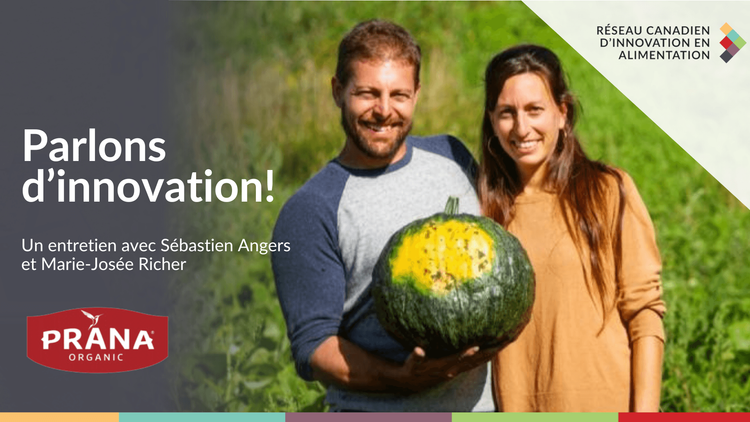
Welcome to Let’s Talk Innovation with Isabelle Marquis, a French-language video covering all areas of food innovation. Today, Isabelle speaks with Sébastien Angers and Marie-Josée Richer about regenerative agriculture. With all the current economic, political and social challenges, one might think that sustainable development is not a priority for many food businesses. Yet caring for the environment while doing business is both possible and desirable. The solution lies in the right blend of vision, boldness and collaboration. Two Québec entrepreneurs embody all of this: Sébastien Angers, an agronomist, innovative farmer and biodiversity designer, and Marie-Josée Richer, co-founder of Prana, present their ambitious innovation project in regenerative agriculture.
Community Manager-
50 Canadian FoodTech Resources – Innovate BC
Welcome to YODL! In addition to daily original content, YODL helps CFIN Members find new partners , resources , and funding opportunities to grow their food business. Learn more about this growing community and become a CFIN Member (for free!) today . Canada has an extensive range of research centres, food incubators, accelerators and labs supporting food and beverage innovation through the research they do and/or the services they offer. Each week throughout 2023, we’re highlighting an organization that’s supporting food innovation in Canada. Name: Innovate BC Location: Vancouver, BC Mission: Innovate BC is a crown agency with a mandate to foster innovation in the province and help create a thriving, sustainable and inclusive innovation economy. Focus: The agency works to foster innovation across the province and bolster the growth of the local economy by delivering a wide range of programs that help companies start up, scale, access talent, develop new technology , and commercialize . Services: Innovate BC designs, manages and oversees a number of programs either delivered d irectly and or indirectly through delivery partners such as its network of accelerators. Programs are focused on growth, talent and tech adoption, and include the Integrated Marketplace initiative, the ScaleUp program, and the Venture Acceleration Program. Other resources include its Diversity, Equity and Inclusion (DEI) Hub, its Job Board , and numerous case studies. Innovate BC also collects data and research, and works to forge strategic industry and community partnerships that create more opportunities for BC innovators. What you need to know: I nnovate BC partners with organizations throughout the province to encourage collaboration and growth of the innovation ecosystem. Partners include Canada’s Digital Technology Supercluster, Genome British Columbia, Mitacs, MIDAS Labs and the BC Tech Association. Notable News: In September 2023 Innovate BC unveiled Capital Compass BC , an interactive data platform developed in partnership with InBC , PacificCan , and New Ventures BC. The new tool is a resource for entrepreneurs, investors and other stakeholders to access funding-related resources and connect with innovative BC businesses and startups. Get Involved: Contact Innovate BC at info@innovatebc.ca or (6 04 ) 335 - 2495 , or reach out to our Regional Innovation Director for BC, Lavina Gully .
Community Manager-
#AskLavina
Welcome to YODL! In addition to daily original content, YODL helps CFIN Members find new partners , resources , and funding opportunities to grow their food business. Learn more about this growing community and become a CFIN Member (for free!) today . In addition to being CFIN’s Regional Innovation Director for BC and Yukon, Lavina Gully is a food scientist and product developer with almost two decades of experience helping food and beverage companies innovate. In this series, Lavina answers questions from CFIN members on everything from product development, R&D, manufacturing best practices, and co-packing – just to name a few! If you have questions for Lavina, you can reach out to her directly and we can answer your question in next month’s mailbag. To kick off the series, Lavina answers questions about sourcing new supply partner s , the basics of applying for funding , and labelling approvals from the CFIA. Q: I’m currently looking for a new supply partner. What are your best business practices when it comes to finding and working with a new ingredient or equipment supplier? A: T he success of your business is often closely tied to the reliability and quality of your suppliers, so investing time and effort in the sourcing process is crucial . T here are several aspects that should be considered when und ertaking this process. A good place to start is by defining your requirements in terms of product needs, standards, quantity and deliver specifications. Based on those needs you’ll then be able to conduct the research and proper due diligence required to choose a potential supplier. To help narrow down the field, look at a company’s reputation in the industry, and review client testimonials or references. Once you have pinpointed the suppl ier you are hoping to work with, it’s time to look at specifics. Quality assurance should be a priority, and ensure that potential suppliers meet or exceed your quality standards . Request samples and visit their facilities if possible for more insight into their operation, and ask about their quality control processes. It’s also crucial to evaluate the supplier’s communication and responsiveness – a supplier which is prompt, transparent and open to communication can help address issues more effectively. You will also want to verify that potential partners comply with all relevant regulations and standards . And if sustainability is a priority for your business, inquire about the supplier ’ s sustainability practices for sourcing, waste management, and environmental initiatives. Other considerations include a cost analysis (including overall value, quality and any additional support services offered by the supplier), the supplier’s financial stability, its ability to scale with your business, and its flexibility in accommodating changes in order volume, specifications, or delivery schedules. You’ll then need to d evelop clear and comprehensive contractual agreements that outline terms, conditions, pricing, delivery schedules, and any other relevant details . Finally, all supplier partnerships require regular monitoring and ongoing performance assessments to ensure they continue to meet your standards and expectations. You may also want to c onsider having alternative suppliers in case of unexpected disruptions with your primary supplier. Q: We’re a foodtech startup that requires financial investment to grow, but t he process of applying for funding seems overwhelming . Do you have any tips on what the process involves ? A: Applying for grant funding can be a complex process, but careful planning and attention to detail can increase your chances of success . Start by identifying g rant opportunities that align with your company or project and ensure that you fully understand the eligibility criteria. If you don’t meet the criteria, don’t bother investing time in the application. It’s important at this point to have a clear project concept that you will be able to outline on grant applications. Define the problem the initiative will address, your objectives , and the expected outcomes – a well-defined concept is essential for demonstrating the potential impact of your work. It’s also essential to establish measurable objectives for your project concept using quantifiable metrics, which will allow funding agencies to assess the potential impact of their investment. Each grant application is unique, so tailor your approach to the specific requirements of each opportunity. Pay close attention to the application instructions to ensure you’ve followed any specific format or length requirements, and that you have included all the required documents. That may include a detailed budget showing how the funds will be used, and supporting documents such as financial statements, resumes of key personnel, letters of recommendation, and letters from the community or stakeholders. Lastly, submit your application on time in order to avoid any technical issue s or last-minute complications . L ate submissions are usually not accepted. If you receive the grant, track the progress of your project and be prepared to provide regular reports to the grantor. Remember that competition for grants can be fierce, so putting in the effort to create a well-crafted, compelling application is a must . Q: We currently sell our food products at our store, but are hoping to begin selling at other retailers. Do I need to submit the label for approval to the CFIA before selling the product? A: The CFIA used to provide a voluntary pre-market label review service, but this was discontinued in 2015. A label review was not required under federal regulations but was provided to industry based on their request. The review service was replaced with the web-based Industry Labelling Tool , and any need for follow-up or clarifications can be sent to your local CFIA office. Check here for more information on the Industry Labelling Tool. If you’re uncertain whether your food label is compliant, finding a regulatory expert to help you with this process is advised . Another good resource is the Small Scale Food Processors Association . The organization host s a number of course s and workshops , and can provide templates on food safety.
Community Manager-
IN 30: Roundup of Talent and Training Articles
Welcome to YODL! In addition to daily original content, YODL helps CFIN Members find new partners , resources , and funding opportunities to grow their food business. Learn more about this growing community and become a CFIN Member (for free!) today . Sometimes, all it takes is 30 minutes to learn the ins and outs of new food technologies and trends that are transforming the food and beverage industry. In this series, we dig into a food innovation topic and link you to content and resources so you can become a master on the topic in 30 minutes (or less!). This year we dug deep into the topic of talent and training . This week we’re recapping all of the original content posted on the topic in 2023. Explained: Food Processing Skills Canada Food Processing Skills Canada is a non-profit organization dedicated to professionalizing the food and beverage manufacturing industry by providing leadership on labour, skills and workforce development. From a Hiring Perspective: A Q&A with Gastronomous Technologies Oakville, ON-based Gastronomous Technologies creates smart commercial kitchens using automation, interconnected robotics and software to solve foodservice challenges such as labour shortages, consistency, profitability, supply chain management and waste disposal. FBO’s CareersNOW ! Program There are a range of resources available to both job seekers and food and beverage industry businesses as they navigate the labour market, including Food and Beverage Ontario ’s CareersNOW ! program. IN 30: Addressing Labour Challenges A look at some of the labour issues, opportunities and resources accessible to food and beverage entrepreneurs looking for talent, and skilled professionals hoping to enter the industry. AI, Foodtech and Talent: Reskilling workers A new global study by the IBM Institute for Business Value reveals that advancements in artificial intelligence are upending traditional business models and transforming the workplace. The study is based on two surveys of 3,000 executive leaders in 28 countries, and 21,000 workers in 22 countries. Emerging Food and Foodtech Jobs A three part series highlighting some of the emerging and in-demand jobs now available in food and beverage manufacturing. Click here for part 2 , and here for part 3 . IN 30: Post-Secondary Food and Beverage Programs Across Canada This week, we’re looking at some of the post-secondary food and beverage programs available across Canada by region. There are many more STEM, business and non-food related courses that may prepare graduates for a career in the food industry offered through colleges, universities and private facilities throughout the country. Listed locations are for each schools’ main campus. All programs may not be running during the current school year. IN 30: Post-Secondary Food Research some of the food, foodtech and food-related work taking place at research centres and departments of post-secondary institutions in Canada. This is just a small sample of the fascinating projects underway across the country. Overtime If you’ve got more than 30 minutes, these are for you: An Interview with a Food Recruiter CFIN’s Carolyn Cooper sat down with Allan Hills, a senior hiring consultant with CPG Executive Search, specialists in hiring for the food and beverage manufacturing industry, to discuss the issues food companies now face when hiring and retaining skilled employees.
Community Manager-
Report: Holiday Spending
Welcome to YODL! In addition to daily original content, YODL helps CFIN Members find new partners , resources , and funding opportunities to grow their food business. Learn more about this growing community and become a CFIN Member (for free!) today . Deloitte recently released its 2023 holiday retail outlook , which reveals that Canadians are feeling cautious about spending this holiday season on groceries and gifts , and are shopping around to find the best deals. Here are four takeaways from the report. 1. Canadians continue to feel the pinch from inflation, and are worried about holiday expenses causing financial issues in the New Year. As a result, consumers are scaling back spending during the holidays this year. Holiday spending is expected to be down 11% from 2022. 67% of Canadians are concerned about a potential recession. 33% of consumers say they worry about how to pay for gifts. Consumers say they will spend less on gifts (-18%), gift cards (-14%), charity (-40%), and groceries (-23%). 2. Online purchases are strong, but have declined since peaking in 2020. Canadians are also diversifying where they shop. 41% of Canadians say they will shop online for gifts this year. 33% of shoppers say they will be buying gifts online but pick them up in-store. 45% say they will visit many stores to get what they need . 69% of respondents say they shop on Amazon; 61% at mass merchants; 40% at warehouse membership clubs; and 36% at department stores. 3. Value is key this year, and consumers say they will be making more conscious choices to stay within their holiday budgets. Canadians say they will visit 37% more stores in person as well as websites than in 2022 to search for the best deals. 55% say they will shop in-store. 57% report that return policies influence their buying choices. 48% says they will only be buying what their family needs; 71% are looking for products on sale; and 29% are shopping at less expensive stores. 4. Sustainability is a priority, and Canadians are purchasing environmentally friendly gifts more often . 37% of consumers are prioritizing eco-friendly gifts whenever possible. 55% say they will pay more for sustainable products. 70% say brands and retailers should make sustainable products , although 4 4% say they don’t believe sustainable claims made by brands.
Community Manager-
Company Profile – Cronometer Software
Welcome to YODL! In addition to daily original content, YODL helps CFIN Members find new partners , resources , and funding opportunities to grow their food business. Learn more about this growing community and become a CFIN Member (for free!) today . This is one in a series of interviews with CFIN member companies that have successfully applied for and received funding . Revelstoke, BC- based Cronometer Software Inc. received $47,378 in funding for a project titled AI Food Suggestions. We spoke with Brendan Benson, senior project manager at Cronometer , to find out more about the company and its project. Q: Please explain what your company does and how your products are improving the food industry? A: Cronometer is a nutrition tracking app that prides itself on being the most accurate and comprehensive tracker on the market today. Unlike our competitors, we primarily source our nutrition data from lab-analyzed sources such as the NCCDB or USDA. Users can enter what they eat and drink into the app, and in exchange, we supply nutrition information on up to 84 different nutrients from protein to choline – all free of charge. Cronometer can be used by anyone on any diet and is often leveraged to ensure adequate nutritional intake. Legally, food production companies are not required to print an exhaustive list of every nutrient on their nutrition labels. Although each branded product entry in our database is verified by a staff member, missing nutrition information on the label itself can lead to less accurate data. We are continually developing features and algorithms to try to fill that gap. For example, we recently released a feature that we like to call “Better Alternative Backfill ,” which is an algorithm that takes nutrition data from packaged nutrition labels, finds a similar entry from our more comprehensive, lab-analyzed database and automatically fills in the missing nutrient information. Q: What is your company’s mission? A: Our mission at Cronometer is to help millions of people improve their health by empowering them to track, measure and learn, delivering the best data and tools to accomplish this. Q: Why did you apply for this funding and how will you use it? A: We applied for CFIN booster funding to help cover the cost of a strategically important R&D project called AI Food Suggestions. The goal of the project is to replace our outdated Food Suggestion feature in our mobile and web app with an AI - powered Food Suggestion feature. The feature will generate personalized suggestions to help users meet their remaining calorie and nutrient targets for the day. Food Suggestions will be generated based on recently logged foods, selected filters, and user inputs. Q: What excites you most about working in this area of the food industry? A: At Cronometer we like to think of ourselves as nutrition data nerds. We are excited about supplying our users with personalized, accurate data and appreciate the power that these insights can hold. New Artificial Intelligence technology has opened up even more possibilities to have a positive impact on our users ’ health and wellbeing and we can’t wait to make it even easier to make healthy and informed decisions. Q: Why is collaboration so important for accelerating innovation in the food industry? Is it difficult to find good collaborating partners, and what would make the process easier? A: Fostering collaboration is essential to driving innovation in the Canadian food industry. We have many different partnerships ranging from collaborations with local doctors and dietitians to wearable device partners like Garmin and WHOOP. These partnerships are key in helping us offer a holistic health tracking approach centered around nutrition. Despite the challenges in forging partnerships within a competitive market, we utilize conferences, academic connections, and professional networks to identify aligned collaborators. Having established communities and organizations like the Canadian Food Innovation Network makes it easier to connect with other industry leaders based i n Canada. Q: Please comment on the importance of public funding to help companies clear innovation hurdles and access leveraged funds. A: In the competitive landscape of health and nutrition tracking technology, public funding is key for Cronometer to navigate innovation challenges and propel our growth. We compete in a crowded space made up of American companies that are supported by heavily funded venture capital firms. Public funding has helped us grow the team and pursue innovative R&D projects that otherwise wouldn’t have been possible. Q: Looking ahead, what’s on the horizon for your company? A: Looking ahead, Cronometer is poised to redefine the landscape of nutritional insights. We are focused on harnessing the power of AI to provide our users with personalized, actionable nutrition advice tailored to their unique health goals and dietary preferences. As these AI-driven features and services evolve, Cronometer is set to become not just a tool for tracking, but an intelligent personal nutrition assistant, helping Canadians and users worldwide achieve their health and wellness objectives with unprecedented precision and ease. Q: What are your passions or hobbies outside of work? A: With our headquarters located in the small-town of Revelstoke, BC we have endless options for staying active. Our team enjoys skiing and boarding during the winter months and group bike rides and climbing during the summer! Q: If you had to pick one person to make you a meal, who would you choose? A: Guy Fieri.
Community Manager-
50 Canadian FoodTech Resources – Biopterre
Welcome to YODL! In addition to daily original content, YODL helps CFIN Members find new partners , resources , and funding opportunities to grow their food business. Learn more about this growing community and become a CFIN Member (for free!) today . Canada has an extensive range of research centres, food incubators, accelerators and labs supporting food and beverage innovation through the research they do and/or the services they offer. Each week throughout 2023, we’re highlighting an organization that’s supporting food innovation in Canada. Name: Biopter r e Location: La Pocatière, QC Mission: To contribute to regional development by increasing the competitiveness of companies in the bioresources sector through applied research. Focus: Biopterre carries out applied research and technology transfers , and offers technical assistance and information services in the bioresources field. It is a college centre for the transfer of technology (CC TT ), and is affiliated with the Cégep de La Pocatière and the Institut de technologie agroalimentaire . Services: Biopterre carries out research in b iotechnology and horticultural products , b iomass and environmental technologies , n on-timber forest products (NTFP) and agroforestry , and m ycotechnologies . Services include environmental research, laboratory work, product development and consulting. Specific services in applied research and technological development include: design, validation or improvement of products, development and testing of specialized processes or apparatus , improvement or development of technologies, and facilitation and technology transfer . Technical support services include : validation and adaptation of technological solutions, expertise transfer, and support . Information and training services include : customized training, technological monitoring, information searches, feasibility studies, and conferences and symposia organization . What you need to know: 59% of Biopterre’s clientele are small to medium-sized businesses (SMEs), and a lmost 70% of Biopterre’s clients are located more than 100 km from its head office. Biopterre collaborates with more than 100 companies annually . Notable News: In May 2023 Cégep de La Pocatière and Biopterre received $2 million in financing from le Fonds des collèges de la Fondation canadienne pour l’innovation and the Government of Quebec . The funding will go towards research and innovation activities that strengthen partnerships between the community and the research community . That includes building energy-efficient greenhouses and purchas ing research and phenotyping equipment that will a llow the precise control of environmental conditions. Get Involved: Contact Biopterre at info@biopterre.com or (418) 856-5917 , or reach out to our Regional Innovation Director for Quebec Julie Daigle .
Community Manager-
Report: The 2024 Food and Beverage Outlook
Welcome to YODL! In addition to daily original content, YODL helps CFIN Members find new partners , resources , and funding opportunities to grow their food business. Learn more about this growing community and become a CFIN Member (for free!) today . Market researcher Circana , formerly IRI and The NPD Group, recently released its 2024 Food and Beverage Outlook report , which reveals some of the key changes and issues that will affect the industry over the next year. Here are three takeaways from the report. 1 . The food and beverage industry will see modest growth in 2024, following three years of decline. According to Circana , h igh inflation is expected to slow in 2024 , which will have a positive affect on industry growth, as will “the macroeconomic environment and growing promotional investments.” Manufacturers and retailers are continuing to innovate and adapt to meet changing consumer interests. 2. Some areas of the industry will grow faster than others. The beverage and deli sectors will outperform overall food and beverage unit sales next year as consumers look for more healthy protein and energy choices in a convenient, grab-and-go format . Circana says the beverage category has been more innovative than other sectors, leading to greater consumer interest and exploration. 3. The frozen category must focus on diversity. Circana says f rozen products in grocery stores and online should be reevaluated “to ensure a variety of products are available to meet consumers’ needs.” It adds that consumers will be looking to the centre of the grocery store for products that offer value, quality and convenience.
Community Manager-
IN 30: Roundup of Personalized Nutrition Articles
Welcome to YODL! In addition to daily original content, YODL helps CFIN Members find new partners , resources , and funding opportunities to grow their food business. Learn more about this growing community and become a CFIN Member (for free!) today . Sometimes, all it takes is 30 minutes to learn the ins and outs of new food technologies and trends that are transforming the food and beverage industry. In this series, we dig into a food innovation topic and link you to content and resources so you can become a master on the topic in 30 minutes (or less!). This year we dug deep into the topic of personalized nutrition . This week we’re recapping all of the original content posted on the topic in 2023. Company Profile – Nutrigenomix Toronto, ON-based Nutrigenomix specializes in personalized nutrition through nutrigenomics, the study of genes and how they interact with diet. Company Profile – Nutri m eals Calgary, AB-based Nutrimeals Inc. offers healthy, ready-to-eat meals incorporating personalized nutrition and fitness requirements and delivers them to customers through a monthly subscription service. Explained: Personalized Nutrition With greater awareness of how nutrients affect them personally, customers will be increasingly looking for solutions tailored to their specific needs. 50 Canadian FoodTech Resources – INAF’s In Vitro Digestion Platform The In Vitro Digestion Platform , part of INAF (Institute of Nutrition and Functional Foods) at Laval University in Quebec City, QC studies the impact of the digestion system on bioactive compounds. 50 Canadian FoodTech Resources – Richardson Centre for Food Technology and Research The Richardson Centre strives to advance food quality and human nutrition through traditional and innovative food processing techniques. Food as Medicine The concept of food as medicine is growing in popularity with consumers, leading innovators to develop software, ingredients, and products that aim to improve health and wellness. The Future of Food as Medicine in Canada CFIN’s Dana McCauley , CEO, Alex Barlow , Vice President of Programs, and Lavina Gully , Regional Innovation Director for BC and Yukon, discuss the future of personalized nutrition. Post-Secondary Food Research A look at some of the food, foodtech and food-related work taking place at research centres and departments of post-secondary institutions in Canada. This is just a small sample of the fascinating projects underway across the country.