Featured

Other Articles

The Tablesetter – February 6, 2023

The Tablesetter – February 6, 2023

Happy Monday CFIN members! Here’s your weekly heads up on what’s happening on YODL and around the food world this week. The YODL Menu Monday: The Tablesetter – February 6, 2023 Tuesday: Visualizing Cellular Food: A Conversation with Yadira Tejeda Saldana of New Harvest (Video) Wednesday: 50 Canadian FoodTech Resources – BC Food Hub Network Thursday: Company Spotlight – BioShur Inc. Friday: News File, and Explainer: Precision Fermentation Something to Celebrate February 6, 2023 is Oatmeal Monday! Also known as Meal Monday, the day is celebrated on the second Monday in February, and commemorates a Scottish tradition dating back to the 17 th century when food could be scarce. In those days, universities held a monthly Oatmeal Monday, when students had the chance to prepare a meal together and share supplies. The University of Edinburgh made Oatmeal Monday an annual celebration in 1896 to allow students to express gratitude for the availability of and access to food. Food Facts Canada is the largest exporter of high-quality oats in the world, producing approximately three million tonnes annually, with almost 90% going to the U.S. Oatmeal consumption in Canada has fluctuated in recent years, and in 2020/20221 Statista shows Canadians consumed 2.34 metric tonnes of oats, compared to 2.42 million metric tons in 2019/2020. Forecasts for 2021/2022 show that oat consumption has decreased to 1.7 million metric tons. Happy YODLing!

Community Manager

News File – February 3, 2023

News File – February 3, 2023

Each Friday we’ll bring you a roundup of news from CFIN, YODL and around the food world. As seen on YODL Check out this week’s most viewed discussions: SK Food Centre - Virtual Tours (facilities for contract processing, R&D, packaging and ingredients) | Open Forum (cfin-rcia.ca) Meal tray preparation challenges? | Open Forum (cfin-rcia.ca) 2023 Top 4 Plant-based Food Trends | Open Forum (cfin-rcia.ca) Around the Food World Research on fermented sea buckthorn shows that it has antimicrobial effects against bacteria including E.coli . Tim Hortons is offering a limited-edition Special Olympics Doughnut at participating restaurants from Feb. 3 to Feb. 5 in support of Special Olympics Canada. A team of chefs from Denmark has won the grand final of the Bocuse d’Or 2023 . Did you Know? The Trusted Brand survey conducted by Ipsos for Readers’ Digest and released in late January, shows that consumer loyalty to brands has shifted as Canadians balance rising food costs with concerns about health and safety. The survey looked at 35 product and service categories to reveal which brands Canadians now trust the most within each category. Here are the winning brands relating to food and beverage: Tea – Tetley Sparkling water – Perrier Plant-based beverage – Silk Cooler (alcoholic beverage) – Smirnoff Ice Hard Seltzer (alcoholic beverage) – White Claw Pet food – Purina Food delivery service platform – Uber Eats Meal kit delivery service – Hello Fresh

Community Manager

Company Spotlight – Earthware Reusables Inc.

Company Spotlight – Earthware Reusables Inc.

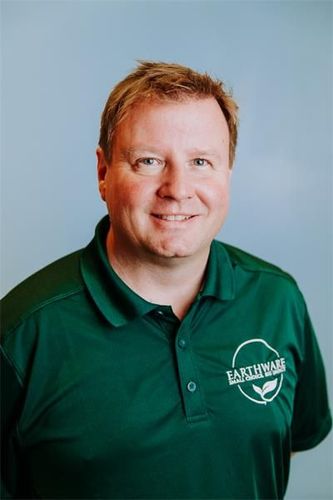
This is one in a series of interviews with CFIN member companies that have successfully applied for and received funding. Earthware Reusables Inc. is a return-for-reuse takeout container service located in Calgary, AB. Since launching in November 2021 the company has stopped approximately 15,000 single-use takeout containers from going into landfills. Earthware’s growth has been quite incredible and the company now needs to invest in facilities for Calgary and expansion to Edmonton. Earthware received $41,075 for the development of durable and UV-resistant hemp reinforced polypropylene composite for vacuum forming of reusable food containers. We spoke with John MacInnes, founder of Earthware, to learn more about the company and its plans. Q: What is your company’s mission? A: E arthware’s mission is to stop billions of single-use takeout containers from being garbage on our streets or entering our landfills. Q: Why did you apply for this funding and how will you use it? A: Our goal is to create a reusable takeout container that has never existed before. Key aspects are: Durability, the container must survive thousands of uses. During those thousands of uses the container will have many different types of foods and cannot stain. The container must be able to survive hot sun and freezing cold temperatures. The container must be able to endure thousands of washes in a commercial dishwasher. The container will travel from restaurants to customers to bottle depots. There will be very harsh conditions that the container must endure. The container must come out of commercial dishwashers clean and dry. The container should have some antimicrobial features to help with food safety. At the end of the container’s useful life it must be able to break down in existing recycling systems or be reused to create a new container. Q: What excites you most about working in this area of the food industry? A: Our impact is very visible and easy to quantify. Every time we wash an Earthware container, a single-use container did not end up as garbage on our streets or in our landfills. Q: Why is collaboration so important for accelerating innovation in the food industry? Is it difficult to find good collaborating partners, and what would make the process easier? A: Our partner, SAIT University, has the know how and expertise to help us attain our goal of a better material for our containers. Q: Please comment on the importance of public funding to help companies clear innovation hurdles and access leveraged funds. A: Innovation is so tough for investors to get behind because they want a return. Public funding allows companies like Earthware to prove an innovation without the need for a proven return. Q: Looking ahead, what’s on the horizon for your company? A: We are very lucky to have raised operating funds from investors like Social Enterprise Fund and others. With that capital our incredible growth is set to multiply exponentially this year with a new business model made possible by an agreement with the Alberta Bottle Depot Association. Our partners will charge a small deposit on all Earthware containers and consumers can retrieve a portion of that deposit by returning Earthware containers with their bottles and cans. This is the big break that we needed to hit our vision of scaling to one million containers in circulation by 2025. Q: What are your passions or hobbies outside of work? A: Family, skiing, hiking and travel. Q: If you had to pick one person to make you a meal, who would you choose? A: My Mom. I miss her love and cooking, every day. Ready to access funding for your innovative initiative? Click here to find out more about CFIN’s funding programs.

Community Manager

50 Canadian FoodTech Resources – Venturepark Labs

50 Canadian FoodTech Resources – Venturepark Labs

Canada has an extensive range of research centres, food incubators, accelerators and labs supporting food and beverage innovation through the research they do and/or the services they offer. Each week throughout 2023, we’ll be highlighting an organization that’s supporting food innovation in Canada. Name: Venturepark Labs . Location: Calgary, AB (accelerator) and North York, ON (food incubator). Focus: Venturepark Labs is a non-profit organization supporting early-stage entrepreneurs in the food and wellness industries. It is part of Venturepark, a business growth ecosystem in Calgary, AB. Mission: To help aspiring food entrepreneurs develop their innovative ideas, grow their concepts, commercialize, and achieve accelerated growth. Services: The Food Incubator offers shared commercial kitchens and private production spaces for early-stage food companies to develop their products. Other services include live events, an online resource library, mentorship opportunities, and support through the business incubator program, which offers help with research and development, production, business fundamentals, and scaling distribution. The organization’s four-month accelerator program helps entrepreneurs scale their products, while receiving one-on-one guidance from industry advisors, sessions on market research, training in sales strategy and forecasting, and connections to investment capital opportunities. What you need to know: The Food Incubator features eight commercial kitchens of different sizes, refrigerated units, specialized food production equipment, onsite storage offering cold, frozen and/or ambient temperatures for ingredients and finished products, separate receiving and shipping areas, and access to meeting rooms. Notable news: Venturepark Labs was founded in 2015 as District Ventures Accelerator and District Ventures Kitchen by Arlene Dickinson, and was renamed in 2021. Since 2019 the Food Incubator has helped establish close to 100 food companies, including Firecracker Pepper Sauce, Easy Peasy Pancakes, BUZZD and Yumba. More than 200 brands have worked with the organization’s accelerator program since 2015, together representing $180 million in sales annually. Get involved: Contact Venturepark Labs at accelerator@districtventures.ca, or at (403) 237-2388, or reach out to our Regional Innovation Director for Western Canada, Hubba Khaton .

Community Manager

Explained: Cellular Food in Canada

Explained: Cellular Food in Canada

The past few years have proven how susceptible Canada’s food industry is to world events, supply chain disruptions and climate changes. New food production technology, such as cellular agriculture, has the potential to alleviate some of these challenges, while creating commercial opportunities and building a more sustainable, resilient food system. What is it? Cellular food – also known as engineering biology, synthetic biology or cell-cultivated products – is the production of food and textile products without using animals or land. Cell cultures harvested from animals, plants or micro-organisms are grown in the lab through tissue engineering or precision fermentation to produce: Cultivated proteins such as chicken, beef and seafood Fermented products like dairy, eggs, honey and chocolate Ingredients to add to products to create hybrid foods including proteins, enzymes, flavour molecules, vitamins, pigments and fats Textiles such as leather, silk and wool Why you should care As global population continues to grow, so does demand for protein, while access to land and other resource inputs become more scarce. Alternative agriculture could be an answer to food scarcity, concerns about animal and environmental welfare, cost inflation and resource challenges due to climate change. Compared to conventional agriculture, cellular agriculture production, is much less energy intensive, produces less greenhouse gas emissions, and has a much lower overall carbon footprint. With our strong food infrastructure, reputation for food safety, biotechnical expertise, and federal support for alternative protein production, Canada is well positioned to become a leader in cellular agriculture. The 2021 report Cellular Agriculture: Canada’s $12.5 Billion Opportunity in Food Innovation from Ontario Genomics and the Food and Agriculture Institute at the University of the Fraser Valley found that the international cellular agriculture market will reach US$100 billion by 2032. Canada’s food industry has the potential to take $12.5 billion that market, while creating up to 142,000 high-paying jobs. Opportunities in Canada Engineered plant proteins are already in the Canadian market, and by all estimates, precision fermented products are expected to appear before cultured meat products. Current Canadian regulations consider food produced through cellular agriculture as a novel food, and products are approved on a case-by-case basis. Here are a few Canadian start-ups making headlines: Because Animals – This Toronto-based pet food company uses cultured ingredients such as probiotics and nutritional yeast to create nutrient-rich cat and dog food designed to help digestive issues. Future Fields – Edmonton, AB-based Future Fields is a R&D producing growth media products that can be used to create commercialized cultivated proteins in a safe and sustainable manner. Cell-Ag Tech – Toronto’s Cell-Ag Tech is doing R&D on cell-cultured fish and seafood. New Harvest International non-profit research institute New Harvest , which promotes the science behind cultured meat through research, funding and a conference , now has a Canadian branch.

Community Manager

What YODLers are Saying and Reading – The TOP YODL Posts and Articles of January 2023

What YODLers are Saying and Reading – The TOP YODL Posts and Articles of January 2023

YODLers kicked off 2023 by chatting up a storm! In case you missed them, here are the top five discussions of January 2023, as well as the top five most read articles for the month. Top YODL Discussions in January Number 5 Upcycled food waste. | Open Forum (cfin-rcia.ca) Eliminating food waste is an ongoing issue for Canadian food and beverage companies. Luckily there are also innovative Canadian businesses actively developing solutions to this global challenge. Number 4 CFIN New Member Meet-Up reflections | Open Forum (cfin-rcia.ca) CFIN regularly holds new member meet-ups to provide information on YODL, funding opportunities, events, and more. Number 3 National Food Days | Open Forum (cfin-rcia.ca) National food days are a fun and creative way to celebrate the food industry. Watch for more national food day coverage each Monday in the Tablesetter. Number 2 HACCP grants needed | Open Forum (cfin-rcia.ca) Food companies and entrepreneurs are always looking for new sources of funding, and many of them are finding solutions through YODL. Number 1 B corp certification | Open Forum (cfin-rcia.ca) Canadian companies are curious about the benefits of becoming B Corp certified for their social and environmental performance. Most Read YODL Articles in January Number 5 News File – January 6, 2023 (cfin-rcia.ca) Each Friday we publish the News File, covering worldwide industry news, as well as the most viewed discussions of the week, and results from recent surveys and studies. Number 4 News File – January 13, 2023 (cfin-rcia.ca) In this issue of News File we looked at a new report from Second Harvest on food bank use. Number 3 The Tablesetter – January 16, 2023 (cfin-rcia.ca) Every Monday we publish the Tablesetter, a look at the articles appearing on YODL that week, as well as coverage of national food days, and food facts. Number 2 50 Canadian FoodTech Resources – The Verschuren Centre (cfin-rcia.ca) Each week this year we’re highlighting one of the many resource centres across Canada available to food and beverage companies. Number 1 Parlons d'innovation: Utilisation de légumineuses entières comme ingrédients fonctionnels (cfin-rcia.ca) This French-language video is part one in a series of videos looking at innovation and research in Canada. Happy YODLing!

Community Manager

The Tablesetter – January 30, 2023

The Tablesetter – January 30, 2023

Happy Monday CFIN members! Here’s your weekly heads up on what’s happening on YODL and around the food world this week. The YODL Menu Monday: The Tablesetter – January 30, 2022 Tuesday: Top YODL discussions and articles for January, and Explainer: Cellular food in Canada Wednesday: 50 Canadian FoodTech Resources – Venture Park Labs Thursday: Company Spotlight – Earthware Reusables Friday: News File Something to Celebrate January 31 is Eat Brussel Sprouts Day! There’s a scientific reason why some of us hate the bitter flavour of brussel sprouts, while others love the little green veggies. We have an average of 25 types of bitter receptors on our tongues, but consumers with more tastebuds are known as “supertasters,” and can experience the bitter flavour up to 60 times more than others. Food Facts According to Statistics Canada, consumers in Quebec eat more fruit and vegetables than other Canadians. In Quebec, 34.5% of consumers say they eat fruit and vegetables at least five times a day each day, compared to just 18.3% of consumers in Newfoundland and Labrador. Respondents from all provinces reported eating fewer fruits and vegetables per day when they spent more time in front of a TV or computer screen. Happy YODLing!

Community Manager

INFOGRAPHIC: A Timeline of Cellular Food Innovation

INFOGRAPHIC: A Timeline of Cellular Food Innovation

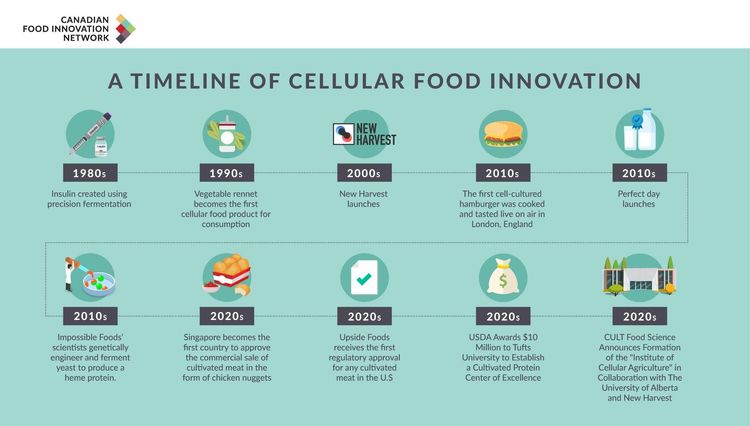
Research and development of cellular food has been ongoing for more than four decades. In coming weeks we'll be discussing more recent developments in cellular food innovation in Canada and around the world. On February 9, 2023 CFIN is presenting an information session on its fourth Food Innovation Challenge - Cultivating a Resilient Food Future: Developing the End-to-End Cellular Food Capacity for Canadian Global Leadership. Click here for more information and to register for the session.

Community Manager

News File – January 27, 2023

News File – January 27, 2023

Each Friday we’ll bring you a roundup of news from CFIN, YODL and around the food world. As seen on YODL Check out this week’s most viewed discussions: B corp certification | Open Forum (cfin-rcia.ca) HACCP grants needed | Open Forum (cfin-rcia.ca) CFIN New Member Meet-Up reflections | Open Forum (cfin-rcia.ca) Around the Food World Debate continues around the use of the Eco-Score label, which outlines environmental footprint, in the EU. Kroger has released its 2023 Food Trends report predicting emerging food trends and consumer behaviour. Oliver Wyman and the Food Industry Association’s new report, Imperative Issues Identifying food industry challenges , outlines issues continuing to impact the retail grocery industry. Did you Know? Every year Mondelēz International releases its year-over-year insights into consumer snacking decisions. As well as discovering that 71% of consumers snack at least twice a day, the 2022 Global Consumer Snacking Trends Study reveals that: 55% of consumers say they make a meal out of snacks at least once a week. 67% of consumers say they would rather buy less of their favourite snack than a private-label brand alternative. 64% say they’d pay more for snacks that are better for the environment. 61% say they go out of their way to find their favourite snacks. 78% of consumers believe it’s important to have moments of indulgence in your day. 70% believe plant-based snacks are better for the environment and the planet. 70% of consumers say they prioritize snacks with less packaging, with 72% saying they typically recycle it.

Community Manager

Company Spotlight - Saltwinds Coffee Company Ltd.

Company Spotlight - Saltwinds Coffee Company Ltd.

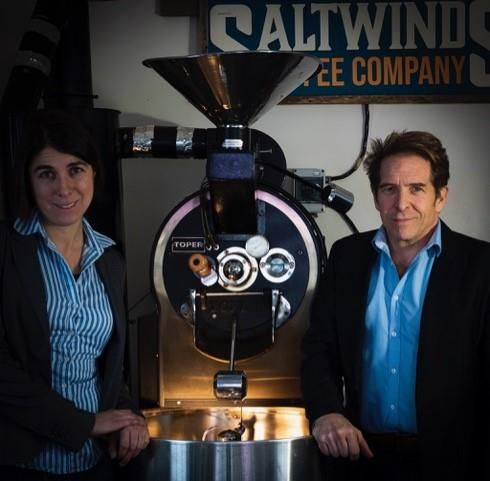
This is one in a series of interviews with CFIN member companies that have successfully applied for and received funding . Douglas, NB-based Saltwinds Coffee Company’s aim is to offer a carbon neutral cup of coffee, something the company began by re-inventing coffee roasting itself to turn it into a zero-emission process. Saltwinds is rooted in a strong sense of place and history, and all of its coffees have a unique Maritime flavour. Co-founders Brad Rideout (CEO) and Laura Richard (COO) are Maritimers with family ties to the ocean industries of Canada's East Coast, and grew up in New Brunswick hearing tales on how coffee used to “taste better” when it arrived in wooden sailing ships. The company rediscovered this lost taste by infusing coffee beans with sea air, leading to its best-selling Ocean Fresh line of coffee beans. This unique Atlantic taste and the compelling environmental benefits of Saltwinds Coffee have created an irresistible brand, and although it only launched in early 2022, Saltwinds has already attracted an enormous amount of interest. The company received $57,681 in funding from CFIN to complete a process to reduce carbon emissions in coffee roasting. We talked to Rideout and Richard to learn more about the company and its plans. Q: What is your company’s mission? A: We’re on a mission to make people feel better every day, by producing great coffee, elevated to provide unique flavours and positive environmental impacts. Q: Why did you apply for this funding and how will you use it? A: To bring Saltwinds’ carbon reduced coffee to even more consumers, we needed help to scale up our reduced emissions roasting technology and demonstrate it on large industrial machinery. We applied for this funding so that we can show the industry that it is possible to change behaviours and processes for the better, and help more people convert their daily cup of coffee into one that is better for the planet. Q: What excites you most about working in this area of the food industry? A: It is a privilege to be producing a product that brings so much pleasure into people’s lives. We are making coffee that is better for the planet, and which tastes better, too – the happy smile on our customers’ faces as they walk away with a bag tells us that they get that, and are excited to get home and experience it as they savour a cup of coffee. Q: Why is collaboration so important for accelerating innovation in the food industry? Is it difficult to find good collaborating partners, and what would make the process easier? A: Innovation, by definition, suggests that we are doing something new, different, unfamiliar. Collaborating with partners outside of our niche domain of coffee roasting allows us to tap into different expertise and experiences that can inform our own innovation pathway. That’s why we applied to join Foresight, Canada’s cleantech accelerator. While no-one else in Foresight is doing anything related to coffee, there are lots of companies exploring how technology can reduce emissions, which is aiding us tremendously. Q: Please comment on the importance of public funding to help companies clear innovation hurdles and access leveraged funds. A: The kind of revolution we are trying to engender in coffee roasting takes a lot of time and money. Without the support of government funding, it’s difficult for a small company to allocate enough resources for that revolution to succeed. Thanks to CFIN’s support, we are optimistic that we can create a substantive change in the carbon footprint associated with coffee drinking here in Canada and around the world. Q: Looking ahead, what’s on the horizon for your company? A: In 2023 and 2024 we will be focused on bringing Saltwinds to even more consumers. Key to doing this is increasing our manufacturing capabilities and growing our distribution channels. There are lots of logistical and operational hurdles involved in this, but we are confident that you’ll be seeing Saltwinds on a store shelf near you soon! Q: What are your passions or hobbies outside of work? A: We are both keen triathletes and have competed in numerous half Ironmans and Ironmans. As triathlon races take place all over the world, this dovetails nicely with a passion for travel. Fortunately, coffee is grown in very interesting places, too! Q: If you had to pick one person to make you a meal, who would you choose? A: (Laura) Ferran Adrià, the chef at the former el Bulli restaurant, and one of the first to pioneer cuisine focused on chemical transformations, i.e., molecular gastronomy. Ready to access funding for your innovative initiative? Click here to find out more about CFIN’s funding programs.

Community Manager

50 Canadian FoodTech Resources - The University of Guelph Meat Science Laboratory

50 Canadian FoodTech Resources - The University of Guelph Meat Science Laboratory

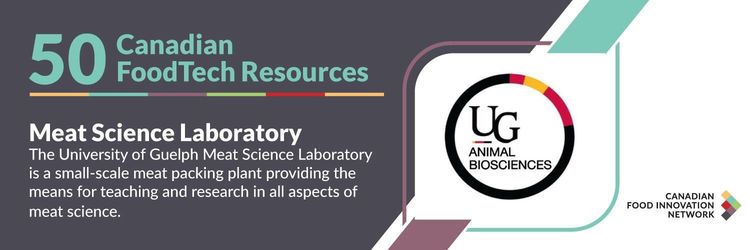
Canada has an extensive range of research centres, food incubators, accelerators and labs supporting food and beverage innovation through the research they do and/or the services they offer. Each week throughout 2023, we’ll be highlighting an organization that’s supporting food innovation in Canada. Name: The Meat Science Laboratory at the University of Guelph. Location: Guelph, ON. Focus: The Meat Science Lab is a small-scale meat packing plant operating under federal meat inspection regulations with the capability to slaughter, cut, and process red meat species. Mission: To provide student training and perform research in meat science. The lab also harvests tissue and organ samples for research programs in other University of Guelph departments. Services: The Meat Science Lab’s abattoir offers students experience in slaughter operations. As well as research and teaching, the lab offers services to companies requiring specialized facilities and expertise, as well as meat product workshops in cooperation with the meat industry. What you need to know: The lab’s cutting room is equipped to process carcasses into wholesale or retail cuts, or to carry out complete carcass dissections. Other features include: A smokehouse; Basic equipment necessary for manufacturing processed meat products; A blast freezer operating at -30 °C and an adjacent storage freezer kept at -20 °C for long-term storage of meat products; A texture profile analyzer; A fully equipped kitchen to cook and evaluate meat products. Teaching areas include: The carcass dissection classroom; A glass-fronted display cooler for carcasses or meat cuts; A 99-seat lecture theatre for lectures or where carcass and meat cutting demonstrations are offered through use of the lab’s monorail system for meat. Notable news: Each spring the Meat Science Lab helps the local Mennonite community prepare meat for canning through a mobile canning facility run by the Mennonite Central Committee . The canned meat is distributed to hungry people worldwide. Get involved: Contact the Meat Lab manager Gino Giansante at ggiansan@uoguelph.ca, or reach out to our Regional Innovation Director for Ontario, Linda Fox.

Community Manager

INFOGRAPHIC: Introduction to Cellular Food

INFOGRAPHIC: Introduction to Cellular Food

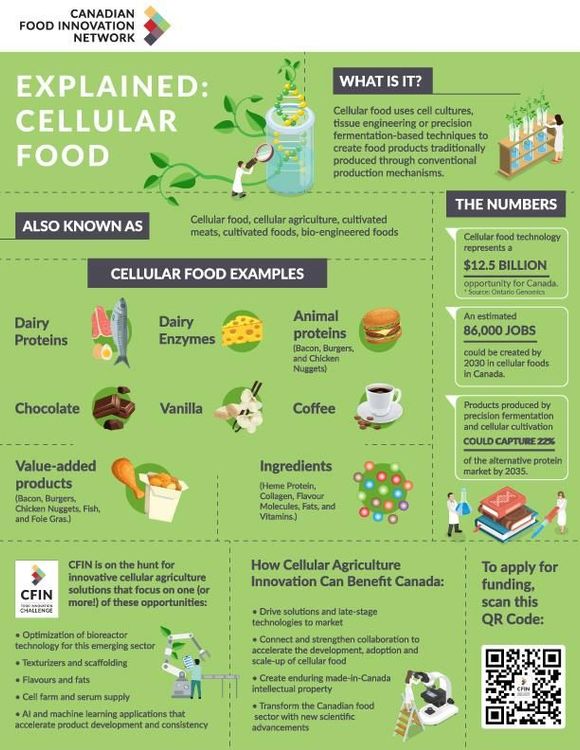
Starting today, we're doing a deep dive into cellular food. Over the next two months look for articles, infographics and videos on YODL explaining everything you need to know about cellular food and its potential in Canada, including regulations, ongoing research, product development, funding opportunities, and much more. On February 9, 2023 CFIN is presenting an information session on its fourth Food Innovation Challenge - Cultivating a Resilient Food Future: Developing the End-to-End Cellular Food Capacity for Canadian Global Leadership. Click here for more information and to register for the session.

Community Manager