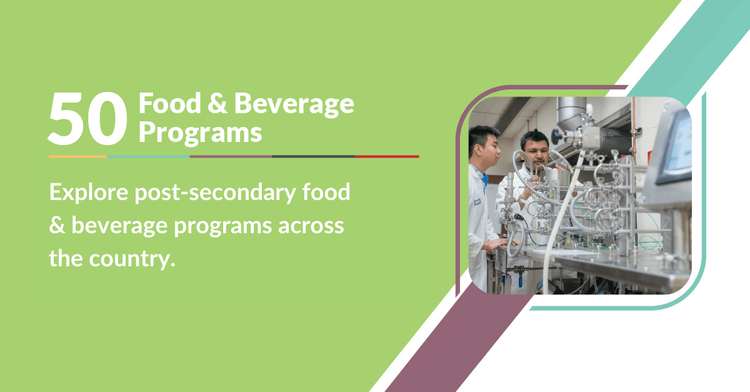
Canada is home to a diverse and dynamic food and beverage industry, supported by educational programs that train the next generation of chefs, brewers, entrepreneurs, and innovators. This roundup highlights 50 standout programs across the country, from top culinary schools and hospitality management courses to cutting-edge research initiatives and sustainability-focused training. Whether you're an aspiring professional, educator, or industry enthusiast, these programs provide valuable insights into the evolving world of food and drink in Canada. BC & Yukon Vancouver Community College UBC BCIT LaSalle College (Vancouver) UBC: Food, Nutrition, and Health Okanagan College Vancouver Island University University of Fraser Valley Northern Lights College North Island College Yukon University Selkirk College Thompson Rivers University Kwantlen Polytechnic University Prairies Saskatchewan Polytechnic University of Alberta University of Saskatchewan University of Manitoba SAIT NAIT Manitoba Institute of Trades & Technology International College of Manitoba Ontario Niagara College Humber College Le Cordon Bleu Ottawa George Brown College Fanshawe College Brock University University of Guelph Toronto Metropolitan University Loyalist College Georgian College Conestoga College Durham College Centennial College Canadore College Algonquin College Trent University St. Lawrence College St. Clair College Sault College Lambton College Confederation College Quebec McGill University LaSalle College Bishop's University Atlantic Canada University of PEI Memorial University Cape Breton University
Community Manager-
50 Food & Beverage Programs - Vancouver Island University
Crafting a Career in BC ’ s Wine Industry: VIU ’ s Wine Business Program The Wine Business program at Vancouver Island University is a comprehensive one-year certificate course designed for those passionate about pursuing a career in the BC wine industry. The program combines practical experience with academic learning in viticulture, wine business practices, marketing, and tourism. Program Highlights: As a student, you ’ ll have the chance to immerse yourself in hands-on experiences at local vineyards and wineries, gaining insights into the entire winemaking process. This practical foundation is then complemented by academic courses in viticulture, wine business practices, marketing, and tourism. A standout feature of this program is its flexibility. Whether you ’ re looking to study full-time for a year or prefer a part-time option spread over two years, VIU has you covered. Located in picturesque Nanaimo, BC, VIU provides an ideal setting for your wine education journey. With a curriculum designed to integrate viticulture essentials with business acumen, VIU ’ s Wine Business program offers a holistic understanding of the wine industry. Students can also earn credits that can be applied toward a Bachelor of Business or a Hospitality and Tourism Management program, opening doors to a wide range of future career prospects. The program includes seven courses and focuses on the broader aspects of the wine industry. In addition to viticulture and winemaking, students delve into wine marketing, exporting, and the vital role of wine tourism. C ourses cover a wide spectrum, from wine marketing and appreciation to beverage theory and the management of wine tourism. The program also offers elective courses in consumer behavio u r, entrepreneurship, and festival management . What You’ll Leave With: Upon graduation, a world of opportunities awaits you in BC ’ s wine industry. Whether you dream of managing a vineyard, excelling in wine s ales and marketing, or even opening your own restaurant, VIU ’ s Wine Business program provides the knowledge and skills to make your wine-related ambitions come true. Career options span winery/vineyard management, retail sales, wine marketing representation, hotel management, culinary arts, a gri - tourism development, and s pecial events coordination. V ideo/Social / Media : VIU YouTube Video
Community Manager-
Cellular Food in Canada
The past few years have proven how susceptible Canada’s food industry is to world events, supply chain disruptions and climate changes. New food production technology, such as cellular agriculture, has the potential to alleviate some of these challenges, while creating commercial opportunities and building a more sustainable, resilient food system. What is it? Cellular food – also known as engineering biology, synthetic biology or cell-cultivated products – is the production of food and textile products without using animals or land. Cell cultures harvested from animals, plants or micro-organisms are grown in the lab through tissue engineering or precision fermentation to produce: Cultivated proteins such as chicken, beef and seafood Fermented products like dairy, eggs, honey and chocolate Ingredients to add to products to create hybrid foods including proteins, enzymes, flavour molecules, vitamins, pigments and fats Textiles such as leather, silk and wool Why you should care As global population continues to grow, so does demand for protein, while access to land and other resource inputs become more scarce. Alternative agriculture could be an answer to food scarcity, concerns about animal and environmental welfare, cost inflation and resource challenges due to climate change. Compared to conventional agriculture, cellular agriculture production, is much less energy intensive, produces less greenhouse gas emissions, and has a much lower overall carbon footprint. With our strong food infrastructure, reputation for food safety, biotechnical expertise, and federal support for alternative protein production, Canada is well positioned to become a leader in cellular agriculture. The 2021 report Cellular Agriculture: Canada’s $12.5 Billion Opportunity in Food Innovation from Ontario Genomics and the Food and Agriculture Institute at the University of the Fraser Valley found that the international cellular agriculture market will reach US$100 billion by 2032. Canada’s food industry has the potential to take $12.5 billion that market, while creating up to 142,000 high-paying jobs. Opportunities in Canada Engineered plant proteins are already in the Canadian market, and by all estimates, precision fermented products are expected to appear before cultured meat products. Current Canadian regulations consider food produced through cellular agriculture as a novel food, and products are approved on a case-by-case basis. Here are a few Canadian start-ups making headlines: Because Animals – This Toronto-based pet food company uses cultured ingredients such as probiotics and nutritional yeast to create nutrient-rich cat and dog food designed to help digestive issues. Future Fields – Edmonton, AB-based Future Fields is a R&D producing growth media products that can be used to create commercialized cultivated proteins in a safe and sustainable manner. Cell-Ag Tech – Toronto’s Cell-Ag Tech is doing R&D on cell-cultured fish and seafood. New Harvest International non-profit research institute New Harvest , which promotes the science behind cultured meat through research, funding and a conference , now has a Canadian branch.
Community Manager-
Other Articles
Friday Food Innovation Round-Up – September 18
New Canadian foodtech venture accelerators, big funding wins, and even bigger collaborations . Here’s some of the food innovation highlights from the past two weeks: 🌎 Canada rolls out new trade resilience supports while deepening ties with Mexico 🌱 MaRS launches national Food & Ag t ech Mission with FCC backing 🥗 Phytokan a & Maia Farms announce $32.5M fava bean processing project in Alberta ☕ RFINE raises $1.7M to scale upcycling tech for spent coffee grounds Let’s dive in! Canada–U.S. Trade Brief: Buying Local, Thinking Global Breaking down what’s changing in Canada-U.S. relations —and what it means for Canad a’s food sector. What’s the Latest Earlier this month, Prime Minister Mark Carney announced what he called the most comprehensive suite of trade resilience measures in Canadian history. Then, this week, Carney reinforced this focus on resilience abroad, meeting President López Obrador in Mexico City to align on cooperation ahead of the 2026 CUSMA review. Both leaders pledged to coordinate closely as U.S. trade policy grows more unpredictable. What You Should Know The Strategic Response Fund will channel $5B into industries adapting to trade disruptions, with a focus on competitiveness and technology adoption. A new Buy Canadian Policy formalizes Ottawa’s push for consumers and retailers to source homegrown goods, giving processors and food manufacturers a chance to expand domestic share. The Regional Tariff Response Initiative ( RTRI ) is being scaled across regions, with $80M recently earmarked for Atlantic Canada to help food, seafood, and manufacturing businesses modernize and diversify. Canada and Mexico are presenting a united front as they prepare for the 2026 CUSMA review, highlighting food and agriculture as priority sectors for cooperation. Key Takeaway Canada’s latest moves signal a pivot from reactive tariff management to a long-term resilience strategy—one that hints at a permanent move away from U.S. trade reliance. For food innovators, the message is twofold: domestically, expect stronger incentives to highlight Made-in-Canada products and build tighter, technology-enabled supply chains . G lobally, expect a more deliberate effort to reduce dependence on U.S. access by forging deeper partnerships with markets like Mexico and beyond. The opportunity lies in treating trade disruption not as a headwind, but as a catalyst to modernize domestic food sector operations and position Canadian food as both locally favour ed and globally competitive. 💡 Food Innovation News MaRS Launches National Food & Agtech Mission Backed by FCC MaRS Discovery District has launched a new Food and Agtech Mission with support from Farm Credit Canada. The initiative will channel capital to high-impact ventures, scale innovations that cut emissions and waste, and build resilience in supply chains. Core components include a venture accelerator (supporting up to 10 startups), an 18-month corporate adopter cohort to co-develop pilots, and guidance from a national coalition of industry leaders and investors. Applications for the accelerator are open until October 17, 2025. Phytokana & Maia Farms Launch $32.5M Project to Turn Fava Beans into Plant-Based Ingredients Alberta’s Phytokana Ingredients and B.C.-based Maia Farms are spearheading a C$32.5 million initiative (including C$6.6M in funding from Protein Industries Canada) to convert Canadian-grown fava beans into protein concentrate, starch flour, and flours. The plan includes building a fully automated facility near Strathmore, AB, with the capacity to process 30,000 tonnes /year, and Maia will upcycle those fava ingredients into mycelium proteins. RFINE Biomass Solutions Closes $1.7M Equity Round Halifax startup RFINE has closed an oversubscribed $1.7 million CAD equity round (surpassing its $1.5M target) to scale its technology that transforms spent coffee grounds into shelf-stable, food-grade ingredients. The company will use the new funds to accelerate commercialization across quick-service coffee partners and broaden its operations in sustainable upcycling. 💰 New Opportunities We h ave some exciting in-person events on the horizon from coast to coast, including regional celebrations of the pioneering companies named to our inaugural Foodtech Frontier list and the Foodtech Next Showcase in Ottawa . See everything else we have planned on our Events Page . Elsewhere, applications have opened for the 2025 FoodTech 500, the definitive list of the world's most promising and influential agrifoodtech startups and scaleups. Learn more and submit your application here . 🛠️ Job Openings Here’s a few cool food innovation jobs that popped up recently: Chief Executive Officer – Protein Industries Canada – Remote Food Technologist Assistant – Lovingly Made – Calgary, AB Marketing & Events Associate – SVG Ventures | THRIVE – Calgary, AB Have an open position you’re looking to fill? Be sure to post it on the Food Innovator Career Hub ! 🌟 Highlights from YODL Catch up on this week’s top YODL conversations … Indulge me: Why are you here? Who are your go-to food safety & regulatory consultants? Do you have something worth including in our next Friday Food Innovation Roundup? Reply to this post to let us know about your news, events, or job openings! Thanks for reading!
Community Manager-
Catch Up: Inside Canada’s Food Lab’s Webinar Recording Now Available
Missed last week's I nside Canada’s Food Labs webinar ? You can now watch the full recording . This session—featuring experts from Vineland Research and Innovation Centre , Agriculture and Agri-Food Canada , and BioFoodTech —offered an inside look at how Canada’s leading food labs support product development, scale-up, and commercialization. You’ll hear: How research centres help food businesses turn R&D into market-ready products What kinds of facilities, equipment, and expertise are available to startups and SMEs Case studies of companies transforming waste streams into new revenue sources Whether you're developing a new ingredient, refining a formulation, or scaling production, this webinar offers practical insights into what’s possible when you collaborate with Canada’s research infrastructure. Sign Up for Future Webinars Want to keep exploring complex industry topics? Check out our Events Page to sign up for upcoming webinars or in-person events in your region.
Community Manager-
From Coast to Crisper: How Seaweed Could Change the Future of Food Packaging
Plastic p ollution is a glob e-spanning problem, the consequences of which are often most visible in our oceans — where plastic waste collects, degrades into microplastics, and wreaking havoc on both marine ecosystems and human health. Yet, the oceans may also hold the solution s we need to move to a post-plastic planet. The team of scientists and innovators behind Vancouver-based PhyCo Technologies b elieve s seaweed is the future of food pack aging , and they are putting the stuff to work to replace petroleum-based plastics with compostable, scalable alternatives. Turning Seaweed into B io-Based P lastics that Work PhyCo’s approach combines Canadian seaweed cultivation with localized organic waste streams to create bio-based pellets, films, and coatings. These are designed for industrial converters and packagers—targeting the 70 % of plastic use that occurs out of sight in farming and food processing. Unlike conventional bioplastics, PhyCo’s process is built for industrial-scale production, with protected IP and partnerships guiding the transition from R&D into commercialization. NextGen Food Innovators Project: Coating for Produce Supported by funding from CFIN ’s NextGen Food Innovators program , PhyC o is also developing a seaweed-based antimicrobial and antifungal coating to extend the shelf life of fresh produce, especially cucumbers and berries. Using advanced spray-coater technology, the team is testing the coating on simple packaging substrates to evaluate durability, safety, and shelf-life benefits. The project is aimed at reducing both plastic use and food waste while contributing to Canada’s broader goals for lowering greenhouse gas emissions tied to food loss. Why it Matters Plastic packaging remains one of the least recycled categories in Canada, with agri-food plastics largely absent from recovery systems. At the same time, produce is the most waste-prone food group in Canadian households and retail. PhyCo’s innovation meets both challenges: creating packaging materials that can compost safely while helping perishable foods last longer in the supply chain. That dual impact aligns with regulatory pressures such as extended producer responsibility (EPR) programs and supports Canada’s Zero Plastic Waste A genda . What’s next for PhyCo The company is advancing lab validation of its spray-on coating and preparing for pilots with produce distributors to test performance in real-world supply chains. At the same time, PhyCo is scaling its biorefinery outputs—pellets, films, and coatings—for commercial manufacturing. With protected IP, an industrial focus, and strategic partners, PhyCo is positioning itself as a player in the overlooked but massive B2B compostable packaging market—bringing ocean resources into the fight against ocean plastic pollution .
Community Manager-
How to Run Grocery Ads That Actually Drive Sales
The way consumers shop for groceries has fundamentally changed — they’re surfing, scrolling, swiping, and streaming their way through countless product inspirations during their shopping journey. For CPG brands, this shift has unlocked enormous potential for reaching consumers at multiple touchpoints. But it’s also introduced a challenge: how do you efficiently manage advertising in this dynamic, increasingly fragmented landscape—and prove your ads are really working? Reaching Today’s Grocery Consumers Where They Are Today’s consumers have grown accustomed to having everything they need at their fingertips. Product inspiration can strike anytime—on social media, a search engine, or right in the middle of scrolling their favorite ecommerce app. Brands that meet consumers at these precise moments—when they’re in discovery mode and ready to make decisions—gain the immense advantage of capturing attention at the point of purchase. Instacart helps CPG brands capitalize on these moments with a unified grocery advertising ecosystem. Our solution enables you to run cohesive, data-driven campaigns across multiple channels—all from one platform. This means you can streamline your advertising strategy and efficiently manage campaigns with a single budget, saving time and maximizing your impact. For food brands looking to win consumers at every stage of their journey, Instacart Ads provides mass reach. Through a single entry point, your ads can appear wherever your customers are shopping. The Proof Is in the Performance—Incremental Sales That Make a Difference We know that our brand partners don’t want just reach — they need results. That’s why we’ve prioritized delivering a performant solution that drives real and verified results. Studies conducted by Circana show that Instacart delivers incremental sales. In fact, more than 15% of sales lift from Instacart Ads is incremental—meaning those sales wouldn’t have occurred without your ad campaign. And the impact doesn’t stop in the digital space. Circana also found that Instacart Ads generate a halo effect on in-store sales, with in-store sales lift exceeding 15% to 21% among consumers exposed to Instacart Ads. These results illustrate the power of Instacart as a complementary platform to brick-and-mortar strategies, helping brands capture untapped potential whether customers shop online or in person. Simplify, Streamline, Succeed Advertisers face countless decisions about where, when, and how to run campaigns. Proof of performance is critical, especially when budgets are under pressure. Instacart is here to make your advertising simple, measurable, and impactful. With our unified platform, you can stop worrying about managing ad spend across multiple channels and focus on delivering a consistent message to your consumers. Measure your results, drive incremental sales, and gain insights you can use to refine your strategy. When it’s easier to execute and measure campaigns, you win back the time and confidence you need to achieve bigger growth objectives . It’s time to stop just running ads and start generating results. Work smarter, not harder, with Instacart—your partner in seamless grocery advertising and proven sales lift. Together, we can drive your brand’s success in the ever-evolving world of grocery shopping. Isn’t it time to explore what those incremental sales could mean for your brand?
Community Manager-
Friday Food Innovation Round-Up – September 5, 2025
It’s been another busy stretch in food innovation as summer comes to a close, with major policy shifts, funding milestones, and industry shakeups all in the news . Here’s what has been making headlines over the past two weeks: 📉 Canada lifts most counter-tariffs on U.S. goods, with price relief on the way 🌱 Friendlier raises $4.5M to expand reusable food packaging network 🥖 Puratos opens new innovatio n centr e in Montréal to serve Quebec’s baking sector 🥦 Yve s Veggie Cuisine to be discontinue d after 40 years in market Let’s dive in! Canada–U.S. Trade Brief: Canada Lifts Most Counter-Tariffs on U.S. Goods Breaking down what’s changing in Canada-U.S. relations —and what it means for Canad a’s food sector. What’s the Latest Most of Canada’s retaliatory tariffs on U.S. goods came down earlier this week , after Prime Minister Mark Carney and President Trump agreed to “intensify” stalled trade talks. U.S. tariffs on non-CUSMA-compliant Canadian goods remain steep at 35%, but both sides say free trade has been re-established for the “vast majority” of goods. What You Should Know Price relief will be felt first on highly perishable U.S. food imports like orange juice. For processed and shelf-stable goods , the effects will reach consumers more gradually as tariffed inventory sells through. Business groups welcomed the move but say this is a short-term reprieve: the bigger structural test is the 2026 CUSMA review, which will determine long-term predictability for Canadian food exporters. The federal government has launched the Regional Tariff Response Initiative (RTRI), which will be delivered by regional development agencies. Applications will open soon, offering SMEs funding to cut costs, strengthen supply chains, and explore new markets in response to tariff uncertainty. Key Takeaway The tariff rollback delivers near-term relief, but the bigger story is resilience. Programs like RTRI signal that government and industry are preparing Canadian food exporters for a bumpier trade landscape over the long haul. Food companies should tap into these supports now and explore market diversification opportunities —before the 2026 CUSMA review sets the next rules of the game. 💡 Food Innovation News Friendlier Raises $4.5M to Expand Reusable Packaging Network Guelph-based Friendlier has secured $4.5 million CAD to grow its reusable food packaging network. Already operating in Ontario, Quebec, and B.C., the system has replaced more than 3.3 million single-use containers with partners. The funding round will help Fri endlier add micro-sanitation hubs in Winnipeg and Halifax and extend into hot beverages, catering, and retail grab-and-go. P uratos Canada Opens Innovation Centre in Montréal Puratos Canada has opened a 3,500-sf innovation centre in Montréal—its third in Canada after Mississauga and Chilliwack. The new facility will provide tailored support for Quebec’s baking sector, with specialized equipment and space for co-creation workshops and testing t o help businesses move faster from ideation to commercialization. Canadian Plant-Based Food Brand Yves Veggie Cuisine to be Discontinued Yves Veggie Cuisine, one of Canada’s earliest plant-based brands, is being retired by parent company Hain Celestial. Famous for soy-based deli slices, burgers, and veggie dogs, Yves helped bring meat alternatives into Canadian households long before plant protein went mainstream. Its exit reflects the growing pains of a maturing alt-meat category, where legacy brands face tougher competition and shifting consumer expectations. 💰 New Opportunities CFIN is still accepting applications for the Ontario Food Technology Pilot (Intake 1 applications close next Thursday, September 11) There’s also a bunch of exciting events on the horizon, including next week's Unpuzzling webinar digging into how food research centres help businesses develop products , and the Foodtech Next Showcase in Ottawa . See everything else we have planned on our Events Page . 🛠️ Job Openings Here’s a few cool food innovation jobs that popped up recently: Applications Lead (Food & Beverage Sector) – LuminUltra – Fredericton, NB Manager, Food Science & Innovation – Phytokana – Calgary, AB Have an open position you’re looking to fill? Be sure to post it on the Food Innovator Career Hub ! 🌟 Highlights from YODL Catch up on this week’s top YODL conversations … Our AI Future in the Food Sector Exploring Collaboration in Functional Mushroom Innovation Do you have something worth including in our next Friday Food Innovation Roundup? Reply to this post to let us know about your news, events, or job openings! Thanks for reading!
Community Manager-
IN 30: Roundup of AI Articles
Sometimes, all it takes is 30 minutes to learn the ins and outs of new food technologies and trends that are transforming the food and beverage industry. In this series, we dig into a food innovation topic and link you to content and resources so you can become a master on the topic in 30 minutes (or less!). Artificial Intelligence (AI) is affecting all aspects of the Canadian food and beverage industry . This week we’re recapping some of the top original content posted on YODL on the topic . AI + Food – A&L Canada Laboratories In the series AI + Food we looked at Canadian food, beverage and foodtech companies using AI to solve a wide variety of challenges . In this installment we highlight London, ON-based A&L Canada Laboratories , which offers soil, plant tissue, feed, fertilizer and water analysis for the agriculture, environmental, food and pharma ( cannabis) industries. AI + Food – BetterC a rt Analytics Saskatoon, SK-based BetterCart Analytics offers real-time, hyper-local price analytics and competitive intelligence to independent grocers, CPG manufacturers, and food and beverage processors . AI + Food – Canvass AI Canvass Analytics Inc. is an industrial AI software developer based in Toronto, ON. AI + Food – Gastronomous Technologies Oakville, ON-based Gastronomous Technologies creates smart commercial kitchens using automation, interconnected robotics and software to solve foodservice challenges . AI + Food – Moosehead Breweries Moosehead Breweries , Canada’s oldest independent beer company, sells a wide range of brands throughout Canada and the U.S., and in 15 countries worldwide. AI + Food – Mycionics Putnam, ON-based Mycionics has developed a fully automated mushroom harvesting system using novel advanced robotics and automation. AI + Food – Savormetrics Mississauga, ON-based Savormetrics offers real- time biophysical and biochemical quality analysis through FoodSafe Analyzers, a fully integrated food quality analysis tool. AI + Food – ThisFish Inc. Vancouver, BC-based ThisFish Inc. provides TallyVision , an AI solution for seafood traceability and production workflows designed to boost business efficiency, transparency and compliance in seafood supply chains. AI + Food – Unilever Unilever is a multinational consumer packaged goods company that uses AI for a variety of reasons. AI + Food – xpertSea Quebec City, QC-based xpertSea uses data and technology to bring trust, transparency and productivity to aquaculture, and incentivize sustainable production. AI, Foodtech and Talent: Reskilling workers A new global study by the IBM Institute for Business Value, Augmented work for an automated, AI-driven world, reveals that advancements in artificial intelligence are upending traditional business models and transforming the workplace. Company Profile – Cronometer Software Revelstoke, BC-based Cronometer Software Inc. received funding from CFIN for a project titled AI Food Suggestions. EXPLAINED: Artificial Intelligence (AI) AI is an integral part of Industry 4.0, and is the basis of a wide range of software systems and products food businesses are already using in different applications. Explained: ChatGPT ChatGPT is an open access chatbot (a computer program designed to interact with customers online to simulate conversation) developed by OpenAI and launched in November 2022. It uses data, artificial intelligence and natural language processing to enable users to ask questions and produce content. From ChatGPT: How AI is transforming the Canadian Food Sector Artificial intelligence is emerging as a promising technology that can help the food industry meet its goals. Guest Blog: Can AI help with Marketing and Communications? In food and beverage there will be many opportunities to use this technology. IN 30 – Machine Learning T he use of machine learning in the food and beverage industry. Overtime If you’ve got more than 30 minutes, these are for you: Parlons d'innovation: L’intelligence artificielle au service de l’industrie alimentaire Isabelle Marquis parle avec Michel Dubois, Directeur principal, Activation IA, centre du recherche Mila, sur l’intelligence artificielle et ses applications et potentiel pour l’industrie alimentaire .
Community Manager-
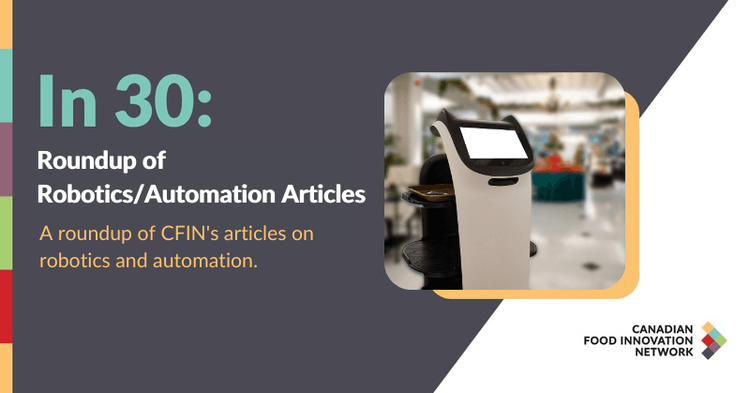
IN 30: Roundup of Robotics and Automation Articles
Sometimes, all it takes is 30 minutes to learn the ins and outs of new food technologies and trends that are transforming the food and beverage industry. In this series, we dig into a food innovation topic and link you to content and resources so you can become a master on the topic in 30 minutes (or less!). Robotics, automation and digitization are changing the way the food and beverage industry operates . This week we’re recapping the top original content we’ve published on the topic. Company Spotlight – App8 Incorporated Ottawa-based App8 received funding for its supply chain automation enablement project. We spoke to CEO Elias Hage to learn more about the company and the project . Company Spotlight – Cibotica Inc. Vancouver, BC-based Cibotica Inc. received funding to help develop a food-safe version of a universal dispensing mechanism and associated control algorithms for use in the company’s robotic salad and bowl makeline. Cibotica’s executive team, Ashkan Mirnabavi , Soroush Sefidkar and Daryoush Sahebjavaher , discuss the project and the company’s plans. Company Spotlight – Relocalize Inc. Relocalize Inc. is a Montreal, QC-based company that received funding to demonstrate the world’s first autonomous micro-factory for food and beverage . We spoke to Wayne McIntyre, CEO and co-founder of Relocalize , to hear more about the company and its plans. Company Spotlight – TheoryMesh Winnipeg, MN-based TheoryMesh received funding to create a more sustainable beef and dairy supply chain through controlled environment agriculture and digitization. CEO Chris Bunio tells us more about the company and its plans. Company Spotlight - Vivid Machines Inc. Toronto, ON-based Vivid Machines received funding for a project to scale fruit volumes and transparency across the fruit supply chain. Jenny Lemieux, founder and CEO of Vivid Machines, tells us more about company and its plans. Company Spotlight – Verschuren Centre The Verschuren Centre Inc. for Sustainability in Energy and the Environment, in Sydney, NS , received funding for a project called Automation and Digital Twin Integration for Precision Fermentation Scale Up of Cell-Based Food Ingredients . V erschuren Centre CEO Beth Mason tells us more about the centre and this project. Emerging Food and Foodtech Jobs New food technology and changing operating requirements are transforming the way food and beverage companies work, as well as the employee skills they require . This is a three-part series featuring just a few of the emerging and in-demand jobs now available in food and beverage manufacturing. Find Part 2 h ere and Part 3 here . Explained: Food Processing Skills Canada Food Processing Skills Canada is a non-profit organization dedicated to professionalizing the food and beverage manufacturing industry by providing leadership on labour, skills and workforce development. Exploring Food Innovation and Technology in Prairies Canada: A Year of Discovery and Growth Hubba Khatoon, CFIN’s Regional Innovation Director for the Prairies, share s her insights and observations on the dynamic trends and support network that thrive within the region ’ s food industry. 50 Canadian FoodTech Resources – Canada’s Advanced Manufacturing Cluster Canada’s Advanced Manufacturing Cluster in H amilton, ON is positioning Canadian companies to lead industrial digitalization, maximizing competitiveness , and participation in global markets. 50 Canadian FoodTech Resources – Eme r gence Emergence in Charlottetown, PE , is a bioscience incubator that accelerates the growth of Atlantic Canadian startups and early-stage companies moving from ideation to commercialization. 50 Canadian FoodTech Resources – RPC Science & Engineering RPC Science & Engineering in Fredericton and Moncton, NB , is N ew Brunswick’s provincial research organization and research and technology organization. 50 Canadian FoodTech Resources – Technology Access Centre for Aerospace & Manufacturing (TACAM), at Red River College The Technology Access Centre for Aerospace & Manufacturing supports innovation in the manufacturing and aerospace sectors through technology, applied research expertise and specialized training. 50 Canadian FoodTech Resources – Walker Advanced Manufacturing Innovation Centre at Niagara College The Walker Advanced Manufacturing Innovation Centre in Welland , ON , helps businesses in Southern Ontario bring ideas to life, from concept through to working prototypes, using innovation and leading-edge technology and software. FBO’s CareersNOW! Program There are a range of resources available to both job seekers and food and beverage industry businesses as they seek to navigate the labour market, including Food and Beverage Ontario ’s CareersNOW ! program. Isabel Dopta , program director of CareersNOW !, talks about th e ways the program is connecting potential employees with employers. Guest Post: Data Quality Matters - Unravelling the Impact of Bad Data on Inventory Expiration In the fast-paced world of food manufacturing, inventory expiration poses a persistent challenge for many companies. While it may be easy to blame inventory planners or analysts for these issues, the root cause often lies in outdated systems and processes that professionals are forced to work with. Guest Post: How Networking on YODL Led to a New Career Path and the Growth of Ontario's Laplace Robotics Find out how CFIN member Jeff Hetherington discovered a new career on YODL. IN 30: Addressing Labour Challenges W ith more companies adding automation, digitization and other food technology, finding workers with the skills and training needed to succeed has become even more challenging. IN 30 – Cobots All about the use of cobots , collaborative robotic systems that work alongside human workers, and their use in the food industry. IN 30 – Robotics in the food and beverage industry A look at the use of robotics in the food and beverage industry. Innovation and Digital Solutions are Future-proofing Canada’s Food and Beverage Industry In order for the food and beverage industry to continue to grow and remain internationally competitive, the industry needs to become more efficient and sustainable, with an emphasis on smart processes and product development. One Year Check In: A Roundtable with CFIN and Ontario Genomic's AcCELLerate-ON Funding Recipients In May 2022 the Canadian Food Innovation Network (CFIN) and Ontario Genomics announced the winners of AcCELLerate-ON , Canada’s first regional cellular agriculture competition. We checked in with the four companies to hear more about how their projects are progressing. Overtime If you’ve got more than 30 minutes, these are for you: CFIN Funded Projects: One Year Updates - Ag-Tronic Control Systems Inc. CFIN has provided funding for many projects over the past two years. Now we’re catching up with the Canadian companies leading CFIN-funded projects to chat about how their innovations have advanced in the year since funding. In part one of the series, Hubba Khatoon, CFIN Regional Innovation Director for the Prairies, sits down with Derek Sorrell, Operations Manager at Ag-Tronic Control Systems Inc. , to discuss the development of the company's compostable fruit and vegetable labels. CFIN Funded Projects: One Year Updates – Gastronomous Technologies In this video, Linda Fox, CFIN Regional Innovation Director for Ontario, talks with Kevork Sevadjian and Andrew Skrepnek , co-founders of Oakville, ON-based Gastronomous Technologies, about how CFIN’s Food Innovation Challenge funding has helped them in creating their connected, autonomous kitchen.
Community Manager-
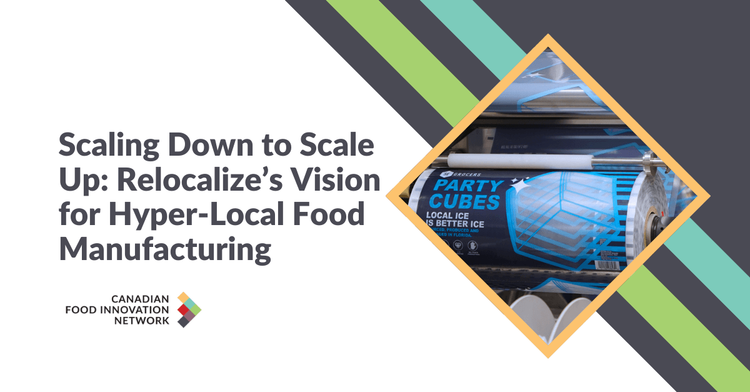
Scaling Down to Scale Up: Relocalize’s Vision for Hyper-Local Food Manufacturing
Relocalize is redefining how—and where—food and beverage processing can be done. The Montreal -based startup’s compact, autonomous units produce packaged ice—and , eventually , other F&B products —right inside grocery distribution hubs. That brings production from hundreds of kilometers away to the foot of the retail shelf, reducing miles, waste, emissions, and reliance on rigid supply chains. Why it Matters: Decentralizing Food Production Relocalize’s approach synchronizes with growing pressure to build resilient, low-carbon food systems. By shifting concentrated processing capabilities to local nodes, the company reduces long-haul trucking, slashes spoilage, and boosts supply reliability—especially when demand surges or infrastructure breaks down. It also aligns with bigger industry forces: rising freight costs, climate disruptions that test long-haul supply chains, and consumer interest in products made closer to home. To scale this vision, Relocalize is building the digital backbone needed to manage a distributed manufacturing network. In December 2024, the company received Innovation Booster funding from CFIN to advance the development of an “ a utonomous m anufacturing c ommand and c ontrol c ent re .” This system brings real-time visibility to their micro-factories by using industrial IoT, edge computing, and machine learning. IoT sensors track performance and quality, edge computing allows instant adjustments, and predictive algorithms anticipate maintenance needs before they slow production. The result is a platform that lets remote teams monitor and fine-tune operations—location by location—so scaling multiple micro-factories across communities becomes stable and efficient. What’s Next for Relocalize The company isn’t building in a vacuum. Its integrated micro-factories have already run ice production pilots in grocery environments and met quality benchmarks. Sector recognition followed : o ver the past year, Relocalize won both the Progressive Grocer Impact Award and Food Logistics Top Tech Award, along with a UNIDO manufacturing prize and inclusion in the Inc. Best in Business list. With their digital operations platform in development, Relocalize plans to expand deployments into new regions and products. They’re piloting additional micro-factory units and laying the groundwork for tech-enabled network of hyper-local local production. It is a model with the potential to redefine how manufactured foods get made and distributed —nearer, fresher, and greener.
Community Manager-
In 30: Roundup of Cybersecurity Articles
Sometimes, all it takes is 30 minutes to learn the ins and outs of new food technologies and trends that are transforming the food and beverage industry. In this series, we dig into a food innovation topic and link you to content and resources so you can become a master on the topic in 30 minutes (or less!). We’ve dug deep into the topic of cybersecurity. Here’s a roundup of the top original content published on the topic . Agriculture and Agri-Food Canada is Putting a Priority on Cyber Resilience in Agriculture and Food Katherine MacDonald , Director General, Strategic Management, Information Systems Branch, Agriculture and Agri-Food Canada , encourage s food businesses to put cyber security measures in place to prevent business disruptions. Cybersecurity 101 A look at cybercrime and cybersecurity, and how they affect Canada ’ s food and beverage industry. Explained: Malware Malware, also known as malicious software or malicious applications, is software designed by cybercriminals to damage computer programs or systems, or to gain unauthorized access to a computer system and/or data. 50 Canadian FoodTech Resources – Canadian Centre for Cyber Security The Canadian Centre for Cyber Security is Canada’s technical authority on cyber security , and is part of Canada’s National Cyber Security Strategy. 50 Canadian FoodTech Resources – Cyber Science Lab The Cyber Science Lab in the School of Computer Science, University of Guelph is an international not-for-profit research lab focused on advancing knowledge and practice in cybersecurity, digital forensics, threat hunting and threat intelligence. IN 30: Ransomware R ansomware is a type of malware that locks a computer or network system and all of its data until a ransom is paid to unlock it. Why CFIN is Creating Cybersecurity Content on YODL As an industry where large amounts of data and technology are interconnected, food and beverage companies and grocery retailers have been vulnerable to cyber security threats and attacks. Overtime If you’ve got more than 30 minutes, these are for you: Cybersecurity and the Food Industry - Ransomware 101 In part two of the series CFIN CEO Dana McCauley discusses ransomware with Dan Couillard of the Canadian Centre for Cybersecurity, and David Shipley of Beauceron. Return to Sender In part three of the series Tyson MacInnis , CFIN’s Regional Innovation Director for Atlantic Canada, sat down with David Shipley of Beauceron, and Vidya ShankarNarayan , CIO and Assistant Deputy Minister, Information Systems Branch, Agriculture and Agri-Food Canada, to discuss business email compromise and how companies can protect their email systems from cyber attacks .
Community Manager-
Feeding Recovery: How Enhanced Medical Nutrition is Redefining Patient Care
Waterloo-based startup Enhanced Medical Nutrition (EMN) was founded on a simple but surprisingly overlooked premise: that high-quality, targeted nutrition before and after surgery can directly improve recovery, reduce complications, and shorten hospital stays. T he company is working to position nutrition as an essential consideration for surgery patients through their evidence-backed clinical formulations and a digital platform that helps care teams see, measure, and act on nutritional support. Building on Clinical Nutrition Science E MN develops oral nutrition supplements designed for patients at risk of malnutrition around the time of surgery. These are not your average nutritional shake . R ather , they are specially formulated blends rich in protein, omega-3s, and immune-supporting nutrients that align with clinical recovery guidelines. Hospitals and care providers use them to strengthen patients heading into surgery and to sustain healing afterward, when appetite and intake often falter. Adding Visibility through Digital Tools What sets EMN further apart is its focus on making nutrition measurable. With funding support from CFIN’s Innovation Booster program e , the company has been advanc ing a connected platform that combines patient-facing tracking with provider dashboards. Intake, adherence, and outcomes can be monitored in real time—helping clinicians catch gaps early, adjust plans, and prove the link between better nutrition and better recovery. Why it Matters Nutrition as part of the treatment plan. Instead of being an afterthought, perioperative nutrition becomes visible and integrated, right alongside medications and vitals. Support beyond the hospital. Many patients struggle to maintain nutrition plans once they leave the surgical ward. A digital platform keeps them engaged and connected. Value for healthcare systems. Even small improvements in healing rates and hospital readmissions can have outsized cost and capacity benefits. What’s Ahead EMN is scaling its partnerships with hospitals and surgical teams to validate its products and platform across a wider patient population. By advancing both product innovation and clinical integration, the company is leading the way in demonstrating how food and technology can be used synergistically to optimize recovery and long-term health.
Community Manager-
In 30: Roundup of Talent & Training Articles
Sometimes, all it takes is 30 minutes to learn the ins and outs of new food technologies and trends that are transforming the food and beverage industry. In this series, we dig into a food innovation topic and link you to content and resources so you can become a master on the topic in 30 minutes (or less!). We’ve dug deep into the topic of F&B industry talent and training . Here’s a roundup of the top original content published on the topic. Explained: Food Processing Skills Canada Food Processing Skills Canada is a non-profit organization dedicated to professionalizing the food and beverage manufacturing industry by providing leadership on labour, skills and workforce development. From a Hiring Perspective: A Q&A with Gastronomous Technologies Oakville, ON-based Gastronomous Technologies creates smart commercial kitchens using automation, interconnected robotics and software to solve foodservice challenges such as labour shortages, consistency, profitability, supply chain management and waste disposal. FBO’s CareersNOW ! Program There are a range of resources available to both job seekers and food and beverage industry businesses as they navigate the labour market, including Food and Beverage Ontario ’s CareersNOW ! program. IN 30: Addressing Labour Challenges A look at some of the labour issues, opportunities and resources accessible to food and beverage entrepreneurs looking for talent, and skilled professionals hoping to enter the industry. AI, Foodtech and Talent: Reskilling workers A new global study by the IBM Institute for Business Value reveals that advancements in artificial intelligence are upending traditional business models and transforming the workplace. The study is based on two surveys of 3,000 executive leaders in 28 countries, and 21,000 workers in 22 countries. Emerging Food and Foodtech Jobs A three part series highlighting some of the emerging and in-demand jobs now available in food and beverage manufacturing. Click here for part 2 , and here for part 3 . IN 30: Post-Secondary Food and Beverage Programs Across Canada This week, we’re looking at some of the post-secondary food and beverage programs available across Canada by region. There are many more STEM, business and non-food related courses that may prepare graduates for a career in the food industry offered through colleges, universities and private facilities throughout the country. Listed locations are for each schools’ main campus. All programs may not be running during the current school year. IN 30: Post-Secondary Food Research some of the food, foodtech and food-related work taking place at research centres and departments of post-secondary institutions in Canada. This is just a small sample of the fascinating projects underway across the country. Overtime If you’ve got more than 30 minutes, these are for you: An Interview with a Food Recruiter Carolyn Cooper sat down with Allan Hills, a senior hiring consultant with CPG Executive Search, specialists in hiring for the food and beverage manufacturing industry, to discuss the issues food companies now face when hiring and retaining skilled employees. An Interview with FoodGrads Carolyn Cooper sat down with Veronica Hislop of FoodGrads to discuss closing the gap between students, graduates and employers in the food and beverage industry. An Interview with a Product Manager Lavina Gully , Regional Innovation Director for BC and Yukon, sits down with Jeff Epstein of North Vancouver, BC’s 16 Volts and Grants for Growth , to discuss the role of a product manager, the importance of product management, and the significant advantages it offers food and beverage companies.
Community Manager-
Barrier Breakthroughs: Nfinite Nanotech is Building Solutions for a Plastic-Free Future
Replacing plastic in food packaging is a lot more complicated than simply switching it out for recyclable or compostable bio-based materials. For sustainable alternative are to supplant plastics at scale , they first have to match plastic’s exceptional barrier performance, survive long supply chains, and integrate seamlessly into existing manufacturing equipment and packaging processes . Backed by funding from CFIN’s Innovation Booster program , Waterloo -based Nfinite Nanotech is tackling this monumental problem by developing a nano-barrier coating that keeps the performance, but ditches the plastic—opening the door for paper, bio-plastics, and other sustainable packaging substrates to compete on equal terms. Performance Without Planetary C ompromise Nfinite’s technology uses spatial atomic layer deposition (SALD) to apply a uniform, pinhole-free coating that’s only nanometres thick. The process runs in open air and at industrial speeds, so packaging manufacturers can integrate it into existing production lines without retooling or slow downs . The result ing packaging products feature a high-barrier layer that protects sensitive foods from moisture and oxygen while preserving the recyclability or compostability of the base material. Why it Matters Across Canada, single-use plastic bans and Extended Producer Responsibility (EPR) rules are accelerating the shift toward lower-impact packaging. For many products, especially perishable foods , that shift depends on packaging that can keep moisture and oxygen out long enough to maintain quality and safety . Nfinite’s nano-barrier coatings bring that level of protection to paper, fibre , and other renewable substrates, extending their utility into categories where plastic continues to dominate. The result is a broader range of sustainable options that meet both regulatory requirements and the practical demands of manufacturing, distribution, and retail. What’s Next for Nfinite Assisted by a $ 48,360 Innovation Booster grant from CFIN in December 2024, Nfinite is tailoring its barrier chemistry for paper-based food packaging. The company plans to scale production in high-priority categories where replacing plastic has been hardest, such as produce, baked goods, and frozen foods. If the results hold up, Nfinite’s coating could give food producers a viable way to cut plastic weight, reduce EPR costs, and meet sustainability targets—all without compromising the protection that keeps food fresh.