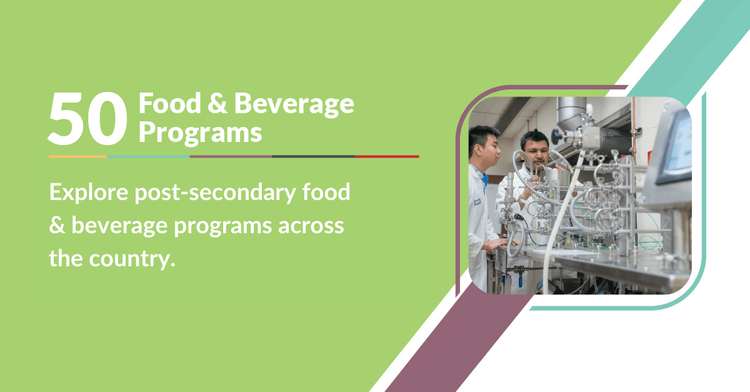
Canada is home to a diverse and dynamic food and beverage industry, supported by educational programs that train the next generation of chefs, brewers, entrepreneurs, and innovators. This roundup highlights 50 standout programs across the country, from top culinary schools and hospitality management courses to cutting-edge research initiatives and sustainability-focused training. Whether you're an aspiring professional, educator, or industry enthusiast, these programs provide valuable insights into the evolving world of food and drink in Canada. BC & Yukon Vancouver Community College UBC BCIT LaSalle College (Vancouver) UBC: Food, Nutrition, and Health Okanagan College Vancouver Island University University of Fraser Valley Northern Lights College North Island College Yukon University Selkirk College Thompson Rivers University Kwantlen Polytechnic University Prairies Saskatchewan Polytechnic University of Alberta University of Saskatchewan University of Manitoba SAIT NAIT Manitoba Institute of Trades & Technology International College of Manitoba Ontario Niagara College Humber College Le Cordon Bleu Ottawa George Brown College Fanshawe College Brock University University of Guelph Toronto Metropolitan University Loyalist College Georgian College Conestoga College Durham College Centennial College Canadore College Algonquin College Trent University St. Lawrence College St. Clair College Sault College Lambton College Confederation College Quebec McGill University LaSalle College Bishop's University Atlantic Canada University of PEI Memorial University Cape Breton University
Community Manager-
50 Food & Beverage Programs - Vancouver Island University
Crafting a Career in BC ’ s Wine Industry: VIU ’ s Wine Business Program The Wine Business program at Vancouver Island University is a comprehensive one-year certificate course designed for those passionate about pursuing a career in the BC wine industry. The program combines practical experience with academic learning in viticulture, wine business practices, marketing, and tourism. Program Highlights: As a student, you ’ ll have the chance to immerse yourself in hands-on experiences at local vineyards and wineries, gaining insights into the entire winemaking process. This practical foundation is then complemented by academic courses in viticulture, wine business practices, marketing, and tourism. A standout feature of this program is its flexibility. Whether you ’ re looking to study full-time for a year or prefer a part-time option spread over two years, VIU has you covered. Located in picturesque Nanaimo, BC, VIU provides an ideal setting for your wine education journey. With a curriculum designed to integrate viticulture essentials with business acumen, VIU ’ s Wine Business program offers a holistic understanding of the wine industry. Students can also earn credits that can be applied toward a Bachelor of Business or a Hospitality and Tourism Management program, opening doors to a wide range of future career prospects. The program includes seven courses and focuses on the broader aspects of the wine industry. In addition to viticulture and winemaking, students delve into wine marketing, exporting, and the vital role of wine tourism. C ourses cover a wide spectrum, from wine marketing and appreciation to beverage theory and the management of wine tourism. The program also offers elective courses in consumer behavio u r, entrepreneurship, and festival management . What You’ll Leave With: Upon graduation, a world of opportunities awaits you in BC ’ s wine industry. Whether you dream of managing a vineyard, excelling in wine s ales and marketing, or even opening your own restaurant, VIU ’ s Wine Business program provides the knowledge and skills to make your wine-related ambitions come true. Career options span winery/vineyard management, retail sales, wine marketing representation, hotel management, culinary arts, a gri - tourism development, and s pecial events coordination. V ideo/Social / Media : VIU YouTube Video
Community Manager-
Cellular Food in Canada
The past few years have proven how susceptible Canada’s food industry is to world events, supply chain disruptions and climate changes. New food production technology, such as cellular agriculture, has the potential to alleviate some of these challenges, while creating commercial opportunities and building a more sustainable, resilient food system. What is it? Cellular food – also known as engineering biology, synthetic biology or cell-cultivated products – is the production of food and textile products without using animals or land. Cell cultures harvested from animals, plants or micro-organisms are grown in the lab through tissue engineering or precision fermentation to produce: Cultivated proteins such as chicken, beef and seafood Fermented products like dairy, eggs, honey and chocolate Ingredients to add to products to create hybrid foods including proteins, enzymes, flavour molecules, vitamins, pigments and fats Textiles such as leather, silk and wool Why you should care As global population continues to grow, so does demand for protein, while access to land and other resource inputs become more scarce. Alternative agriculture could be an answer to food scarcity, concerns about animal and environmental welfare, cost inflation and resource challenges due to climate change. Compared to conventional agriculture, cellular agriculture production, is much less energy intensive, produces less greenhouse gas emissions, and has a much lower overall carbon footprint. With our strong food infrastructure, reputation for food safety, biotechnical expertise, and federal support for alternative protein production, Canada is well positioned to become a leader in cellular agriculture. The 2021 report Cellular Agriculture: Canada’s $12.5 Billion Opportunity in Food Innovation from Ontario Genomics and the Food and Agriculture Institute at the University of the Fraser Valley found that the international cellular agriculture market will reach US$100 billion by 2032. Canada’s food industry has the potential to take $12.5 billion that market, while creating up to 142,000 high-paying jobs. Opportunities in Canada Engineered plant proteins are already in the Canadian market, and by all estimates, precision fermented products are expected to appear before cultured meat products. Current Canadian regulations consider food produced through cellular agriculture as a novel food, and products are approved on a case-by-case basis. Here are a few Canadian start-ups making headlines: Because Animals – This Toronto-based pet food company uses cultured ingredients such as probiotics and nutritional yeast to create nutrient-rich cat and dog food designed to help digestive issues. Future Fields – Edmonton, AB-based Future Fields is a R&D producing growth media products that can be used to create commercialized cultivated proteins in a safe and sustainable manner. Cell-Ag Tech – Toronto’s Cell-Ag Tech is doing R&D on cell-cultured fish and seafood. New Harvest International non-profit research institute New Harvest , which promotes the science behind cultured meat through research, funding and a conference , now has a Canadian branch.
Community Manager-
Other Articles
EXPLAINED: Artificial Intelligence (AI)
What is it? Machines and systems that are programmed with AI can simulate human intelligence , can acquire and apply knowledge in order to perform tasks, solve complex problems, and improve performance. Machine learning is a subset of AI algorithms. Why you should care New food technologies and the introduction of AI programs in the computers that control production lines have the potential to change the way the food industry works, especially as businesses look for automated solutions to address issues such as supply chain traceability, production efficiency, food safety and quality control, and waste reduction. Some of the manufacturing technology included under the category Industry 4.0 relies on AI to process the data captured by Industrial Internet of Things (IIoT) devices, enterprise resource planning (ERP) systems, and connected remote access monitoring software. By using AI, businesses can collect and analyze data that enables them to generate business intelligence, giving them a competitive advantage. Most AI-driven functions are machine-to-machine transactions. AI-driven systems can add value and efficiency to many areas in food operations, including to: Automate tasks across different departments, such as accounting, IT, customer service and marketing. Streamline resource tracking throughout the supply chain and ensure compliance from vendors. Provide data for forecasting sales, resource demand and R&D on consumer trends. Automate production activities, including management work. Provide more effective quality and safety control in real time. Help create “smart” factories that run more efficiently with less downtime, using less energy and lower operating costs. Help drive greenhouse gas emission reduction targets. Help scale operations using predictive technology. Offer real-time monitoring of security systems. Provide technical support for employees and customers. Monitor and automate social media activity. Provide customized offers for consumers based on data analysis. Perform self-service analytics. Opportunities in Canada There are a range of companies offering AI-enabled software and equipment to Canadian food and beverage companies. Saint John, NB-based independent brewery Moosehead uses a conveyor belt at its bottling plant embedded with Internet-enabled sensors and data analytics software to monitor pasteurization, filling, labelling, capping and packaging, increasing capacity while lowering costs. Sobeys ’ fully automated Customer Fulfillment Centre, a $150-million, 500,000-sq.-ft. warehouse and distribution centre in Vaughan, ON, features AI-driven automated case picking and palletizing systems. The system can stack up to 10 per cent more products on each pallet, saving up to 40 per cent on labour costs. Fredericton, NB-based Eigen Innovations produces machine vision solutions powered by AI to help businesses automate their quality control system. Toronto, ON-based Canvass AI provides industrial AI software such as its Canvass Platform that can help food companies boost production efficiency and output, while reducing waste. If you have a digital solution to make supply chains safer and more agile, apply for our Food Innovation Challenge . Applications are due July 7th. Nestor ’s Take: AI, automation and robotics are already changing how food manufacturers and foodservice operators work. To see some of this technology in action, check out Burlington, ON-based Gastronomous Technologies Inc., a provider of automated solutions for foodservice. Gastronomous is one of five winners of CFIN’s recent Food Innovation Challenge for the development, in partnership with Recipe Unlimited and Sodexco Canada Ltd., of smart/connected kitchen equipment for food ingredient preparation, cold storage, and accurate automated portioning/dispensing of ingredients.
Community Manager-
Meet YODL
Meet YODL, an exciting new interactive online platform designed to help Canadian food and beverage professionals from all sectors of the industry connect, learn, and grow their businesses. We created YODL as a place for entrepreneurs to discover cutting-edge technology and solutions, meet new business partners throughout the Canadian supply chain, and access government funding opportunities. On YODL you’ll find: Unique daily content Access to CFIN’s innovation challenges and members-only events Access to direct mentorship from CFIN’s five Regional Innovation Directors Opportunities to network and collaborate with other food and beverage professionals from across Canada Information on CFIN members, staff and board of directors Business resources, including original research and information on best business practices, consumer trends, R&D, training and much more
Community Manager-
Q&A for Robotics in Action
Robotics in Action – Seeing is Believing generated lots of questions from CFIN Members who were eager to learn more about the innovative companies that were featured during the event. So, to help answer these questions, we thought we’d tap into the founders and executives at the companies to get the answers to your most pressing questions. Stefan Glibetic, lead engineer and CTO, Mycionics Inc. Q: Are there any processing effects of robots and scanning on mushrooms? A: Since the mushrooms are very fragile, one of the biggest challenges in the mushroom harvesting industry is picking mushrooms without damage. Our system was designed from the ground up with this in mind, hence why we developed custom soft gripping technology instead of using commonly seen end-effectors on the market. Our system is able to pick and process mushrooms with damage rates equal to skilled human harvesters. Additionally, our scanning technology is very low-powered, safe, and doesn’t affect the mushrooms. Q: How can this technology be commercialized in other fruit and vegetable picking environments? A: Our systems are highly modular, and structured in a way that can be easily applied to other crops and industries, especially those with tight space restrictions. Right now, we are focusing our efforts on mushrooms, but the same technology and principles can be applied to new applications in the future. Q: Are the mushroom robotics currently using AI? A: Yes, our machine vision system applies a combination of algorithms, including AI, to process the vision data in order to determine mushroom properties, and how to pick those mushrooms effectively and without damage. We also capture environmental microclimate data, such us temperature, humidity and CO 2 , which helps the farmer visualize their growing environment and grow higher-quality mushrooms. Q: With an increase in consistent delivery of mushrooms, will we see more umami products on shelves? A: Although it's no a current goal of ours, we do hope that through the use of our technology, the mushroom quality will increase over time as farmers will be able to focus more of their efforts on growing, rather than on harvesting logistics. Kristian Tazbazian, co-founder and COO Gastronomous Technologies Q: Which parts of Gastronomous robots use AI ? A: The AI side of food automation lies in software and the way that data is analyzed in order to improve both operational as well as user efficiency. Nipun Sharma, CEO, SJW Robotics Q: How do you monitor inventory levels/replenishments? A: The system has full traceability and product data recorded at the point of refill via bar scan. Along with temperature controls, volume/weight dispensing sensors and recipe metrics, we can accurately measure inventory levels and shelf-life to allow us to trigger timely refills. Q: How is nutritional quality maintained in these systems? A: The nutritional quality will be determined by selection of input ingredients, and our temperature controls will measure shelf-life pertaining to that ingredient. Q: How do you keep the machine clean? A: The machine has scheduled self-cleaning mechanism utilizing high pressure hot water and steam, and our equipment certification conforms to the highest food safety standards. Q: How adaptable is this technology? Can you switch out the wok for a cold application? A: Yes. The wok is the replacement module, and can be switched by a grill, deep fryer or conveyor oven for all hot food alternatives. While the hot area can be bypassed for all cold bowls such as salads and yogurt. The current version can do any variation of starches that include noodles, pasta and rice. Tharwat Fouad, founder and president, Anubis 3D Q: Can Anubis print EOAT for direct contact with food that is FDA approved? A: Yes, the Nylon 12 (PA2200) we use to build most of our EOAT is FDA approved for food contact. When we build tools for food contact, we do not stain them with any colour, we keep them at their original white colour. We also add a finishing process called vapour finish that closes the porosities and makes the tool easy to clean.
Community Manager-
CFIN Announces Food Innovation Challenge Call for Proposals focused on Supply Chain Digitization
The last 36 months have demonstrated significant weaknesses in global, national, provincial, and regional supply chains. COVID-19 resulted in the movement restrictions of workers, changes in demand of consumers, closure of food production facilities, restricted food trade policies, and financial pressures in the food supply chain. Russia’s war on Ukraine has exposed vulnerabilities in global supply chains and pushed nations across the globe to push additional grain, corn, and fertilizer supplies into world markets to make up for the disruption of more than a quarter of the worlds grain trade. Restaurants reopening post COVID-19 closures also felt significant supply chain impacts, with increased food costs and shortages of main ingredients, such as chicken and corn. Supply lines are jammed, which has created pockets of scarcity and added costs that are eventually passed on to consumers. A recent National Restaurant Association survey revealed that 95% of restaurants in the US had experienced considerable supply delays or shortages in recent months, which is concerning. Rise of omni-channel sales has also pushed fulfillment capabilities to the maximum at all points throughout the supply chain. Channel mismatches as consumer buying trends shifted from restaurants to in-home eating. As a result of these challenges, CFIN is issuing their Spring 2022 Food Innovation Challenge Call with a theme of Digitization and digitalization solutions that create safer, more secure, and more agile food supply chains. Digitization and digitalization of the supply chain enables food sector resilience with new tools to address the increasing volatility in customer requirements and supply availability, while also addressing overall efficiency improvement expectations and food safety needs. With Supply Chain 4.0 solutions, Canadian firms can move products faster, with more flexibility, granularity, accuracy and ultimately with less risk of disruptions. Key Program Priorities: As a result of these challenges and the opportunities presented by Supply Chain 4.0 technologies, this CFIN-led call is dedicated to the research, development, and demonstration of digital and digitalized solutions for Canada’s food supply chain. Key program priorities include: Data capture and management Predictive analytics and demand planning Automation of the physical flow of goods Digital order management Driving improved capacity utilization in food processing Food safety and traceability throughout the supply chain All projects should: Address the food supply chain from farm-gate to consumer’s plate Result in cross-firm solutions Offer accessible solutions to small and medium sized enterprises All applicants must be CFIN members and submit their application online at: https://cfin-rcia.smartsimple.ca/ Call Timelines: Letter of intent application opens –June 1, 2022 Info Session – June 7, 12-1 EST Letters of intent due: July 8, 2022 Full proposals due: September 16, 2022 Projects start: November 1, 2022 Projects complete - no later than Mar 31, 2025 More Program Details are available here
Community Manager-
Robotics in Action – Top Five Takeaways
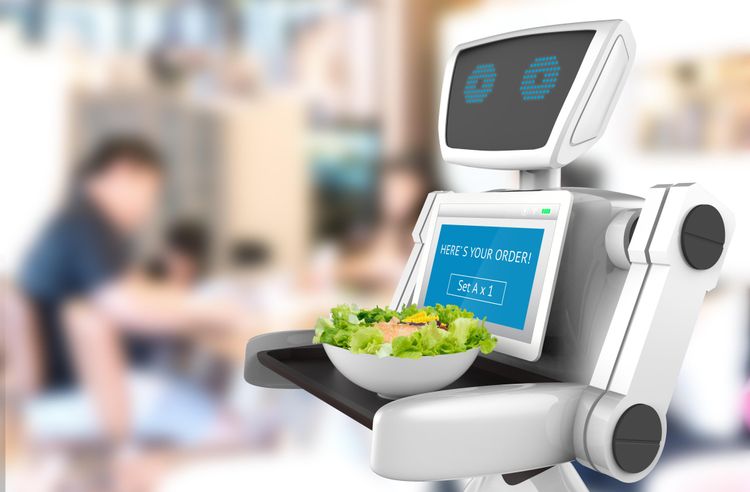
The Canadian food industry is currently facing numerous challenges, from labour shortages and supply chain disruptions, to increasing input costs and changing consumer expectations. Many of these challenges are common to manufacturing, grocery and foodservice sectors, and can be addressed by automating processes so that they are faster, safer and more reliable. While the shift to automation has been slower in the food industry than in other industries, the use of automation, robotics and data analytics has the potential to transform Canada’s food and beverage industry. By investing in technology, the industry could become more agile, traceable and transparent, while growing capacity and ensuring our food supply chain remains strong, sustainable, and competitive in the world market. On May 12, 2022 CFIN presented its second members-only event, Robotics in Action: Seeing is Believing . The virtual event was sponsored by Farm Credit Canada and hosted by Jim Beretta, president of Customer Attraction, a marketing consultancy which focuses on robotics, automation and applications. Beretta spoke with several Canadian entrepreneurs whose companies are leading technological change in the food industry, and demonstrated cutting-edge automation solutions at Western University, Mycionics , Ghost Kitchen Brands and 168 Sushi , and robotic systems from SJW Robotics , Anubis 3D , Gastronomous Technologies , JMP Solutions , Armo Tool and Tiny Mile Robotics . Here are the top five takeaways from the session: 1. Automation and robots don’t reduce jobs Robots and automatic systems are designed to do the tasks that are dangerous, dirty or repetitive and are a solution to current labour shortages in the industry. While robots perform tasks such as picking and packing, employees are freed up to complete more value-added and skilled duties. Collaborative robotic systems are designed with added safeguards so that they work side-by-side with their human counterparts. 2. Automation is becoming more efficient and less costly In the last decade, costs of implementing automatic systems or robotics have fallen, while performance and consistency have increased dramatically. There are also many new advancements in gripping technology, resolving older robotic challenges such as distinguishing between different sized and shaped products or boxes. 3. Robotic systems can be integrated into existing operations Automation systems and robotics are now easier to integrate into food operations, and are often designed so that companies can add one piece of technology at a time to ensure success and worker comfort. Working together with technology companies, food businesses can integrate plug-and-play components or create unique, custom-designed system featuring different technology modified to fit their needs. 4. Automation can lead to lower energy and input costs, while boosting food safety and capacity Technology that provides food producers with real-time data analytics enables them to optimize the use of energy and raw materials, reduce food and energy waste, and achieve higher production capacities. Data analytics can also be used to predict preventative maintenance in the system and prevent drops in throughput. Many companies rely on robotics that target sanitary compliance to safely and reliably assemble foods such as protein and uncooked ready-to-eat meals for retail or healthcare, where safe food handling is crucial. 5. Automated foodservice offerings go far beyond vending Quick-service kiosks that offer a wide range of hot and cold food choices like salad, pizza and cooked noodles are appearing on campuses, in malls and in other public spaces. Far beyond vending machines, the kiosks offer made-to-order meals prepared while you watch in just minutes, with a variety of customizations and payment options available. With a low carbon footprint and minimal labour needs, the kiosks have the potential of replacing QSR units in some locations. If you have a digital solution to make supply chains safer and more agile, apply for our Food Innovation Challenge . Applications are due July 7th.
Community Manager-
The Tablesetter: June 20, 2022
Happy Monday CFIN members! Every Monday, we’ll give you a heads up on what will be appearing on YODL this week and around the food world. The YODL Menu Monday: The Tablesetter Tuesday: Takeaways from CFIN’s second members-only virtual event, Robotics in Action: Seeing is Believing Wednesday: Artificial Intelligence (AI) and machine learning are changing the food industry Thursday: CFIN’s most recent Food Innovation Challenge, which focuses on creating safer, more secure food supply chains Friday: Weekly News Roundup Around the Food World PIC, NPC, Protein Highway, and Humane Society International Canada, has released Game Changers: Canadian Opportunities In Alternative Protein a report outlining how Canada is translating the challenges of the alternative protein industry into competitive growth opportunities. The Golden Pencil Award winners have been announced. Collision takes place Jun 20, 2022 09:00 (ET) to Jun 23, 2022 17:00 (ET). Something to Celebrate June 24 is the Seventh Annual National Food Truck Day , celebrating the more than 35,000 entrepreneurs who own and operate food trucks across Canada and the U.S. The food truck industry was estimated to be worth $1.16 billion as of 2021, and has grown at an average rate of 12.1 per cent since 2016. Consumers aged 25 to 44 account for 43 per cent of food truck spending, with those aged 18 to 34 more likely to frequent food trucks. Food Facts According to Zippia Research, the most profitable food truck menu items to serve are: Burgers Indian street food Stone baked pizza Loaded fries Grilled cheese Falafel Macaroni and Cheese