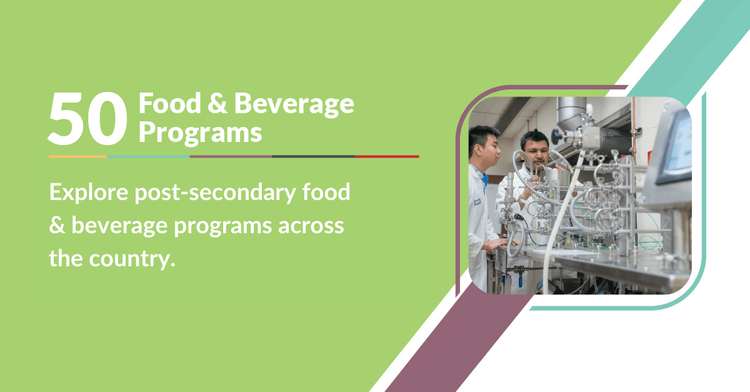
Canada is home to a diverse and dynamic food and beverage industry, supported by educational programs that train the next generation of chefs, brewers, entrepreneurs, and innovators. This roundup highlights 50 standout programs across the country, from top culinary schools and hospitality management courses to cutting-edge research initiatives and sustainability-focused training. Whether you're an aspiring professional, educator, or industry enthusiast, these programs provide valuable insights into the evolving world of food and drink in Canada. BC & Yukon Vancouver Community College UBC BCIT LaSalle College (Vancouver) UBC: Food, Nutrition, and Health Okanagan College Vancouver Island University University of Fraser Valley Northern Lights College North Island College Yukon University Selkirk College Thompson Rivers University Kwantlen Polytechnic University Prairies Saskatchewan Polytechnic University of Alberta University of Saskatchewan University of Manitoba SAIT NAIT Manitoba Institute of Trades & Technology International College of Manitoba Ontario Niagara College Humber College Le Cordon Bleu Ottawa George Brown College Fanshawe College Brock University University of Guelph Toronto Metropolitan University Loyalist College Georgian College Conestoga College Durham College Centennial College Canadore College Algonquin College Trent University St. Lawrence College St. Clair College Sault College Lambton College Confederation College Quebec McGill University LaSalle College Bishop's University Atlantic Canada University of PEI Memorial University Cape Breton University
Community Manager-
50 Food & Beverage Programs - Vancouver Island University
Crafting a Career in BC ’ s Wine Industry: VIU ’ s Wine Business Program The Wine Business program at Vancouver Island University is a comprehensive one-year certificate course designed for those passionate about pursuing a career in the BC wine industry. The program combines practical experience with academic learning in viticulture, wine business practices, marketing, and tourism. Program Highlights: As a student, you ’ ll have the chance to immerse yourself in hands-on experiences at local vineyards and wineries, gaining insights into the entire winemaking process. This practical foundation is then complemented by academic courses in viticulture, wine business practices, marketing, and tourism. A standout feature of this program is its flexibility. Whether you ’ re looking to study full-time for a year or prefer a part-time option spread over two years, VIU has you covered. Located in picturesque Nanaimo, BC, VIU provides an ideal setting for your wine education journey. With a curriculum designed to integrate viticulture essentials with business acumen, VIU ’ s Wine Business program offers a holistic understanding of the wine industry. Students can also earn credits that can be applied toward a Bachelor of Business or a Hospitality and Tourism Management program, opening doors to a wide range of future career prospects. The program includes seven courses and focuses on the broader aspects of the wine industry. In addition to viticulture and winemaking, students delve into wine marketing, exporting, and the vital role of wine tourism. C ourses cover a wide spectrum, from wine marketing and appreciation to beverage theory and the management of wine tourism. The program also offers elective courses in consumer behavio u r, entrepreneurship, and festival management . What You’ll Leave With: Upon graduation, a world of opportunities awaits you in BC ’ s wine industry. Whether you dream of managing a vineyard, excelling in wine s ales and marketing, or even opening your own restaurant, VIU ’ s Wine Business program provides the knowledge and skills to make your wine-related ambitions come true. Career options span winery/vineyard management, retail sales, wine marketing representation, hotel management, culinary arts, a gri - tourism development, and s pecial events coordination. V ideo/Social / Media : VIU YouTube Video
Community Manager-
Cellular Food in Canada
The past few years have proven how susceptible Canada’s food industry is to world events, supply chain disruptions and climate changes. New food production technology, such as cellular agriculture, has the potential to alleviate some of these challenges, while creating commercial opportunities and building a more sustainable, resilient food system. What is it? Cellular food – also known as engineering biology, synthetic biology or cell-cultivated products – is the production of food and textile products without using animals or land. Cell cultures harvested from animals, plants or micro-organisms are grown in the lab through tissue engineering or precision fermentation to produce: Cultivated proteins such as chicken, beef and seafood Fermented products like dairy, eggs, honey and chocolate Ingredients to add to products to create hybrid foods including proteins, enzymes, flavour molecules, vitamins, pigments and fats Textiles such as leather, silk and wool Why you should care As global population continues to grow, so does demand for protein, while access to land and other resource inputs become more scarce. Alternative agriculture could be an answer to food scarcity, concerns about animal and environmental welfare, cost inflation and resource challenges due to climate change. Compared to conventional agriculture, cellular agriculture production, is much less energy intensive, produces less greenhouse gas emissions, and has a much lower overall carbon footprint. With our strong food infrastructure, reputation for food safety, biotechnical expertise, and federal support for alternative protein production, Canada is well positioned to become a leader in cellular agriculture. The 2021 report Cellular Agriculture: Canada’s $12.5 Billion Opportunity in Food Innovation from Ontario Genomics and the Food and Agriculture Institute at the University of the Fraser Valley found that the international cellular agriculture market will reach US$100 billion by 2032. Canada’s food industry has the potential to take $12.5 billion that market, while creating up to 142,000 high-paying jobs. Opportunities in Canada Engineered plant proteins are already in the Canadian market, and by all estimates, precision fermented products are expected to appear before cultured meat products. Current Canadian regulations consider food produced through cellular agriculture as a novel food, and products are approved on a case-by-case basis. Here are a few Canadian start-ups making headlines: Because Animals – This Toronto-based pet food company uses cultured ingredients such as probiotics and nutritional yeast to create nutrient-rich cat and dog food designed to help digestive issues. Future Fields – Edmonton, AB-based Future Fields is a R&D producing growth media products that can be used to create commercialized cultivated proteins in a safe and sustainable manner. Cell-Ag Tech – Toronto’s Cell-Ag Tech is doing R&D on cell-cultured fish and seafood. New Harvest International non-profit research institute New Harvest , which promotes the science behind cultured meat through research, funding and a conference , now has a Canadian branch.
Community Manager-
Other Articles
🚀 CFIN at RC Show 2026: Into the Beyond!
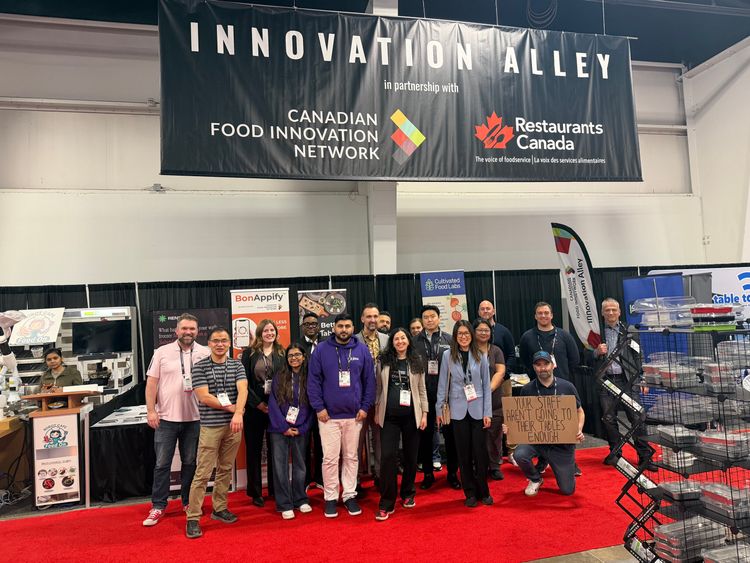
The Canadian Food Innovation Network (CFIN) was thrilled to return to the RC Show 2026 with the second annual Innovation Alley, showcasing the most exciting foodtech companies shaping the future of foodservice and hospitality. This year’s show, themed “Into the Beyond,” was bigger than ever, bringing together 650 vendors and brands, six stages, and more than 58 sessions — a testament to the incredible work of the RC team in creating a program that spoke to every corner of the industry. A Hub for Foodtech Innovation At the heart of the show, Innovation Alley provided a dedicated space where foodtech startups and scale-ups could connect directly with restaurant groups, hospitality operators, investors, distributors, and industry leaders. Attendees explored technologies transforming the sector, from AI and robotics to sustainable ingredients, operational tools, and automation solutions. Participating companies included Jitto, BetterTable, Food Integration, Cultivated Food Labs, M2M Tech, NextGen Kitchens, Profillet, TableTouch, and Renergy Technologies — each bringing innovations designed to improve efficiency, sustainability, and profitability. Insights from the Experts CFIN proudly participated in the panel “Doing More with Less: The Next Tech Era of Restaurant Efficiency.” Moderated by @Abigail Van Riesen , the discussion brought together founders from Jitto, BetterTable, and TableTouch, alongside experienced hospitality leaders, to explore how restaurants can operate smarter under today’s pressures. The conversation delved into reducing operational waste, streamlining vendor relationships, protecting margins, and enhancing the guest experience — practical insights that operators could implement immediately. @Dana McCauley also joined a dynamic discussion on leadership and innovation during challenging times, highlighting how collaboration, adaptability, and connection are essential for navigating the evolving foodservice landscape. Together, these conversations showcased how technology, strategy, and leadership intersect to shape a more resilient and future-ready industry. Passion, Collaboration, and the Future of Foodservice RC Show 2026 highlighted that the industry is under immense pressure — and exactly when leadership, connection, and collaboration matter most. Through Innovation Alley, panels, and live demonstrations, the event celebrated passion, innovation, and collaboration, showing that Canadian foodtech is ready to shape the future of foodservice. CFIN was proud to be part of this exciting event, connecting innovators, operators, investors, and leaders to discover solutions that drive growth, efficiency, and sustainability across the sector. Our team gained fresh insights that will inform CFIN’s work—shaping strategies, fostering collaborations, and accelerating solutions for a more resilient and efficient foodservice sector.
Community Manager-
Canada's Food Supply Chain is Vulnerable. Here’s What's Needed to Fix It
Canada's food supply chains are under more pressure than they've been in decades — and the cost of that pressure keeps landing on consumers. CFIN's new report, Building Resilient Food Supply Chains Through Canadian Innovation , examines the structural vulnerabilities behind those rising costs, profiles the Canadian companies building solutions, and makes the case for what kind of investment would bring those solutions to the thousands of food businesses that need them. Canada's grocery prices are driven by structural supply chain vulnerabilities Canada's food affordability problem is a supply chain problem. Although C anada is one of the world's largest agricultural producers, it has outsourced much of the processing, technology, and infrastructure that turns raw commodities into food. That dependency means every tariff, currency swing, and shipping disruption flows through foreign supply chains and ultimately lands on consumers. An undercapitalized domestic food processing sector exacerbates the problem . Of roughly 6,900 food and beverage processors, 92 percent are SMEs. Capital investment in machinery has declined 16 percent over the past decade. Productivity fell 0.6 percent from 2019 to 2024 while U.S. productivity rose 10.1 percent. The barriers are self-reinforcing: thin margins, high equipment costs, constrained cash flow, lack of digital skills, and difficulty finding solutions that fit specific operations. Canadian companies are building domestic alternatives across processing, automation, and traceability Canadian innovator s are already building alternatives. C ompanies across three areas — domestic processing capacity, operational efficiency, and supply chain traceability — are replacing imported ingredients with Canadian-produced alternatives, deploying automation that lowers costs at the plant level, and building the real-time data infrastructure the sector needs to modernize . Several have raised significant private capital on the strength of validated, commercially deployed technology. Technology reduces food prices — but only when it reaches the firms that need it most Th e key challenge Canada must address is h ow to accelerate the adoption of those solutions across the sector. EU-wide research show s that technology investment in food processing directly reduces food prices — but only when deployed through programs and partnerships that reach the firms facing real barriers to adoption, not just early adopters who would have modernized anyway. One area where investment would have substantial impact: Canada's 573 medium-sized processors — firms generating $18.4 billion in annual sales with 71 percent export intensity. These are the companies best positioned to adopt new technology , scale domestic capacity, and grow into the anchor processors that a more resilient food system requires. The report argues there are far too few of them — and that growing and supporting this segment is among Canada’s highest-leverage opportunit ies to build a more resilient food sector . From vulnerability to resilience: what the evidence shows The full report maps the current landscape of Canadian supply chain innovation and builds the case for the sustained investment and collaborative infrastructure needed to close the productivity gap, strengthen domestic capacity, and reduce the systemic exposure that makes Canadian food prices vulnerable to forces beyond our control. On April 23, we're bringing the report's findings to life with the innovators and operators deploying these solutions across the sector — register for the webinar here . Get the full picture with CFIN+ Building Resilient Food Supply Chains Through Canadian Innovation is available to CFIN+ members — along side exclusi ve Nielse nIQ market data, s ix additio nal original reports on Canadian foodtech and innovation, and over $3,000 in savings from partners across the food and business services sectors. Read the full report | Learn more about CFIN+
Community Manager-
Building the Factory of the Future: How Canadian Food Manufacturing Tech Is Driving the Food 4.0 Transition
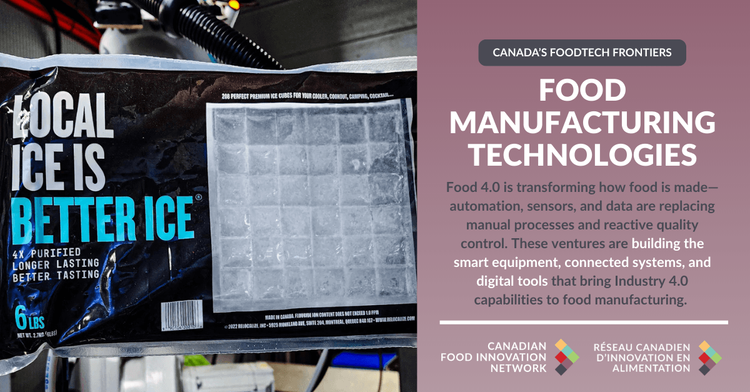
Canada's food manufacturing sector stands at an inflection point. After decades of incremental improvements to largely manual processes, the industry is now confronting the need for more fundamental transformation. Labour shortages, margin pressure, sustainability mandates, and global competition are converging to make automation, digitization, and smart manufacturing not optional upgrades but competitive necessities. Since 2021, Food Manufacturing Technologies has accounted for 14% of all program submissions—the largest share alongside NextGen Food & Ingredients and Kitchen & Restaurant Tech—and approximately $1.85 million in awarded funding. The projects in this domain span everything from advanced thermal processing and industrial-scale freezing to AI-driven production optimization and fit-for-purpose bioreactor systems. Canada's food manufacturing innovators are attacking the full spectrum of production challenges—from how raw materials are processed to how finished goods are monitored and optimized in real time. The result is an emerging ecosystem of manufacturing tech ventures that could help position Canada as a leader in Food 4.0. Why Manufacturing Tech Is Accelerating Now Several converging pressures are pushing food manufacturers toward technological transformation. Labour constraints have reached critical levels, with vacancy rates in food manufacturing remaining elevated since the pandemic. Automation is increasingly the only viable path to maintaining output. At the same time, margin compression from input costs, energy prices, and wage pressures has made operational efficiency improvements essential rather than aspirational. Sustainability requirements are also tightening . Scope 3 emissions reporting, water usage targets, and waste reduction mandates are pushing manufacturers to adopt technologies that can demonstrably reduce environmental footprints. And for processors competing in international markets, export competitiveness increasingly requires matching the productivity and quality standards of global peers who have invested more aggressively in manufacturing technology. Meanwhile, the enabling technologies themselves have matured. Industrial IoT sensors, edge computing, machine learning, and robotics have all reached price points and reliability levels that make them viable for food manufacturing environments—even for mid-sized processors who couldn't previously afford such systems. The Frontier of Canadian Food Manufacturing Tech Seven of CFIN's inaugural Foodtech Frontier 25 honourees are working across the Food Manufacturing Technologies domain—from equipment exporters operating on six continents to early-stage startups reimagining how and where food gets made. EnWave Corporation (Vancouver, BC) has built a global licensing business around its Radiant Energy Vacuum (REV™) technology, a vacuum-microwave dehydration method that dries food products in 30-60 minutes rather than the hours or days required by conventional methods. The publicly traded company has licensed its technology to over 50 partners across 26 countries, including Dole, B onduelle , and major dairy processors. E nWave also operates R EVworx , a toll manufacturing facility in Vancouver that allows food companies to test and scale REV-dried products without upfront capital investment. FPS Food Process Solutions (Richmond, BC) has grown from a Vancouver-area startup in 2010 to a global leader in industrial freezing and chilling systems, with over 1,000 employees across 20 locations on six continents. The company designs and manufactures spiral freezers, IQF tunnels, and immersion systems for meat, poultry, seafood, bakery, and prepared foods applications. Its patented Spiral Immersion System (SIS)™ delivers rapid, uniform freezing while meeting stringent sanitary standards. Major 2026 expansion plans include new facilities in Morocco, Brazil, China, Oregon, and the Netherlands. mode40 (Steinbach, MB) brings Industry 4.0 capabilities to food manufacturing through AI-powered analytics, real-time monitoring, and automated alerts. Founded in 2020 by Cameron Bergen—who spent 20 years in food and beverage manufacturing—the company's MAST (Manufacturing Source of Truth) platform launched at Hannover Messe 2025 as part of Team Canada's delegation. mode40 has also developed a Meat Quality Management system for AI-driven carcass cooling, backed by over $465,000 from the Canadian Agri-Food Automation and Intelligence Network (CAAIN). n!Biomachines (Burlington, ON) designs and manufactures fit-for-purpose bioreactors for cellular agriculture, precision fermentation, and food ingredient applications. A subsidiary of German biotech The Cultivated B, the company's AUXO V systems are simpler to operate , more energy-efficient, and significantly less expensive than pharmaceutical-grade equipment—making biomanufacturing accessible to startups and SMEs. Recent partnerships with Lambton College and the Weizmann Institute of Science are advancing validation and commercialization efforts. Qualtech (Québec City, QC) combines nearly three decades of expertise in stainless-steel sanitary equipment, process engineering, and turnkey project implementation. The company employs over 300 people across North America and has completed more than 150 cheese plant expansions for dairy, food, beverage, and pharmaceutical clients. An authorized integrator for Alfa Laval and Rockwell Automation, Qualtech handles everything from custom tank building and CIP systems to full-facility automation—offering food manufacturers a one-stop partner for major capital projects. Relocalize (Montreal, QC) deploys autonomous microfactories —built from shipping containers and operated by five robots—that produce packaged goods at retailer distribution centres rather than centralized plants. The model eliminates middle-mile transportation, reducing carbon emissions by up to 90% and product costs by up to 30%. Relocalize piloted successfully with Southeastern Grocers in Jacksonville producing private-label packaged ice, and received CFIN FoodTech Next funding to demonstrate its platform. SmartSkin Technologies (Fredericton, NB ) uses sensor-enabled "digital container twins" to identify exactly where and how containers are damaged on production lines. Founded in 2009 as a UNB spinout, the company's technology measures pressure, shock, spin, tilt, and scuffing in real time as containers travel through filling and packaging systems. SmartSkin now works with 15 of the world's top 20 pharmaceutical companies and 6 of the 7 largest beverage manufacturers—including a major carbon footprint reduction initiative with Coca-Cola. The company has raised over $29 million from investors including BDC Capital, SCHOTT AG, and CIBC Innovation Banking. Investment Momentum in Food Manufacturing Tech CFIN's early-stage funding programs are designed to de-risk innovation and generate the proof points that attract follow-on capital. In Food Manufacturing Technologies, that catalytic effect is playing out in real time—with CFIN-backed companies progressing from pilot validation to venture rounds, strategic acquisitions, and international expansion. The clearest example is Relocalize , which used CFIN Food t ech Next funding to demonstrate its autonomous micro-factory concept with Southeastern Grocers. That successful pilot helped the company close a $5.8 million seed round led by Desjardins Capital—capital that is now fueling deployments across North America. Some CFIN-backed companies have reached exit . Cyberworks Robotics received $227,946 through FoodTech Next to pilot autonomous self-driving technology for tow tugs and forklifts in food facilities, subsequently won NGen AI for Manufacturing Challenge funding in partnership with Linamar, and was acquired by Great Rock Development in July 2025. Others have pursued consolidation: Escarpment Laboratories, a Guelph-based craft yeast company that received Innovation Booster support, completed a strategic merger with Le Labo Solutions Brassicoles in January 2025 and now serves over 500 breweries across Canada with growing international reach. CanDry Technologies illustrates how pilot funding can accelerate commercial traction. After using Food t ech Next support to customize its patented low-temperature dehydration system for berry and spent grain applications, the Vancouver-based company secured backing from Plug and Play, Innovate BC, and HATCH Venture Builder, signed deals with leading pet food brands, landed a pilot with a global food company, and built a commercial-scale production facility in British Columbia. Across all innovation domains, CFIN-funded projects have leveraged $23.3 million in public support into more than $82 million in follow-on private investment—a four-to-one multiplier that illustrates how targeted early-stage funding can unlock market confidence and accelerate commercialization. What’s Still Holding Food Manufacturing Tech Back? Despite growing interest and proven solutions, scaling manufacturing technology across Canada's food sector faces persistent hurdles: An undercapitalized sector with limited room to invest. The vast majority of Canada's food processors are SMEs operating on thin margins, without the cash flow or balance sheet strength to fund major automation and digitization projects—even when long-term ROI is clear. A capital gap between pilot and scale. Early-stage validation funding exists, and late-stage private capital is available for proven technologies. But the mid-stage financing needed to move from successful pilot to commercial deployment remains scarce—particularly for capex-heavy manufacturing equipment. Legacy infrastructure that resists integration. Older facilities often lack the electrical, data, and physical infrastructure to support advanced manufacturing systems. Retrofits are costly and disruptive to ongoing operations, making adoption riskier for processors who can't afford downtime. Workforce skills gaps. Finding workers who can operate , maintain, and optimize advanced manufacturing systems remains difficult. Training programs have not kept pace with technology evolution, and smaller processors rarely have dedicated technical staff. Risk aversion in procurement. Food manufacturers are conservative buyers, preferring proven technologies from established vendors over innovative solutions from startups—even when the latter offer superior performance or economics. The result is a bias toward the status quo that slows adoption across the sector. These frictions mean that even the most compelling technologies can struggle to move from pilot to platform. Canada has a well-documented productivity challenge—and food manufacturing is no exception. Building What Comes Next Food Manufacturing Technologies represents not just better equipment for existing plants, but new models for how food gets made—autonomous microfactories that produce at the point of distribution, AI-driven production intelligence that turns operational data into margin improvement, sensor systems that catch quality issues mid-run rather than after the fact, and fit-for-purpose bioreactors that make cellular agriculture accessible to startups and SMEs. The market need is structural and growing. Labour constraints, margin pressure, sustainability mandates, and global competition are converging to make automation and digitization competitive necessities rather than optional upgrades. Technology that can improve throughput with less labour , reduce waste and downtime, or enable new production models addresses urgent, measurable gaps across the sector. Canada has the agricultural base and the innovation pipeline to build a globally competitive food manufacturing sector. What's needed is sustained investment in getting these technologies to the thousands of processors who make up the backbone of the industry—and the deployment infrastructure that helps them adopt what works. If that investment materializes, these ventures will help form the foundation of a more productive, resilient, and competitive Canadian food economy.
Community Manager-
Foodtech Next 2026: What a Day!
Thank you to the 280+ attendees who joined us at Foodtech Next 2026 last week . It was energizing to see funders, founders, policymakers, and industry leaders come together at the Rogers Centre to celebrate Canadian food innovation and chart the path toward Food 4.0. The event came at a pivotal time for Canada's food sector. The last few weeks have seen more capital and policy attention flowing toward Canadian agri-food than we've seen in years. M omentum is building , but the challenges we face remain immense — Foodtech Next laid out the roadmap we need to navigate those challenges. Here’s a quick recap of the highlights. Candid Conversations on Canada's Food Future Foodtech Next kicked off with a fireside chat between Dana McCauley (CEO , CFIN ) and Laurent Carbonneau (Vice President of Policy & Advocacy, Council of Canadian Innovators). Laurent made the case that Canada has every ingredient needed to lead globally in food innovation, but that we're leaving value on the table by failing to build brand awareness and adoption at home. Canadian innovators too often find their first customers abroad. The opportunity—and the imperative—is to change that. Later, a panel discussion with Matt MacDonald ( National Leader, F&B Processing, MNP), Alex Barlow (VP of Programs, CFIN) , Kristina Farrell ( CEO, Food and Beverage Canada), and Kim Furlong ( CEO, Retail Council of Canada), brought in innovation perspectives from across the value chain . The discussion explored some key sector challenges, like how food remains chronically underrepresented in how Canada defines and invests in innovation. But it closed on a rallying note—the attention is here, the momentum is real, and now is the time for everyone in Canadian food to get loud and work together. This Is What Food 4.0 Looks Like Anchoring the day were our five Foodtech Next project showcases that demonstrated exactly the kind of Canadian-made innovation the sector needs right now : FoodPM, by UDP Software – AI-powered platform to digitize and optimize food processing operations Knead Technologies – Platform rescuing surplus food to improve food security and reduce waste uDesign Solutions – Next-generation automation for food and beverage packaging with flexible, scalable robotic systems Gastronomous Technologies – Autonomous beverage production for high-volume foodservice environments Freshr Technologies – Sustainable, compostable packaging that extends shelf life and reduces food waste These projects are boosting productivity through automation, enhancing traceability and food safety, improving sustainability, and modernizing processing—e ach exemplifying the potential of Food 4.0 in action. Beyond the Stage Innovation Alley reinforced the breadth of innovation coming from Canada’s foodtech ecosystem , featuring nin e s ector spanning solutions—from Real Life Robotics’ autonomous deliver y robots to Opalia’s animal-free, cell-based dairy products . Between the "Meet the Innovators" lunch and the closing reception , we hope you left with new collaborators, potential partners, and a renewed sense of possibility for Canada's food sector. It Takes a Community Foodtech Next 2026 was made possible by our presenting sponsor MNP , and the generous support of FCC , MLT Aikins , Redstick Ventures , Verdex Capital , Easly , Mergen AI , and RBCx . We're grateful to everyone who made this event a success—attendees, sponsors, speakers, and the featured companies build ing the future of Canadian food.
Community Manager-
Meeting Canadians Where They Eat: How Consumer Apps and Services Are Reshaping Food Choices
Consumer-facing food technology occupies a unique position in Canada's innovation landscape. Unlike upstream innovations in ingredients or processing, consumer apps and services sit at the point of decision—the moment when a person chooses what to eat, how to prepare it, and where it comes from. That proximity to behaviour makes this category both commercially promising and increasingly influential in shaping how Canadians eat. Since 2021, Consumer Apps and Services has accounted for 6% of all CFIN program submissions and approximately $345,000 in awarded funding. While this represents the smallest funding allocation among CFIN's eight innovation priority areas, the category punches above its weight in reach: ventures in this space routinely serve hundreds of thousands—or millions—of users, translating relatively modest R&D investments into outsized consumer impact. This asymmetry between funding and reach reflects the nature of consumer tech itself. Unlike capital-intensive ingredient manufacturing or packaging infrastructure, consumer platforms can scale quickly once product-market fit is established . The challenge is building sustainable business models in categories where consumer loyalty is fragile, and competition from global players is fierce. Why Consumer Foodtech Is Accelerating Several converging forces are reshaping how Canadians interact with food . The first is the advent of p ersonalization. Consumers increasingly want food recommendations, nutrition tracking, and meal planning that reflect their individual health goals, dietary restrictions, and preferences. The global personalized nutrition market is projected to grow from roughly $12 billion in 2022 to over $45 billion by 2032 , driven by advances in wearable technology, continuous glucose monitoring, and AI-powered dietary guidance. C onvenience expectations have also fundamentally shifted . The pandemic accelerated adoption of meal kits, grocery delivery, and workplace food services—and much of that behaviou r has persisted. Canadian meal kit penetration remain s around 3.5% of households, with projections suggesting growth toward 4.2% by 2029 . While modest compared to streaming services or ride-sharin g , this represent s a billion-dollar addressable market . Sustainability is another key factor . Consumers—particularly younger demographics—are scrutinizing packaging waste, food miles, and corporate environmental claims. Ventures that can d emonstrate credible sustainability credentials are finding competitive advantage in categories where differentiation is otherwise difficult. F inally , the rise of AI and wear able integr ation is creating new possibilities for consumer food platforms. Nutrition tracking apps are moving beyond calorie counting toward comprehensive metabolic health monitor ing. Mea l services are incorporating AI-powered personalization to reduce food waste and improve customer reten tion. Th e line bet ween "fo od ap p" and "h e alth pl atform" is blurring . The Frontier of Canadian Consumer Apps and Services Three of CFIN's inaugural Foodtech Frontier 25 honourees are working in Consumer Apps and Services. Together, they illustrate the range of approaches Canadian innovators are taking to meet evolving consumer expectations: Cronometer (Revelstoke, BC) has built one of the world's most accurate nutrition tracking platforms, serving over 13 million users across 150+ countries. Unlike crowd-sourced competitors, Cronometer draws from lab-analyzed databases to track 84+ nutrients—macronutrients, micronutrients, amino acids, and compounds like choline—with scientific-grade precision. The platform is used by Stanford's Nutrition Studies Group, the Cleveland Clinic, and appears in peer-reviewed research. C ubbi (Calgary, AB) is rethinking workplace food through a platform that connects local restaurants to office employees via bulk advance-ordering and proprietary IoT-connected refrigeration units. By aggregating demand and using on-payroll drivers for single-route morning delivery, Cubbi claims to offer meals at up to 50% less than traditional delivery apps—while giving restaurants a reliable channel to fill idle kitchen capacity. The model addresses a gap between expensive catering and fragmented individual ordering, with deployments across Calgary, Saskatoon, and Regina . Fresh Prep (Vancouver, BC) has grown from a Chinatown basement startup to a $100-million national meal kit company , in part by its innovative approach to solving an industry-wide problem: packaging waste. Its patented zero-waste system uses reusable cups, trays, and insulated bags collected and sanitized with each delivery, achieving a 95% return rate and diverting over 68,000 kg of plastic. Critically, the system costs less than traditional single-use packaging—making sustainability economically advantageous and a brand differentiator . Fresh Prep is the only meal kit provider in the industry to offer this system at scale. Investment Momentum in Consumer Food t ech Across all innovation priority areas, CFIN-funded food innovation projects have leveraged $23.3 million in public support into more than $82 million in follow-on private investment—a four-to-one multiplier that demonstrates how early-stage funding can unlock market confidence. For Consumer Apps and Services specifically, recent activity highlights the growth potential. Fresh Prep has raised over $35 million CAD across multiple rounds . In 2023, CFIN awarded Fresh Prep a $96,736 Innovation Booster grant to develop an AI-powered virtual nutrition advisor for personalized dietary guidance. Most recently, it secured a large minority investment from SEMCAP Food & Nutrition . The company has delivered 40% compound annual growth over the past five years while maintaining profitability—a rare combination in the meal kit category—and completed strategic acquisitions of Cook It Recipes (expanding into Quebec) and Peko Produce (surplus grocery delivery). Cubbi secured $1.35 million CAD in seed funding led by Conexus Venture Capital. At CFIN's 2025 Foodtech Frontier Awards, Cubbi received $100,000 in catalytic equity funding from Redstick Ventures. Cronometer's trajectory is unusual in venture terms—the company has reached an estimated $3.8 million in monthly revenue while remaining largely bootstrapped , demonstrating that patient, profitable growth remains a viable path in consumer tech. In 2023, Cronometer received funding through CFIN’s Innovation Booster program to advance its AI food suggestions feature . The broader market context supports continued investment in this space . The global diet and nutrition apps market is projected to grow at nearly an 18% CAGR in the coming years . Canada's meal kit market sits at approximately $1 –2 billion with household penetration projected to continue climbing. For ventures that can build sustainable unit economics and defensible differentiation, the addressable opportunity is substantial . What's Still Holding Consumer Food t ech Back? Despite promising traction, Canadian consumer food ventures face persistent structural challenges: Competition from global incumbents remains intense . HelloFresh controls roughly 75% of the North American meal kit market through its portfolio of brands. Nutrition tracking app MyFitnessPal has hundreds of millions of users. Canadian ventures must find defensible niches rather than competing on scale. Consumer acquisition costs are high and rising . Digital advertising costs have increased substantially, making customer acquisition expensive for subscription-based models. Ventures that can grow through word-of-mouth, earned media, or B2B channels (like Cubbi's employer-paid model) have structural advantages. Retention is difficult. Meal kit churn rates industry-wide remain elevated , with many customers cycling through services rather than committing long-term. Building genuine loyalty requires sustained innovation in product, pricing, and experience. Scaling beyond regional markets is operationally complex . Meal delivery and meal kit services face logistics constraints that pure software platforms don't —Fresh Prep's national expansion required acquisitions and new production facilities, not just marketing spend. A ccess to growth capital for consumer-facing ventures can be challenging . Many food-focused investors prefer B2B models or upstream technology plays, leaving consumer platforms competing for generalist venture attention in a crowded market . Building What Comes Next Consumer Apps and Services may represent a small share of CFIN's funding portfolio, but the category's influence extends well beyond its dollar allocation. These platforms shape daily decisions for millions of Canadians—what they eat, how they track their health, and where their food comes from. A s AI-powered personalization, wearable health integration, and sustainability expectations continue to reshape consumer behaviour , Canada has an opportunity to develop platforms that serve these emerging needs. The infrastructure is different from ingredient manufacturing or food processing— it's software, logistics , and user experience rather than bioreactors and production lines—but the strategic importance is comparable. Consumer food platforms are becoming critical tools for how Canadians eat . With continued support for early-stage innovation and a growing cohort of ventures demonstrating commercial traction, Canada can build a consumer foodtech sector that serves domestic consumers while developing exportable expertise in personalized nutrition, sustainable delivery, and food-as-health platforms.
Community Manager-
Automating the Back of House: How Kitchen & Restaurant Tech Is Reshaping Canada’s Foodservice Sector
Canada’s restaurant industry is caught in a structural squeeze. Labour shortages have left tens of thousands of foodservice positions unfilled—the h ighest vacancy rate of any sector in the country. More than half of operators are running at a loss or barely breaking even. Food costs have jumped 22% since 2022 , and 7,000 Canadian restaurant s permanently shuttered in 2025 . For an industry that employs 1.2 million workers and generates over $100 billion in annual revenue, these pressures are existential. That urgency show s up in CFIN’s portfolio of funded projects innovating this space . Since 2021, Kitchen & Restaurant Tech has accounted for 14 percent of all program submissions and over $3.09 million in awarded funding—making it one of the highest-volume innovation domains across CFIN’s eight priority areas, trailing only NextGen Food & Ingredients in total applications. From autonomous robotic kitchens to AI-powered grilling systems, the technologies emerging in this space fundamentally reshaping how food gets prepared and served—and who (or what) does the work. Why the Back of House Is Breaking A ccording to Restaurants Canada, 41 percent of Canadian restaurants were o perating at a loss or barely breaking even in 2025. The foodservice sector continues to carry one of the highest job vacancy rates o f any industry nationwide. Restaurants r emain the country's fourth-largest employer with n early 1.2 million workers, but operators have been adapting by cutting hours on slow days, reducing menus to limit waste, and shifting from dinner service toward lower-margin breakfast and lunch dayparts. Food and l abour costs r emain the sector's dominant pressure points . M eanwhile, consumers are pulling back. More than a third of Canadians report eating out less f requently , with per-capita restaurant spending still below pre-pandemic levels—$1,035 at full-service restaurants in 2025 versus $1,165 in 2019. Younger Canadians are driving the shift: Gen Z are the most likely to cut back on quick-service visits, even as they account for t he majority of impulse delivery orders. And food waste across the restaurant sector continues to cost an estimated $ 4.4 billion annually—part of a broader $ 58 billion national problem . T hese converging pressures have made automation and operational technology not a luxury, but a survival strategy. The global restaurant technology market was valued at approximately $59 billion in 2024 and is projected to exceed $314 billion by 2033. The kitchen automation and robotics segment is growing at nearly 14 percent annually. Across the sector, operators are increasingly clear-eyed about the challenges . The question for Canada isn't whether the sector will automate— it's whether Canadian companies will be the ones building the tools . The Frontier of Canadian Kitchen & Restaurant Tech Four of CFIN’s inaugural Foodtech Frontier 25 honourees are working in Kitchen & Restaurant Tech. Together, they offer a revealing cross-section of where the sector is headed—from full kitchen automation to smart beverage dispensing to tech-enabled foodservice platforms. Appetronix (Toronto, ON) designs and builds fully autonomous robotic kitchen kiosks that prepare made-to-order meals with zero onsite staff. Their flagship RoWok ™ system prepares Asian stir-fry dishes autonomously, delivering over 60 meals per hour from a roughly 100-square-foot footprint. A second product line—developed in partnership with U.S. pizza chain Donatos—uses robotic arms to prepare, bake, slice, and box pizzas in approximately four minutes per order. The company holds an exclusive Canadian partnership with Compass Group Canada and launched its first revenue-generating autonomous pizza kitchen at John Glenn Columbus International Airport in June 2025, operated by HMSHost. D ispension Industries (Dartmouth, NS) builds secure, intelligent self-service kiosks that use biometric verification and AI to dispense age-restricted products without human supervision. Their foodservice application— SmartServ ™—is an automated beer and canned beverage kiosk designed for stadiums and large venues. The system scans government-issued ID, compares the photo to the customer’s face, and completes transactions in under 60 seconds. Critically, it integrates Intoxivision ™, a patent-pending contactless intoxication detection system that uses thermal imaging to screen patrons in real time . Gastronomous Technologies (Oakville, ON) builds the ChronoGrill ®, an autonomous AI-powered charbroiler purpose-built for quick-service restaurant kitchens. Rather than replacing entire kitchens, the ChronoGrill retrofits into existing kitchen lines, automating the specific task of flame-grilling. The company reports an 85 percent reduction in labour attendance, a 50 percent increase in speed of service, and 75 percent less natural gas consumption per unit. CEO Kevork Sevadjian previously grew automotive manufacturer Summo Corp to 300+ employees and $60M+ annual revenue before its acquisition. The founding team’s insight: the way QSR food is prepared is fundamentally a manufacturing process—and should be automated like one. K itchen Hub (Toronto, ON) operates Canada’s first virtual food hall s —compact, multi-brand shared kitchen facilities where customers can order from multiple restaurant brands in a single transaction for delivery or pickup. Each location houses 6 to 13 kitchens in spaces like office lobbies, apartment buildings, and grocery stores, delivering the variety of a traditional food hall at a fraction of the footprint and cost . The company now operates four locations , with plans to expand across North Amer ica . Its proprietary KitchenHub OS platform is evolving the company from operator to technology provider, enabling landlords to add multi-brand ordering to existing food halls and food courts . Investment Momentum in Kitchen & Restaurant Tech These four companies are signals of a broader market shift. Kitchen & Restaurant Tech is one of the most active categories in CFIN’s innovation portfolio, and catalytic public funding is playing a clear role in accelerating commercial traction. Since 2021, CFIN’s $23.3 million in early-stage funding and other programming support has helped unlock over $82 million in follow-on private investment across its portfolio. In kitchen and restaurant tech specifically, that momentum includes: Appetronix closing over $10 million in total seed funding in November 2025. The round, led by Donatos Pizza founder Jim Grote, will help the Toronto startup expand its partnership with Donatos and work with other partners on robotic kitchen tech. Gastronomous Technologies which received $1.92 million through CFIN’s Food Innovation Challenge in 2022 to advance commercial kitchen automation , went on to close a pre-seed private investment round led by Redstick Ventures, validating the company’s commercial trajectory and positioning it for scale. The broader market is reinforcing that momentum. The global kitchen robotics and automation segment stood at approximately $3 billion in 2024 and is projected to reach nearly $10 billion by 2033 . Globally, restaurant tech funding fell to $1.3 billion in 2024 from peak-era highs—but within that correction, automation and AI-focused companies are attracting a growing share. The signal is clear: investors are becoming more selective, but the companies solving real operational pain points are still raising capital. What’s Still Holding Kitchen & Restaurant Tech Back? Despite clear demand signals and growing adoption, scaling kitchen and restaurant technology in Canada faces persistent hurdles: Razor-thin operator margins of 3–5 percent leave little room for technology experimentation, even when long-term ROI is favourable High upfront capital requirements for hardware-based solutions like robotic kitchens and automated cooking equipment, which require manufacturing scale to bring per-unit costs down Regulatory fragmentation across provinces—particularly for automated dispensing of age-restricted products like alcohol, which requires navigating different liquor control frameworks in every jurisdiction Cultural and adoption barriers in a sector that has historically been slow to digitize—where 76 percent of operators acknowledge technology gives them a competitive advantage, yet fewer than half have made significant investments Cautionary market signals from the global ghost kitchen correction —where high-profile failures like Kitchen United ($175M raised, closed all locations) and CloudKitchens ($850M raised before significantly retrench ing ) have made investors more cautious about capital-intensive foodservice models These frictions mean that even the most compelling technologies can struggle to move from pilot to platform. Canada has a well-documented productivity challenge—and the foodservice sector is no exception. Building What Comes Next Kitchen & Restaurant Tech represents not just new tools for existing kitchens, but new models for how foodservice operates—autonomous kiosks that run 24/7 without staff, smart grills that bring factory-grade consistency to QSR lines, biometric dispensing systems that remove the need for a bartender, and platform models that let restaurants scale without opening new locations. T he market need is structural and growing. Canada’s foodservice labour shortage predates the pandemic and will outlast it. Technology that can deliver meals with significantly less labour , operate leaner kitchens, or enable brands to reach new customers at a fraction of the cost of a traditional buildout addresses an urgent, measurable gap . If the current momentum holds—and if the right investments in infrastructure, regulation, and adoption continue—these ventures will help form the foundation of a more productive, resilient, and globally competitive Canadian foodservice economy.
Community Manager-
AI Is Giving the Food Sector Better Data—and Less Waste
Food waste in Canada’s supply chain rarely comes from carelessness. More often, it results from decisions made under uncertainty: processors hedging against unknown shelf life, distributors rejecting products out of caution, and retailers disposing of inventory because the risk of keeping it is too high. The system loses edible food because operators don’t know enough early enough. Canadian innovators are using artificial intelligence to tighten that information gap, giving producers, processors, and distributors clearer signals about quality, timing, and surplus. Earlier Signals From the Field Toronto-based Vivid Machines develops computer vision and machine learning technology that captures orchard-level data weeks before harvest using a multispectral camera system mounted on tractors or ATVs. Their AI models analyze each fruit’s chemical and physical signatures to forecast yield and quality—Accuracy reached 97% in field trials one week before harvest , according to the whitepaper. This matters downstream. Packhouses and processors rarely know what they’re getting until fruit arrives at the facility. When the actual quality or volume doesn’t match expectations, waste follows—either through overharvesting, undersupplied orders, or rushed storage decisions. With earlier, crop-specific forecasts, partners can plan labour , allocate storage, and align sales commitments to what will actually come off the trees. Less mismatch means less waste before the product even reaches processing facilities . Moving Surplus Before It Expires Calgary startup Knead Technologies is tackling waste at the surplu s recovery stage. Their digital platform automates the logistics of matching donors with nonprofits, coordinating pickups, and tracking deliveries—tasks that historically consumed time and made diversion inconsistent. AI is used to optimize routing and analyze donation patterns, improving responsiveness. The platform has already enabled the recovery of over 900,000 kg of food (equivalent to 1.67 million meals ) and avoided more than 236 tonnes of CO₂ emissions , according to the whitepaper. By removing friction from the handoff between donors and charities, Knead makes diversion a routine operational pathway rather than a special initiative. Download the Full Whitepaper: AI and the Future of Canada’s Food Sector See how Canadian companies like Vivid Machines and Knead Technologies are applying AI to product development, automation, food safety, supply chains, and waste reduction. Our latest whitepaper will help you u nderstand the obstacles to adoption, the competitive advantages at stake, and the policy supports needed to strengthen Canada’s food innovation ecosystem. Available exclusively to CFIN members. Access the full report here !
Community Manager-
How Canadian Food Safety and Traceability Innovation Is Gaining Global Traction
In a sector defined by thin margins and complex supply chains, food safety failures now trigger immediate economic consequences: product recalls, halted production, lost export access, terminated retailer contracts, and long-tail reputational damage that can take years to unwind. At the same time, regulatory pressure is intensifying. New traceability rules under the U.S. FDA’s FSMA 204, tightening EU import laws for seafood and animal products, and voluntary buyer mandates from major retailers are all reshaping the business case for traceability. This is forcing a shift from episodic inspection and after-the-fact recalls to continuous verification and real-time risk detection. In other words, food safety i s increasingly becoming essential operational infrastructure for businesses across the value chain . Canada’s advantage lies in turning that infrastructure into exportable capability. Our foodtech ecosystem is producing technologies that replace paper logs, random inspections, and batch testing with biosensors, machine vision, digital traceability, and automated compliance tools. The value extends beyond safety. It accelerates audits, lowers recall risk, and unlock s trust across buyers, regulators, and consumers. The Frontier of Canadian Food Safety & Traceability Innovation F ood Safety and Traceability represen ts 7% of all CFIN project submissions , with just under $2 million in awarded funding to d ate. By volume, it sits in the middle of CFIN’s eight innovation domains. By leverage, it punches above its weight . Projects in this space tend to be capital-efficient and highly targeted, addressing specific failure points in inspection, testing, verification, and recall readiness. When they work, they reduce risk across entire operations—making this one of the most consequential “force-multiplier” domains in the foodtech landscape. S ix of CFIN’s inaugural Foodtech Frontier honourees are focused on food safety and traceability. Together, they illustrate how Canadian innovation is modernizing how safety is measured, mo nitored , and proven across the food system . P&P Optica (Waterloo, ON) uses hyperspectral imaging and AI to detect quality defects and foreign materials on high-speed processing lines—including low-density plastics, bone shards, and spoiled meat that traditional sensors miss. Their platform replaces batch-based spot checks with continuous, in-line assurance. Index Biosystems (Toronto, ON) has developed BioTags : edible, DNA-based microbial “ barcodes ” that tag food products for end-to-end traceability. These invisible identifiers create a secure, tamper-proof audit trail that simplifies recalls and verifies product origin. Bioeureka Technologies (Montreal, QC) is building AI-powered pathogen detection tools that enable faster, more accessible food safety testing. Their system turns smartphones into low-cost microbial diagnostics for processors and inspectors. PULR Technologies (Québec City, QC) enables organizations to integrate sustainable RFID, end-to-end cold-chain traceability, and AI-driven shelf-life optimization, into a single, continuously improving data layer . Innodal (Québec City, QC) creates clean label antimicrobial solutions that eliminate Listeria on packaged foods. The technology allows processors to maintain shelf life and food safety without using chemical preservatives. ThisFish (Vancouver, BC) builds full-stack seafood traceability solutions. Its Tally software digitizes plant-floor processes while TallyVision —an AI-powered camera system—monitors quality in real time. Their tools help processors comply with export regulations and buyer requirements while improving operational visibility. Signs of Momentum in Food Safety and Traceability Across all innovation domains, CFIN-funded projects have leveraged $23.3 million in public support into more than $82 million in follow-on private investment. Food Safety and Traceability innovations are earning investor attention and demonstrating clear momentum in other ways—notably through regulatory validation, commercial expansion, and international traction. In 2025, Index Biosystems close d a n oversubscribed US $5 million investment , underlining both investor belief and sector readiness for microbial traceability systems. Innodal used CFIN funding to refine and optimize its peptide-based antimicrobial platform . The company has since secured GRAS approval in the U.S. —a milestone that opens significant doors in cross-border processing and retail. Further afield, ThisFish i s illustrating the export potential of Canadian-made foodtech . Its Tally and TallyVision platforms, developed with CFIN support, have gone on to serve clients across Japan, Latin America, and Southeast Asia. That 90% of the company’s revenue now comes from outside Canada speaks to both global demand for traceability tools and the capacity of Canadian ventures to deliver them. What Comes Next If Canada scales its food safety and tracea bility solutions to their fullest potential , the payoff s will b e comp o unding . Continuous verification will replace episodic inspection, c omplia nce will become faster and less labor-intensive , and SMEs will gain access to safety infrastructure once reserved for multinationals. Canada’s food exports —including the export of foodtech solutions—will benefit as a result. In that future, food safety is more than regulatory compliance , but a competitive advantage—one that protects margins, unlocks markets, and strengthens trust across the value chain. The frontier is already forming , a nd the Canadian innovators profiled here are leading the way.
Community Manager-
How Canadian Food Companies Are Using AI to Get Products to Market Faster
New product development in food manufacturing has always been slow, iterative, and expensive. Formulation teams test dozens of variations, measure sensory performance, adapt to ingredient availability, and try to anticipate how a product will perform with consumers months after launch. Those cycles are shrinking, but the expectations placed on R&D teams continue to grow. Canadian companies are now using AI to cut through some of that uncertainty. Not to replace food scientists, but to give them better information before they commit to expensive prototypes and long development cycles. Predictive Insight Before a Product Ever Hits the Shelf Consumer tastes shift fast. In put prices change even faster . Every category is crowded with competing claims. Getting a product "right" isn't only about nailing the flavour or texture . Brands need to understand whether there's actual room in the market for what you're making. Saskatoon-based startup BetterCart Analytics is making that easier BetterCart has built a machine learning system that tracks Canadian retail pricing and product assortments in real time. Their platform spots whitespace opportunities and competitive pressure points across categories before you've mixed a single batch. Instead of relying on anecdotal competitive scans or retailer feedback gathered late in the process, BetterCart gives product teams a data-informed view early. That allows for more focused formulation work and avoids pursuing concepts that don’t have market viability from the start. Digital Sensory Modelling and Faster Iteration Traditional sensory testing is thorough but painfully slow. It involves panels, coordination , and multiple rounds of samples. Small changes in moisture or fat content can send product teams back to square one. Toronto’s Genuine Taste uses AI to accelerate this process and addres s one of the most difficult challenges in plant-based and cell-based food development: reproducing the flavour of animal fat. The company is developing an AI model that predicts optimal culture media formulations for growing cultivated fat with specific sensory attributes . Instead of running multiple rounds of expensive wet-lab experiments, Genuine Taste simulates flavour outcomes digitally. This reduces trial-and-error, accelerates R&D cycles, and helps developers understand how changes in media formulations will shape the taste of the final cultivated fat product The technology is aimed at improving flavour realism in alternative meats and pet foods, where authentic fat characteristics remain a major barrier to consumer adoptio n. Earlier Insight, Fewer Blind Spots BetterCart and Genuine Taste are solving very different product development problems by using AI to surface information that was previously inaccessible or prohibitively slow to obtain. BetterCart turns an enormous, constantly shifting retail landscape into structured signals about where a product can realistically compete. Genuine Taste applies modelling to a part of R&D that has always been guesswork: how a n ingredient will taste before it has been produced Both reduce the “unknowns” that usually define early product development. Instead of building prototypes or commissioning research to find the limits of a concept, companies can see those limits upfront. AI is doing much more than speeding up work. It’s changing the order in which the work becomes possible. Download the Full Whitepaper: AI and the Future of Canada’s Food Sector See how Canadian companies like BetterCart Analytics and Genuine Taste are applying AI to product development, automation, food safety, supply chains, and waste reduction. Our latest whitepaper will help you u nderstand the obstacles to adoption, the competitive advantages at stake, and the policy supports needed to strengthen Canada’s food innovation ecosystem. Available exclusively to CFIN members. Access the full report here !
Community Manager-
Catch Up: Intellectual Property in the Age of AI
Artificial intelligence is no longer an emerging technology in food and beverage—it is becoming ubiquitous . As AI accelerates research, formulation, quality assurance, and supply-chain decision-making, it is also compressing the timelines that once defined intellectual property strategy. That tension sat at the centre of CFIN’s recent webinar on Intellectual Property in the Age of AI . The session brought together perspectives from academia, legal practice, and industry, featuring Steve De Brabandere and Dr. Maria G. Corradini (University of Guelph), Lorelei Graham (Bennett Jones LLP), and Harjeet Bajaj ( Savormetrics ). Together, the panel examined how food innovators should adapt their IP thinking as AI becomes embedded across the sector—and what now determines competitive advantage when iteration cycles are measured in months, not years. Below are some of t he highlights th at emer ged from the discu ssion. Four K ey Takeaways 1) The IP clock is moving faster One of the most consistent signals from the panel was the shrinking window of IP relevance. Where companies once assumed multi-year advantages from novel processes or technologies, AI-driven iteration is now narrowing those gaps dramatically. This shift does not mean IP no longer matters . It means timing, execution, and integration matter more than ever. Patents filed too late, or disconnected from operational reality, offer limited protection in fast-moving markets. Conversely, companies that combine speed, governance, and clear commercialization pathways are better positioned to extract value before competitors catch up. 2) Data governance is now an IP strategy Across the discussion, data emerged as both the most valuable and most vulnerable asset in AI-enabled innovation. Panelists highlighted persistent gaps in how food companies manage: ownership and permitted use of training data validation of AI-generated outputs security and confidentiality when using third-party AI tools contractual clarity with vendors, partners, and collaborators In many cases, these risks are not technological—they are organizational. Agreements that pre-date AI adoption often fail to specify how data can be reused, commercialized, or retained once models are trained. In an environment where AI systems continuously learn, those ambiguities can quickly translate into lost advantage. The implication is that data governance is no longer a compliance exercise. It is a core component of IP protection. 3) Traditional tools still matter—but only in combination The panel rejected the idea that AI requires abandoning established IP mechanisms. Instead, it called for a layered approach . Patents, trade secrets, licensing structures, and contractual controls each serve different purposes—and none are sufficient on their own. In practice, effective IP strategies increasingly align protection mechanisms with how value is actually created and defended in the business. For many food companies, that means focusing less on owning algorithms—which are rapidly commoditizing—and more on controlling application context, operational know-how , and customer-specific learning. 4) AI accelerates work; humans still own decisions Despite the technical depth of the discussion, one conclusion remained non-negotiable: human judgment must remain in the loop . From product quality to food safety to legal defensibility, panelists stressed the importance of validation, oversight, and accountability. AI can compress timelines and expand analytical capacity, but it does not replace responsibility—particularly in a sector where trust, safety, and reputation are foundational. Going D eeper The full discussion is available to watch here . Many of the themes explored in the webinar are also examined in greater detail in CFIN’s recent whitepaper, Artificial Intelligence and the Future of Canada’s Food Sector , which outlines how AI is already reshaping productivity, security, and competitiveness across food safety, supply chains, automation, product development, and food waste reduction. The report provides practical context for companies navigating AI adoption and is available to CFIN+ members. Sign Up for Future Webinars Want to keep exploring complex industry topics? Check out our Events Page to sign up for upcoming webinars or in-person events in your region.
Community Manager-
Catch Up: Building Canada's Path to Food Sector Modernization
Canada's food sector faces a productivity paradox. With 4,700 small and medium-sized processors employing nearly 6 million Canadians, the industry remains fragmented, undercapitalized, and increasingly vulnerable to trade shocks and consolidation pressures. CFIN ’s CEO , Dana McCauley , and VP of Programs , Alex Barlow , hosted a webinar in partnership with Food in Canada on January 21 to discuss how CFIN's Food 4.0 Action Plan addresses these structural challenges. T he conversation largely centered on how we can scale Canadian foodtech solutions while accelerating technology adoption among the SMEs that form the backbone of the country's food economy . Three Key Takeaways 1 ) Capital access and unclear ROI remain the primary innovation blockers Food companies struggle to invest in technology they can't afford or don't trust will deliver returns. Most food SMEs face higher interest rates and operate on tight cash flow. When business leaders lack bandwidth to source solutions or internal expertise to evaluate them, the result is a self-reinforcing cycle. Underinvestment in automation and digital systems undermines competitiveness, which further constrains capital for modernization. The intervention that surfaced most clearly in the discussion was de-risking innovation through pilots. 2 ) Food tech scaling requires intentional market-making, not just venture creation Canada has seen 88% growth in foodtech venture creation over the past six years, but scaling remains a critical bottleneck. Too many companies prove their technology works in pilots, then struggle to find buyers, build reference cases, or access markets that can generate meaningful revenue. Upcoming CFIN programs like the Global Food Tech Navigator plant to address this gap by connecting proven Canadian solutions with the right buyers in the right countries. The webinar discussion made clear that without deliberate support for post-pilot adoption and export strategy, even strong technologies remain trapped in the pilot-to-nowhere cycle. 3 ) Four technology priorities will define sector productivity through 2030 Intelligent automation and robotics address labor shortages while capturing institutional knowledge before retirements accelerate. Waste reduction and circularity unlock new revenue streams from byproducts while improving margins. Next-generation ingredients enable domestic supply chains for climate-vulnerable commodities and better functional performance. Agile and distributed manufacturing shortens supply chains and improves food access in remote communities. These priorities are not aspirational themes but validated investment areas that will shape CFIN's funding calls, events, and research agenda. What the Community Said When asked about barriers to technology adoption in a live webinar poll , 54% of participants identified cost and access to capital as the primary constraint, with 28% citing unclear return on investment. Lack of bandwidth to source solutions and insufficient internal expertise followed at 21% and 18% respectively. On catalyzing modernization, responses distributed across multiple strategies: helping SMEs adopt proven technologies received the strongest support, followed closely by funding pilots and de-risking innovation. Scaling Canadian food tech solutions, building ecosystem connections, and supporting trade diversification all emerged as complementary priorities rather than competing approaches. Most respondents expressed interest in pilots or projects, with significant appetite for consultation and working groups. Only 15% indicated they were not ready to participate , suggesting broad sector readiness for collaborative action. What's Next CFIN projects membership growth from 8,000 to 20,000 over the next five years, amplifying the network effects that drive innovation adoption. New programs including the Technology Adoption Accelerator Fund and the Global Food Tech Navigator will complement existing funding mechanisms, with an emphasis on scaling impact beyond individual pilot projects. Catch the full recording of the webinar if you'd like to dig deeper. It's also not too late to join us at CFIN's Foodtech Next showcase in Ottawa on February 11, 2026, which will feature dozens of emerging food technologies and continued conversation on implementing Food 4.0 priorities. Sign Up for Future Webinars Want to keep exploring complex industry topics? Check out our Events Page to sign up for upcoming webinars or in-person events in your region.
Community Manager-
How Food Waste Innovation Is Creating Circular Value in Canada’s Food Economy
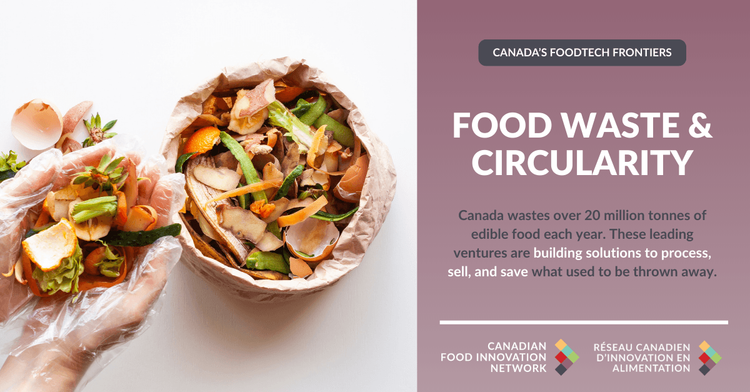
Few areas of food system transformation combine economic, environmental, and regulatory urgency quite like food waste. At every stage of the value chain—from farms to processing facilities, retailers to homes—Canada discards edible food at industrial scale. Every year, we toss out over 20 million tonnes of food intended for human consumption. That waste costs the economy an estimated $58 billion in lost value —the equivalent of nearly 3% of national GDP. It also generates more than 25 million tonnes of CO₂e in avoidable emissions annually , primarily from decomposing organic matter in landfills. That scale of inefficiency would be unacceptable in any other industry. Yet food loss was long treated as simply an inevita ble reality of a complex sector . But t hat’s changing fast. As landfill bans, methane targets, and food waste regulations tighten across provinces, waste is being repositioned as an unacceptable inefficency . And inefficiency means opportunity for innovation From bioprocessing by-products to smart composting systems and upcycled food ingredients, Canada is building the foundations of a new circular economy for food. And it’s happening just in time. Globally, the push to halve food waste by 2030 has made waste reduction an exportable capability. The EU, U.S., and Netherlands have each embedded food waste in their national circular economy strategies. Canada has both the regulatory momentum and the innovation pipeline to compete . The Frontier of Canadian Food Waste Innovation Food Waste and Circularity accounts for 12% of all CFIN project submissions to date and has received just over $2 million in awarded funding . That makes it a mid-tier domain by dollars but top three by activity, reflecting a clear and growing pull from industry. This domain’s breadth is part of the appeal: projects span smart kitchen tech, upcycled ingredients, decentralized composting, and waste-to-feed platforms. That diversity makes it one of the most cross-cutting areas in the entire foodtech landscape—and uniquely well-aligned with both sus tainability objectives and economic growth . Three of CFIN’s inaugural Foodtech Frontier 25 honourees focus on f ood waste and circularity , and together offer a snapshot of how Canadian i nnovation creating value: Crush Dynamics (Summerland, BC) turns discarded grape pomace—a winery waste byproduct—into functional food ingredients using a proprietary fermentation process that activates polyphenols and fibers. The result is a low-sugar input that enhances flavour , improves texture, and extends shelf life—giving manufacturers a performance ingredient with circular origins. Food Cycle Science (Ottawa, ON) produces the FoodCycler —a suite of residential and commercial appliance s that turn food scraps into a stable soil amendment. With over 250,000 units sold globally , and municipal programs across Canada, the company is proving that decentralized food waste recovery can reduce emissions by up to 75%, even in remote communities. RFINE Biomass Solutions (Halifax, NS) has developed an in-store drying system that converts spent coffee grounds into a shelf-stable raw material for food and feed. With pilots in major chains and a manufacturing partner in place, RFINE is turning one of Canada’s most common foodservice waste streams into a commercial circular input . Investment Momentum in Food Waste and Circularity Across all domains, CFIN-funded projects have leveraged $23.3 million in public support into more than $82 million in follow-on private investment—a multiplier that holds true in the food waste and circularity space. Crush Dynamics has raised more than $3.6 million in seed funding from private investors. Subsequent CFIN funding and project support focused on commercialization, enabling the company to expand production, validate performance in national food applications, and form strategic industry partnerships—including a collaboration with Purdys Chocolatier to reduce sugar in chocolate products. Food Cycle Science secured a major strategic growth investment from Power Sustainable Lios, one of Canada’s leading agrifood-focused private equity firms. This follows the company’s municipal pilot success and rapid product deployment, supported in part by CFIN . RFINE Biomass Solutions recently closed a $1.7 million oversubscribed equity round , bucking a broader decline in early-stage funding across Canada. The raise positions the company to accelerate commercialization and pursue additional non-dilutive funding. These ventures used early CFIN support to unlock investor confidence, accelerate commercialization, and close critical capital gaps. They all show a different facet of circularity in action: industrial byproduct upcycling, decentralized food waste recycling at both the consumer and municipality-level , and foodservice waste-to-resource conversion. What Comes Next If circular food innovation scales as envisioned, it will reshape the economics of waste, not just reduce it. Marginal byproducts will be reimagined as profitable outputs. Disposal costs become revenue opportunities. And emissions tied to waste will shrink in parallel . However, the pace of adoption still lags the pace of innovation. Infrastructure isn’t evenly distributed, procurement is slow to adapt to new processes and ingredients , and regulatory clarity remains patchy across provincial and municipal jurisdictions . Despite these frictions, the trajectory is clear. Venture-backed companies like Food Cycle and Friendlier are reaching industrial scale and deploying solutions in Canada and abroad , m unicipal programs are proving the economics of investing in decentralized waste recycling , c ommercial buyers are showing early signs of demand for circular ingredients and inputs. Food waste is no longer treated as an inevitable cost of doing business , but rather an opportunity for innovation—as space where waste is simultaneously reimagined into economic growth and environmental progress.