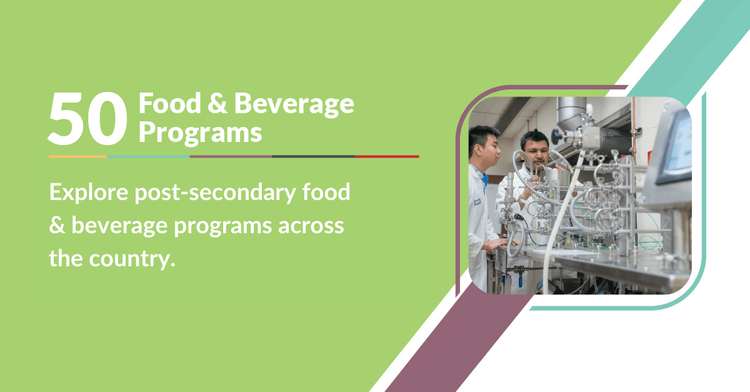
Canada is home to a diverse and dynamic food and beverage industry, supported by educational programs that train the next generation of chefs, brewers, entrepreneurs, and innovators. This roundup highlights 50 standout programs across the country, from top culinary schools and hospitality management courses to cutting-edge research initiatives and sustainability-focused training. Whether you're an aspiring professional, educator, or industry enthusiast, these programs provide valuable insights into the evolving world of food and drink in Canada. BC & Yukon Vancouver Community College UBC BCIT LaSalle College (Vancouver) UBC: Food, Nutrition, and Health Okanagan College Vancouver Island University University of Fraser Valley Northern Lights College North Island College Yukon University Selkirk College Thompson Rivers University Kwantlen Polytechnic University Prairies Saskatchewan Polytechnic University of Alberta University of Saskatchewan University of Manitoba SAIT NAIT Manitoba Institute of Trades & Technology International College of Manitoba Ontario Niagara College Humber College Le Cordon Bleu Ottawa George Brown College Fanshawe College Brock University University of Guelph Toronto Metropolitan University Loyalist College Georgian College Conestoga College Durham College Centennial College Canadore College Algonquin College Trent University St. Lawrence College St. Clair College Sault College Lambton College Confederation College Quebec McGill University LaSalle College Bishop's University Atlantic Canada University of PEI Memorial University Cape Breton University
Community Manager-
50 Food & Beverage Programs - Vancouver Island University
Crafting a Career in BC ’ s Wine Industry: VIU ’ s Wine Business Program The Wine Business program at Vancouver Island University is a comprehensive one-year certificate course designed for those passionate about pursuing a career in the BC wine industry. The program combines practical experience with academic learning in viticulture, wine business practices, marketing, and tourism. Program Highlights: As a student, you ’ ll have the chance to immerse yourself in hands-on experiences at local vineyards and wineries, gaining insights into the entire winemaking process. This practical foundation is then complemented by academic courses in viticulture, wine business practices, marketing, and tourism. A standout feature of this program is its flexibility. Whether you ’ re looking to study full-time for a year or prefer a part-time option spread over two years, VIU has you covered. Located in picturesque Nanaimo, BC, VIU provides an ideal setting for your wine education journey. With a curriculum designed to integrate viticulture essentials with business acumen, VIU ’ s Wine Business program offers a holistic understanding of the wine industry. Students can also earn credits that can be applied toward a Bachelor of Business or a Hospitality and Tourism Management program, opening doors to a wide range of future career prospects. The program includes seven courses and focuses on the broader aspects of the wine industry. In addition to viticulture and winemaking, students delve into wine marketing, exporting, and the vital role of wine tourism. C ourses cover a wide spectrum, from wine marketing and appreciation to beverage theory and the management of wine tourism. The program also offers elective courses in consumer behavio u r, entrepreneurship, and festival management . What You’ll Leave With: Upon graduation, a world of opportunities awaits you in BC ’ s wine industry. Whether you dream of managing a vineyard, excelling in wine s ales and marketing, or even opening your own restaurant, VIU ’ s Wine Business program provides the knowledge and skills to make your wine-related ambitions come true. Career options span winery/vineyard management, retail sales, wine marketing representation, hotel management, culinary arts, a gri - tourism development, and s pecial events coordination. V ideo/Social / Media : VIU YouTube Video
Community Manager-
Cellular Food in Canada
The past few years have proven how susceptible Canada’s food industry is to world events, supply chain disruptions and climate changes. New food production technology, such as cellular agriculture, has the potential to alleviate some of these challenges, while creating commercial opportunities and building a more sustainable, resilient food system. What is it? Cellular food – also known as engineering biology, synthetic biology or cell-cultivated products – is the production of food and textile products without using animals or land. Cell cultures harvested from animals, plants or micro-organisms are grown in the lab through tissue engineering or precision fermentation to produce: Cultivated proteins such as chicken, beef and seafood Fermented products like dairy, eggs, honey and chocolate Ingredients to add to products to create hybrid foods including proteins, enzymes, flavour molecules, vitamins, pigments and fats Textiles such as leather, silk and wool Why you should care As global population continues to grow, so does demand for protein, while access to land and other resource inputs become more scarce. Alternative agriculture could be an answer to food scarcity, concerns about animal and environmental welfare, cost inflation and resource challenges due to climate change. Compared to conventional agriculture, cellular agriculture production, is much less energy intensive, produces less greenhouse gas emissions, and has a much lower overall carbon footprint. With our strong food infrastructure, reputation for food safety, biotechnical expertise, and federal support for alternative protein production, Canada is well positioned to become a leader in cellular agriculture. The 2021 report Cellular Agriculture: Canada’s $12.5 Billion Opportunity in Food Innovation from Ontario Genomics and the Food and Agriculture Institute at the University of the Fraser Valley found that the international cellular agriculture market will reach US$100 billion by 2032. Canada’s food industry has the potential to take $12.5 billion that market, while creating up to 142,000 high-paying jobs. Opportunities in Canada Engineered plant proteins are already in the Canadian market, and by all estimates, precision fermented products are expected to appear before cultured meat products. Current Canadian regulations consider food produced through cellular agriculture as a novel food, and products are approved on a case-by-case basis. Here are a few Canadian start-ups making headlines: Because Animals – This Toronto-based pet food company uses cultured ingredients such as probiotics and nutritional yeast to create nutrient-rich cat and dog food designed to help digestive issues. Future Fields – Edmonton, AB-based Future Fields is a R&D producing growth media products that can be used to create commercialized cultivated proteins in a safe and sustainable manner. Cell-Ag Tech – Toronto’s Cell-Ag Tech is doing R&D on cell-cultured fish and seafood. New Harvest International non-profit research institute New Harvest , which promotes the science behind cultured meat through research, funding and a conference , now has a Canadian branch.
Community Manager-
Other Articles
Friday Food Innovation Round-Up – August 8
Tariffs may be back on the menu, but Canadian food innovators aren’t slowing down. From a first-of- its -kind alt-dairy deal to fresh market entry pathways into Asia, h ere’s what’s been making headlines over the past two weeks: 📉 New U.S. tariffs target non-USMCA Canadian goods, raising select food costs 🌱 APAC market-entry program opens for Canadian plant-based brands 🥛 First-ever commercial deal for cell-based dairy between Opalia and Hoogweg t 🏭 Maniob a food processors get $6M investment to modernize operations Let’s dive in! Canada–U.S. Trade Brief: Tariffs Hit Home as Food Sector Braces for Fallout Breaking down what’s changing in Canada-U.S. relations —and what it means for Canad a’s food sector. What’s the Latest The U.S. has implemented a 35% tariff on Canadian goods outside USMCA coverage, effective Aug 7, following a transition period for in-transit shipments. While the majority of agrifood trade remains tariff-free under USMCA, non-qualifying packaged goods, specialty ingredients, and certain dairy-adjacent products are now in the crosshairs. What You Should Know Most Canadi an food exports still avoid tariffs under USMCA, but the affected categories could see higher costs and tighter margins. Price pressure will be most acute in specialty packaged goods, ingredients, and premium imports where margins are already thin. Producers and processors should audit HS codes, supplier origin documentation, and rules-of-origin compliance now to confirm tariff-free status. Key Takeaway Expect targeted disruption rather than a sector-wide freeze. Still, the shift adds friction for some exporters and creates urgency to hedge with new markets and supply chain resilience. 💡 Food Innovation News Opalia Announces "First Ever" Commercial Supply Agreement for Cell-Based Dairy Montréal’s Opalia has signed what is being called the first commercial supply agreement for cell-based dairy ingredients with Dutch giant Hoogwegt . Starting in 2026, cultured milk components from Opalia will be integrated into Hoogwegt’s development pipelines, marking a milestone in bringing alt-dairy from lab to market. Protein Industries Canada Initiative to Help Canadian Plant-Based Companies Enter Asia-Pacific PIC and Singapore’s Nurasa have unveiled a new pathway into Asia-Pacific for Canadian plant-based brands. The program will help companies adapt products for regional tastes, navigate regulations, and connect with Nurasa’s extensive distribution network. Applications for the first cohort are open now . Manitoba Food Processors Granted $6M to Modernize Facilities The governments of Canada and Manitoba are providing over $6 million through the Sustainable Canadian Agricultural Partnership (Sustainable CAP) to modernize food processing facilities across the province. Nineteen approved projects will add new equipment, expand production lines, and adopt technologies that improve efficiency and environmental performance, strengthening jobs and resilience in Canada’s food supply chain. 💰 New Opportunities CFIN is currently accepting applications for three different foodtech funding programs: Innovation Booster (applications close August 12th, 2025) Innovation Scouting Fund (applications close August 30, 2025) Ontario Food Technology Pilot (Intake 1 applications close September 11, 2025) 🛠️ Job Openings Here’s a few cool food innovation jobs that popped up recently: Inside Sales Development Representative – LuminUltra – Fredericton, NB R &D Manager – Sweets from the Earth – Toronto , ON Have an open position you’re looking to fill? Be sure to post it on the Food Innovator Career Hub ! 🌟 Highlights from YODL Catch up on this week’s top YODL conversations … Free access to AI tool to automate CFIA labels and costing - CFIN Member offer Call for partnership, alternative proteins and bio-based ingredients Do you have something worth including in our next Friday Food Innovation Roundup? Reply to this post to let us know about your news, events, or job openings! Thanks for reading!
Community Manager-
In 30: Roundup of Personalized Nutrition Articles
Sometimes, all it takes is 30 minutes to learn the ins and outs of new food technologies and trends that are transforming the food and beverage industry. In this series, we dig into a food innovation topic and link you to content and resources so you can become a master on the topic in 30 minutes (or less!). We’ve dug deep into the topic of personalized nutrition . Here’s a roundup of the top original content published on the topic. Company Profile – Nutrigenomix Toronto, ON-based Nutrigenomix specializes in personalized nutrition through nutrigenomics, the study of genes and how they interact with diet. Company Profile – Nutri m eals Calgary, AB-based Nutrimeals Inc. offers healthy, ready-to-eat meals incorporating personalized nutrition and fitness requirements and delivers them to customers through a monthly subscription service. Explained: Personalized Nutrition With greater awareness of how nutrients affect them personally, customers will be increasingly looking for solutions tailored to their specific needs. 50 Canadian FoodTech Resources – INAF’s In Vitro Digestion Platform The In Vitro Digestion Platform , part of INAF (Institute of Nutrition and Functional Foods) at Laval University in Quebec City, QC studies the impact of the digestion system on bioactive compounds. 50 Canadian FoodTech Resources – Richardson Centre for Food Technology and Research The Richardson Centre strives to advance food quality and human nutrition through traditional and innovative food processing techniques. Food as Medicine The concept of food as medicine is growing in popularity with consumers, leading innovators to develop software, ingredients, and products that aim to improve health and wellness. The Future of Food as Medicine in Canada CFIN’s Dana McCauley , CEO, Alex Barlow , Vice President of Programs, and Lavina Gully , Regional Innovation Director for BC and Yukon, discuss the future of personalized nutrition. Post-Secondary Food Research A look at some of the food, foodtech and food-related work taking place at research centres and departments of post-secondary institutions in Canada. This is just a small sample of the fascinating projects underway across the country.
Community Manager-
How Innodal Extends Shelf Life Without Extending Food Labels
Consumers increasingly expect meat to be fresh, safe, and minimally processed. Retailers, meanwhile, are trying to keep displays full without driving up shrink, recalls, or markdowns. Meeting both goals usually involves tradeoffs—but Quebec-based startup Innodal is working on a way to reduce spoilage and extend shelf life in a way that meets clean-label expectations without altering ingredient declarations. Innodal received a $49,750 Innovation Booster grant from CFIN in December 2024 to advance its encapsulated peptide platform for red meat. The company’s technology uses naturally occurring proteins—known as antimicrobial peptides—to inhibit the growth of spoilage and pathogenic bacteria. These peptides are approved in Canada and the U.S. for food use and are classified as processing aids —meaning they play their role during production, but don’t remain active in the final product. Shelf-Life Extension that Meets Clean-Label Expectations Innodal’s lead product line, INNEO , is built for food brands and retailers looking to improve shelf life and reduce spoila ge without relying on synthetic preservatives or long ingredient lists. Because INNEO peptides are used as processing aids, they don’t require labeling , offering a solution that supports clean-label strategies without compromising transparency or regulatory compliance. This makes them especially valuable in fresh red meat, where maintaining product quality and meeting consumer expectations can be difficult to balance. Engineered for Seamless Integration INNEO peptides are designed to complement existing preservation strategies, such as modified -atmosphere packaging and cold-chain controls. By encapsulating the peptides, Innodal enhances their stability and ensures they deliver targeted antimicrobial activity at the right stage of production. This allows processors to incorporate INNEO without overhauling equipment, packaging, or workflows—offering a practical solution that strengthens shelf life without adding complexity. What the Project is Testing With CFIN support, Innodal is conducting applied R&D on how INNEO performs across different red meat formats and packaging conditions. The project will evaluate microbial reductions, added shelf life, and potential impacts on flavour , texture, and colour . The team is also optimizing dosage and cost-in-use to meet processor and retailer needs. Why it Matters Reduces shrink and spoilage : Even modest extensions in display life can significantly lower returns and markdowns, especially for high-value fresh cuts. Supports clean-label strategies : INNEO provides a non-synthetic option that aligns with modern consumer expectations—no tradeoffs between food safety and simplicity. Regulatory-ready : INNEO peptides are already approved in both Canada and the U.S., reducing time-to-market for processors and exporters. What’s Next for Innodal Innodal will continue optimizing its red meat applications through 2025, with commercial pilots planned thereafter. By offering a new layer of protection that works with clean-label goals, the company is helping meat processors and retailers keep products fresher, longer, with less waste and fewer compromises.
Community Manager-
Friday Food Innovation Roundup – July 25, 2025
Trade tensions are back in the spotlight, but that hasn’t slowed the pace of Canadian food innovation. From multi-million-dollar raises to new protein partnerships and functional food breakthroughs, the sector is pressing forward with resilience and momentum. Here’s what’s been making headlines over the past two weeks: 📉 Trade tensions threaten to upend produce access, dairy exports, and input costs 💰 Major raises for omega-3 innovation, upcycled packaging, and functional chocolate 🥤 A $48.7M pea protein initiative focused on aging nutrition and ingredient scale-up 🛠️ New job openings across R&D, product development, and sales in food innovation Let’s dive in! Canada–U.S. Trade Brief: Tariff Brinkmanship Raises Stakes for Food Supply Chains Breaking down what’s changing in Canada-U.S. relations —and what it means for Canad a’s food sector. What’s the Latest Canada–U.S. trade tensions have escalated dramatically —again . President Trump is threatening to impose a 35% blanket tariff on Canadian imports by August 1 if a new deal isn’t reached , raising the prospect of widespread disruption. Negotiations are ongoing, but both sides remain far apart on key issues like dairy market access, procurement rules, and enforcement mechanisms. Canada has paused retaliatory tariffs and removed a planned digital services tax in a bid to cool tensions. Still, supply chain uncertainty is growing —and food and produce sectors are warning of price hikes and product shortages if a deal isn’t struck in time. What You Should Know Dairy and produce are flashpoints: The U.S. wants more access to Canada’s tightly controlled dairy market, while Canadian officials insist supply management is non-negotiable. Meanwhile, the North American produce industry has warned that tariffs could destabilize fresh food access, hike prices, and hurt consumers on both sides of the border. Procurement and policy tools are in play: Canada’s new Interim Policy on Reciprocal Procurement Policy allows it to block U.S. companies from federal contracts if Canadian firms aren’t given equal access—adding another layer of tension. Small businesses are also feeling the pinch, with nearly two-thirds expecting conditions to worsen if tariffs take effect. Key Takeaway The Canada–U.S. trade relationship is teetering on the edge. If no deal is reached by August 1, tariffs could reshape food supply chains, raise costs, and squeeze small businesses. While cross-border integration remains strong, food and agri-food firms should prepare for volatility—and watch closely for a n increasingly unlikely last-minute breakthrough. 💡 Food Innovation News Mara Renewables Raises $9.1M from S2G to Scale Algae-Based Omega-3 Platform Halifax-based Mara Renewables has raised US$9.1 million from S2G Investments to expand its algae-based omega-3 production for human and animal nutrition. Using precision fermentation, Mara’s algae-derived omega-3 oils offer a scalable, traceable, and sustainable alternative to fish-based DHA. The funding will deepen R&D, grow global manufacturing partnerships, and help offset pressure on wild fisheries . Mara’s 2024 output alone replaced the equivalent of 6.7 billion anchovies . Tydra Labs Wins $100K at Startupfest for Seafood Waste Innovation Vancouver-based biotech startup Tydra Labs has won the $100,000 Women in Tech prize at Montréal’s Startupfest for its breakthrough technology that transforms seafood waste into high-value sustainable materials. The company’s platform upcycles byproducts from shellfish processing into biodegradable alternatives to plastic packaging. Protein Industries Canada and Louis Dreyfus Partner on $48.7M Pea Protein Initiative Protein Industries Canada has partnered with global agri food merchant and processor Louis Dreyfus Company and Seven Oaks Hospital Chronic Disease Innovation Centre (CDIC) on a $48.7 million project to develop novel pea protein ingredients and healthy food products. The initiative will create high-protein, easy-to-consume foods targeted at aging populations while supporting the buildout of a new pea protein processing facility in Yorkton, Saskatchewan . Awake Chocolate Raises $8M to Scale Functional Snack Innovation Toronto-based functional food brand Awake Chocolate secured $8 million in growth funding to support supply chain expansion, product innovation , and marketing of its caffeine-infused chocolate line . The round was led by Btomorrow Ventures, with participation from BDC Capital, bringing Awake’s total funding to $15.5 million. The company will use the capital to accelerate R&D and advance their position in the fast-growing functional snack food category. 💰 New Opportunities CFIN is currently accepting applications for three different foodtech funding and support programs: Unpuzzling: Foodtech Ontario ( applications close August 5th, 2025 ) Innovation Booster (applications close August 12th, 2025) Innovation Scouting Fund (applications close August 30, 2025) 🛠️ Job Openings Here’s a few cool food innovation jobs that popped up recently: Sales & Marketing Coordinator / Executive Assistant – Crush Dynamics – Remote Research Chef - Frozen Yogurt & Ice Cream Product Innovati – Yogen Früz – Markham, ON R&D Assistant (Food Science) – New School Foods – Toronto, ON Innovation Manager – Nature's Way Canada – Dartmouth, NS (Hybrid) Have an open position you’re looking to fill? Be sure to post it on the Food Innovator Career Hub ! 🌟 Highlights from YODL Catch up on this week’s top YODL conversations … Purification Challenges in Food Processing Wanted: formulator & coman partner for functional / sports nutrition powders C4C IP Corner: Precision Fermentation Ingredients Set for Explosive Growth Do you have something worth including in our next Friday Food Innovation Roundup? Reply to this post to let us know about your news, events, or job openings! Thanks for reading!
Community Manager-
In 30: YODL
Sometimes, all it takes is 30 minutes to learn the ins and outs of new food technologies and trends that are transforming the food and beverage industry. In this series, we’ll dig into a food innovation topic and link you to content and resources so you can become a master on the topic in 30 minutes (or less!). This week, we’re looking at everything CFIN members can do on YODL. The Overview CFIN now has more than 7,000 members (and growing) , including food and beverage processors, distributors, retailers, funders, innovators, regul ators and researchers from all areas of Canada . One of the benefits of becoming a member is access to YODL, our interactive online platform. Here’ s just a taste of what you’l l find on YODL: Original d aily content covering food industry news, foodtech resources , and information on topics such as cellular food , automation and robotics , personalized nutrition , removing plastics waste , and digitization . O nline events that showcase how innovation is transforming the food value chain , including Cultivating Success: Canada's Big Biomanufacturing Opportunity and Robotics in Action -- Seeing is Believing! Profiles of CFIN member companies and individuals . Guest posts and interview s with industry specialists in packaging , marketing, food law , arti ficial intelligence and more. Funding opportunities for food innovators through a range of CFIN programs. N etworking , mentoring , sourcing , and collaboration opportunities with other food and beverage professionals through our discussion forum. Access to one of our five Regional Innovation Directors located across the country , who can c onnect you with funding and partnership opportunities to help grow your business and innovation capacity. Lively discussion posts from members , RID s, and CFIN staff. An open community of food and beverage professionals sharing ideas and solutions. YODL is also bilingual – simply toggle between French and English on the widget located at the bottom right of the site. Additional R esources YODL offers two member-exclusive tools: a Funding Finder featuring federal, regional and provincial funding opportunities available across Canada, and a Resource Finder , offering more than 2,000 food-related products and services. CFIN members are using the finder resources to find funding, source ingredients and find supply partners and co-packers. Get Involved CFIN members have automatic access to YODL. Becoming a member of CFIN takes less than five minutes and is free! Find out how to sign up here . Or click here to learn more about CFIN. Overtime If you’ve got more than 30 minutes, these are for you: YODL – Guest Post: How Networking on YODL Led to a New Career Path and the Growth of Ontario's Laplace Robotics Read how two CFIN members met on YODL to establish a n innovative robotics business. YODL – Meet YODL! Find out more about our one-of-a-kind online platform. YODL – Le RCIA innove avec de nouveaux outils pour ses membres Julie Daigle, Directrice régionale pour le Québec, présente quatre fonctionnalités uniques à la plateforme YODL, dont deux nouveaux outils de recherche de financement ou de ressources en soutien aux innovateurs alimentaires canadiens.
Community Manager-
Turning Prairie Berries into Evidence-Backed Wellness Solutions
Alberta-based haskalife ™ is scaling its ambitions—from producing delicious haskap powders and shots to pioneering clinical-grade research on the berry’s benefits for women’s health. Backed by a $50,000 Innovation Booster grant from CFIN , the company is accelerating work on validation and ingredient development rooted in its farm-to-ingredient model. A Canadian Berry with Untapped Potential Haskap berries—the deep-purple fruit also known as honeyberry—are celebrated for their rich anthocyanin content, reportedly up to four times higher than blueberries, and prized for their antioxidant and anti-inflammatory properties. Partnering with Prairie Hill Farms, haskalife combines h igh- p ressure p rocessing and freeze-drying techniques to retain nutrients and flavour , delivering single-ingredient powders and juice shots. Building Science-Backed Clean-Label Ingredients With CFIN funding, haskalife is now expanding beyond food products into clinical validation. The company is preparing a placebo-controlled trial focused on women aged 35+, designed to test the impact of its Pure Haskap Berry formulation on cardiovascular and cognitive markers. Trial results are expected this year . This initiative brings together academic and clinical partners including the University of Manitoba, Chronic Disease Innovation Centre, Alberta’s Bio Processing Innovation Centre and Alberta Food Centre, and Dr. Eldon Smith from the University of Calgary’s Libin Cardiovascular Institute’s Strategic Advisory Board. Canadian- G rown, G lobally R elevant haskalife is fully vertically integrated—growing, processing, and packaging all within Alberta. Its CanadaGAP -certified farm-to-ingredient approach ensures traceability, sustainability, and quality control from field to functional product. The berry powders are already available in major grocery outlets across Alberta and online. Unlocking Value for Consumers, Brands, and Growers Targeted wellness : Women over 35 are often overlooked in supplement development—this trial could unlock credible, berry-based cardiometabolic and cognitive support tailored to their needs. Market differentiation : A clinically validated ingredient sourced entirely from Canadian-grown haskap helps nutrition brands stand out amid scrutiny over health claims. Grower opportunity : As demand for functional nutrition ingredients grows, haskalife’s success opens new markets for Prairie haskap producers. What’s N ext for haskalife haskalife is completing its clinical trial in 2025, aiming to translate results into validated ingredient claims and new product formats by late 2026. If successful, the company will offer a uniquely Canadian, science-backed superberry ingredient in a market hungry for clean-label, evidence-backed wellness solutions.
Community Manager-
Inside Innovation Alley: Bridging the Gap Between Foodtech and Foodservice
In early April, more than 23,000 attendees f illed Toron to’s Ene rcare Centre for the 80 th annual RC Show — Canada's premiere foodservice and hospitality trade event . This year, they encoun tered something entirely new: Innovation Alley, a dynamic pavilion spotlighting Canadian foodtech innovators, presented by the Canadian Food Innovation Network (CFIN) . Marsha Druker, CFIN’s Regional Innovation Director for Ontario, brought this groundbreaking initiative to life , leveraging her expertise in community building and event planning to create a tightly curated foodtech showcase , where early-stage Canadian startups could gain exposure, gather feedback, and build relationships with decision-makers from across the foodservice industry. Druker’s talent for connecting people and ideas was honed through her earlier work , founding a speaker series and community that shares stories of professional failure, helping people embrace failure as a critical learning tool —and an essential part of ever y success story . She understands the power of creating space for purposeful connections and meaningful conversations better than anyone and recognized the opportunity to bring such a space to the RC Sho w , one that could help bridge the gap between groundbreaking food technologies and their adoption throughout the industry . This initiative began by offering exclusive, subsidized floor space to CFIN member companies—high-potential innovators developing solutions for the future of foodtech . Positioned in a prime, high-traffic area of the show near the speaker stage, Innovation Alley gave these companies a platform to connect directly with foodservice operators and industry leaders. "Innovation Alley was about accelerating tech adoption in a sector that’s under constant pressure to adapt," says Druker. "We knew that making it easier for emerging companies to engage with the right audience could help operators discover solutions to their most pressing challenges.” Those challenges include rising costs, staff shortages, unreliable supply chains, and mounting pressure to reduce waste and meet sustainability targets. Operators are actively searching for tools that could help them stay competitive while navigating those challenges. And they found them in Innovation Alley. One of the startups that stood out was Ask JADA, an AI-powered virtual assistant designed to streamline restaurant operations by managing incoming calls and texts. Founder Lara Tiu described participating in Innovation Alley as transformative, noting the direct business outcomes that came from the event. "We actually signed a big customer thanks to the show, and have quite a few good leads lined up," she said. "We’re immensely grateful for the exposure and the chance to network with industry professionals. It was also a privilege to connect with our fellow exhibitors." Join the Community! Food Cycle Science also turned heads with its FC-75 food cycler—a compact, user-friendly device that rapidly converts food waste into nutrient-rich soil amendment . Developed in part through a CFIN-funded project, the FC-75 offered operators a practical and sustainable solution to managing food waste directly within their kitchens . "We were very proud to be under the CFIN banner in Innovation Alley, showcasing the FC-75 technology that our CFIN project helped bring to life ,” CEO Bradley Crepeau said. “ The response has been tremendous, and we’re excited to be pushing forward toward mass production." In addition to Ask JADA and Food Cycle Science , a r emarkably wide range of technologies were on display , each tackling different but equally urgent challenges in foodservice . Companies l ike Still Good Foods, RFINE Biomass Solutions, and New School Foods stood out for their focus on sustainability , whether through upcycl ing food waste or plant-based, whole cut seafood products . Others focused on improving operational efficiency , customer experience , and delivery. BUBS, a food delivery robot from Real Life Robotics, delighted crowds by autonomously navigating the event floor. Together, they reflected the broad potential for innovation throughout the industry. Innovation Alley gave these pioneering solutions high visibility among executives, investors, restaurateurs , and other key industry players . "The companies we brought in are doing some truly exciting work," says Druker. " We wanted to put them in front of the right people. It’s one thing to have a great solution , but when you connect with someone who can help bring it to life, that’s when things really start to happen." Innovation Alley’s debut at the RC Show reflects how the foodservice industry at large is beginning to view technology adoption not as a novelty or optional luxury , but as a necessity for staying resilient and competitive . For many attendees , it was a first encounter with foodtech solutions that can help them address immediate operational challenges and attract new customers . Druker’s community bui lding exp ertise shaped the initiative into something far more than a trade show and played a critical ro le in facili tating connections—bridging the gap between foodtech innovators and adopters . As the industry faces mounting pressure to do more with less, initiatives like Innovation Alley show how targeted exposure and sector-specific engagement can foodservice tech adoption and help both operators and startups thrive in a n increasingly demanding and rapidly changing business landscape. Join the Community!
Community Manager-
Catch Up: Sustainability in Food Webinar Recording Now Available
Missed last week’s Sustainability in Food: Practices and Progress session? You can now watch the full recording . The panel—featuring leaders from CarbonOne , Quantify Environmental , and E nviro-Stewards —shared what they’re seeing on the ground: where sustainability efforts stall out, how to measure impact without overcomplicating things, and what’s actually working inside food business es. You’ll hear: Why some carbon reporting frameworks fail food businesses—and what to do instead How to find overlooked sources of waste in energy, water, and materials How to move sustainability beyond pilot projects and into core operations If you’re in the middle of an ESG rollout or trying to build one that won’t get shelved, this is a valuable hour . Watch it here . Sign Up for Future Webinars Want to keep exploring complex industry topics? Check out our Events Page to sign up for upcoming webinars or in-person events in your region.
Community Manager-
Friday Food Innovation Roundup – July 11, 2025
The fireworks didn’t stop with Canada Day—Canadian foodtech has been lighting up the news cycle. From big investments to cross-border deals, there’s been plenty of action to start the summer. Some highlights from the last 2 weeks include : 💰 New funding call for Canadian foodtech ventures 💡 U.S. investors double down on Canadian foodtec h ♻️ Circular food waste startup gets a growth-stage lift 🛠️ A bevy of new food innovation job openings from coast to coast Let’s dive in! Canada–U.S. Trade Brief: Cross-Border Investment Fuels Canadian Foodtech , Despite Trade Uncertainty Breaking down what’s changing in Canada-U.S. relations —and what it means for Canad a’s food sector. What’s the Latest Canada–U.S. trade negotiations remain unsettled. Tariff threats, dairy access disputes, and policy friction continue to dominate bilateral negotiations. While leaders have signaled progress on a new deal, the process remains uncertain. But amidst the uncertainty, cross-border investments, acquisitions, and new partnerships dominated this week’s food innovation news. Canadian companies including Fresh Prep, Area 52 , and Future Fields were all acquired by or received substantial investments from U.S.-based entities. What You Should Know Cross-border capital is reinforcing integration: U.S. investments in Canadian foodtech firms are deepening cross-border ties—supporting scale-up, enabling U.S. market access, and embedding Canadian innovations within North American supply chains. This integration continues even as trade negotiations remain unresolved. Canada’s growth-stage funding gap persists: While support for growth stage foodtech funding is growing through initiatives like FCC Capital’s $2-billion commitment , many Canadian companies still look to U.S. investors to bridge the scale-up phase. The surge in cross-border deals reflects both opportunity and an ongoing reliance on external capital to reach commercial maturity. Key Takeaway Even as formal trade relations stall, cross-border investment is accelerating integration in the food sector—highlighting both the strength of Canada-U.S. business ties and the need to strengthen Canada’s own investment capacity for scaling food innovation. 💡 Food Innovation News Fresh Prep Secures U.S. Investment to Expand Zero-Waste Meal Kits Vancouver-based meal kit company Fresh Prep has secured a major investment from U.S.-based SEMCAP Food & Nutrition to support its expansion into Ontario and Quebec. Known for its z ero- w aste meal kit innovation , Fresh Prep has grown to over C$100M in annual revenue. Future Fields Raises $8M to Scale Insect-Based Biomanufacturing Edmonton biotech startup Future Fields has raised US$8 million in an oversubscribed Series A round to expand production of its EntoEngine platform, which uses genetically modified fruit flies to produce proteins for cultivated meat, biopharma, and agriculture. Co-led by BDC ’s Climate Tech Fund , Toront o’s Amplify Capital, and Chicago-based R7 Partners, the raise highlights growing investor confidence in Canada’s bio-manufacturing capabilities and sustainable protein innovation. Fortifi acquires crustacean processing machine builder Area 52 New Brunswick seafood automation firm Area 52 has been acquired by Texas-based Fortifi Food Processing Solutions , a global player in automated equipment and automation solutions . Area 52’s robotics improve efficiency and safety in lobster and crab processing —t he deal will help bring their seafood automation technology to new international markets . Minus Waste Solutions Secures Growth Equity to Expand Circular Food Waste Platform Ontario-based Minus Waste Solutions has received a growth equity investment from the Canada Business Growth Fund to scale its food waste recycling operations. The company transforms food waste into animal feed, renewable energy, and other value-added products—positioning itself as a key player in Canada’s growing circular food economy. 💰 New Opportunities CFIN announced a new program for southern Ontario foodtech startups and opened applications for the latest round of our Innovation Booster program : Unpuzzling: Foodtech Ontario — Learn more and apply ( applications close August 5th, 2025 ) Innovation Booster — Learn more and apply (applications close August 12th, 2025) 🛠️ Job Openings Here’s a few cool food innovation jobs that popped up recently: Food Technologist Assistant – Lovingly Made – Calgary, AB Partner Growth Specialist – Too Good to Go – Toronto, ON Food Scientist - Agri-Food Innovation – Loblaw Brands – Brampton, ON Research Scientist – Freshr Technologies – Dartmouth, NS Lab Technician (Chemistry) – Freshr Technologies – Dartmouth, NS Have an open position you’re looking to fill? Be sure to post it on the Food Innovator Career Hub ! 🌟 Highlights from YODL Catch up on this week’s top YODL conversations … Automated Coffee Packaging Equipment? Global Consultant/Researchers Wanted Searching for Ready to Eat (RTE) Specialty Flours Do you have something worth including in our next Friday Food Innovation Roundup? Reply to this post to let us know about your news, events, or job openings! Thanks for reading!
Community Manager-
Going Global: Opportunities for Canadian Food Innovators in China
This post is part of our weekly spotlight on each market featured in Going Global: A Market Guide for Canadian Food Innovators . This week, we’re looking at China. China’s food system is changing fast. Recent years have brought sweeping new policies focused on food safety, traceability, sustainable packaging, and domestic supply security. For Canadian companies that can navigate the regulatory complexity, this is a high-potential market. There’s strong demand for shelf-stable, traceable, and eco-conscious products that serve a growing middle class. Canadian companies offering compliance-ready technologies in processing, packaging, or food safety may find an opening—especially when paired with trusted local partners. That said, this is not a plug-and-play market. Import rules are detailed, and government policies around domestic substitution and digital compliance are evolving. E-commerce platforms like Alibaba and pilot zones like Shanghai’s Free Trade Zone, are incre asingly common entry points for foreign firms. The full Going Global guide includes insights on: Trade and regulatory context, including MFN tariffs, Decree 248, and facility registration rules Key innovation opportunities in traceability, packaging, and s m a rt manufacturing In-market allies like the Bright Food Innovation Center and the Canadian TCS offices across China Want the full picture? Download the guide here and start exploring China’s growing food innovation ecosystem .
Community Manager-
Farmery Estate Brewery Finds New Potential in Spent Grain
In Manitoba’s Neepawa region, Farmery Estate Brewery has spent more than a decade building a rare kind of beer operation—one where the barley and hops are grown just steps from the brewhouse, and almost nothing goes to waste. Now, with support from a $50,000 CFIN Innovation Booster grant awarded in December 2024 , the brewery is taking the next step by exploring a new use for its biggest waste stream: brewing mash. The goal is to extract functional proteins and fibres from spent grain— valuable nutrients that typically go to waste. Exploring W hat’s Left in the Grain While brewers’ spent grain (BSG) is rich in protein and dietary fibre , it’s rarely used in human food. Farmery aims to change that through a research and development project focused on identifying —and testing—ways to extract these compounds from barley mash at small scale. Initial lab work is underway, focused on enzyme-based methods for extracting protein and peptides from spent grain, guided by current research in food science and brewing by-product applications. Later stages of the project will move from lab to brewhouse. If extraction workflows prove viable , Farmery plans to run pilot demonstrations on-site, validating results and refining processes before scaling further. The brewery's integrated operation—where ingredients are grown, processed, and brewed in one place—gives it a unique advantage when it comes to closing the loop. A Natural Fit for a Vertically Integrated Brewery Farmery already produces a surprising range of products beyond beer: malted sodas, hop-infused bath and beauty items, and barley-based energy drinks. The ability to unlock new food-grade ingredients from existing by-products fits squarely within the brewery’s ethos: to reduce waste, reuse what’s already on hand, and generate value without expanding its land base or supply chain. What Comes Next Farmery's CFIN-funded project runs through 2025 and includes a full series of lab experiments, prototype development, and early-stage product trials. If successful, the work could lead to small-batch production of new functional food or wellness ingredients—sourced entirely from Farmery’s own crops. By building on what they already grow and brew, Farmery is taking a practical step toward deeper sustainability—one that turns a familiar by-product into a homegrown ingredient with a new purpose.
Community Manager-
Going Global: Opportunities for Canadian Food Innovators in Singapore
This post is part of our weekly spotlight on each market featured in Going Global: A Market Guide for Canadian Food Innovators . This week, we’re looking at Singapore. Singapore is one of the most innovation-forward food markets in the world. With a national goal to produce 30% of its food domestically by 2030 and limited land or labour , the country has become a hub for high-efficiency, technology-driven solutions. Canadian companies working in traceability, sustainable packaging, precision fermentation , or functional ingredients will find a market that moves quickly, values IP, and opens doors across Southeast Asia. While Singapore’s domestic market is relatively small , it serves as a regional testbed. Success here often translates into commercial traction in surrounding ASEAN countries. The government also backs innovation through funding programs, tax incentives, and partnerships with accelerators and research hubs. The full Going Global guide includes insights on: Singapore’s trade and regulatory landscape, including its strong trade relationship with Canada Innovation opportunities in food safety, packaging, and clean-label products In-market partners like Enterprise Singapore and GROW Accelerator Want the full picture? Download the guide here and start building your Singapore expansion strategy.