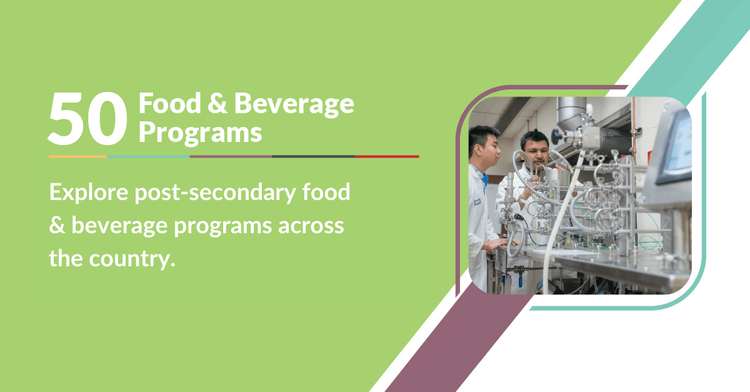
Canada is home to a diverse and dynamic food and beverage industry, supported by educational programs that train the next generation of chefs, brewers, entrepreneurs, and innovators. This roundup highlights 50 standout programs across the country, from top culinary schools and hospitality management courses to cutting-edge research initiatives and sustainability-focused training. Whether you're an aspiring professional, educator, or industry enthusiast, these programs provide valuable insights into the evolving world of food and drink in Canada. BC & Yukon Vancouver Community College UBC BCIT LaSalle College (Vancouver) UBC: Food, Nutrition, and Health Okanagan College Vancouver Island University University of Fraser Valley Northern Lights College North Island College Yukon University Selkirk College Thompson Rivers University Kwantlen Polytechnic University Prairies Saskatchewan Polytechnic University of Alberta University of Saskatchewan University of Manitoba SAIT NAIT Manitoba Institute of Trades & Technology International College of Manitoba Ontario Niagara College Humber College Le Cordon Bleu Ottawa George Brown College Fanshawe College Brock University University of Guelph Toronto Metropolitan University Loyalist College Georgian College Conestoga College Durham College Centennial College Canadore College Algonquin College Trent University St. Lawrence College St. Clair College Sault College Lambton College Confederation College Quebec McGill University LaSalle College Bishop's University Atlantic Canada University of PEI Memorial University Cape Breton University
Community Manager-
50 Food & Beverage Programs - Vancouver Island University
Crafting a Career in BC ’ s Wine Industry: VIU ’ s Wine Business Program The Wine Business program at Vancouver Island University is a comprehensive one-year certificate course designed for those passionate about pursuing a career in the BC wine industry. The program combines practical experience with academic learning in viticulture, wine business practices, marketing, and tourism. Program Highlights: As a student, you ’ ll have the chance to immerse yourself in hands-on experiences at local vineyards and wineries, gaining insights into the entire winemaking process. This practical foundation is then complemented by academic courses in viticulture, wine business practices, marketing, and tourism. A standout feature of this program is its flexibility. Whether you ’ re looking to study full-time for a year or prefer a part-time option spread over two years, VIU has you covered. Located in picturesque Nanaimo, BC, VIU provides an ideal setting for your wine education journey. With a curriculum designed to integrate viticulture essentials with business acumen, VIU ’ s Wine Business program offers a holistic understanding of the wine industry. Students can also earn credits that can be applied toward a Bachelor of Business or a Hospitality and Tourism Management program, opening doors to a wide range of future career prospects. The program includes seven courses and focuses on the broader aspects of the wine industry. In addition to viticulture and winemaking, students delve into wine marketing, exporting, and the vital role of wine tourism. C ourses cover a wide spectrum, from wine marketing and appreciation to beverage theory and the management of wine tourism. The program also offers elective courses in consumer behavio u r, entrepreneurship, and festival management . What You’ll Leave With: Upon graduation, a world of opportunities awaits you in BC ’ s wine industry. Whether you dream of managing a vineyard, excelling in wine s ales and marketing, or even opening your own restaurant, VIU ’ s Wine Business program provides the knowledge and skills to make your wine-related ambitions come true. Career options span winery/vineyard management, retail sales, wine marketing representation, hotel management, culinary arts, a gri - tourism development, and s pecial events coordination. V ideo/Social / Media : VIU YouTube Video
Community Manager-
Cellular Food in Canada
The past few years have proven how susceptible Canada’s food industry is to world events, supply chain disruptions and climate changes. New food production technology, such as cellular agriculture, has the potential to alleviate some of these challenges, while creating commercial opportunities and building a more sustainable, resilient food system. What is it? Cellular food – also known as engineering biology, synthetic biology or cell-cultivated products – is the production of food and textile products without using animals or land. Cell cultures harvested from animals, plants or micro-organisms are grown in the lab through tissue engineering or precision fermentation to produce: Cultivated proteins such as chicken, beef and seafood Fermented products like dairy, eggs, honey and chocolate Ingredients to add to products to create hybrid foods including proteins, enzymes, flavour molecules, vitamins, pigments and fats Textiles such as leather, silk and wool Why you should care As global population continues to grow, so does demand for protein, while access to land and other resource inputs become more scarce. Alternative agriculture could be an answer to food scarcity, concerns about animal and environmental welfare, cost inflation and resource challenges due to climate change. Compared to conventional agriculture, cellular agriculture production, is much less energy intensive, produces less greenhouse gas emissions, and has a much lower overall carbon footprint. With our strong food infrastructure, reputation for food safety, biotechnical expertise, and federal support for alternative protein production, Canada is well positioned to become a leader in cellular agriculture. The 2021 report Cellular Agriculture: Canada’s $12.5 Billion Opportunity in Food Innovation from Ontario Genomics and the Food and Agriculture Institute at the University of the Fraser Valley found that the international cellular agriculture market will reach US$100 billion by 2032. Canada’s food industry has the potential to take $12.5 billion that market, while creating up to 142,000 high-paying jobs. Opportunities in Canada Engineered plant proteins are already in the Canadian market, and by all estimates, precision fermented products are expected to appear before cultured meat products. Current Canadian regulations consider food produced through cellular agriculture as a novel food, and products are approved on a case-by-case basis. Here are a few Canadian start-ups making headlines: Because Animals – This Toronto-based pet food company uses cultured ingredients such as probiotics and nutritional yeast to create nutrient-rich cat and dog food designed to help digestive issues. Future Fields – Edmonton, AB-based Future Fields is a R&D producing growth media products that can be used to create commercialized cultivated proteins in a safe and sustainable manner. Cell-Ag Tech – Toronto’s Cell-Ag Tech is doing R&D on cell-cultured fish and seafood. New Harvest International non-profit research institute New Harvest , which promotes the science behind cultured meat through research, funding and a conference , now has a Canadian branch.
Community Manager-
Other Articles
Atlantic Canada’s Foodtech Frontier: Turning Regional Ingenuity Into Global Solutions
Atlantic Canada’s food sector has always punched above its weight, driven by resourcefulness and a focus on practical innovation. Its foodtech leaders are extending that tradition into new territory —from smart packaging to circular materials to autonomous service systems. The region’s Foodtech Frontier 25 winners are showing how small-market ingenuity can create globally relevant technologies. SmartSkin Technologies — Digital Twins for Smarter Packaging Lines Fredericton ’s SmartSkin Technologies has become a global leader in industrial sensing. Its patented “digital container” technology embeds pressure and motion sensors into replica bottles and cans, allowing beverage and food manufacturers to i dentify stress points along production lines. The company’s software platform converts that data into actionable insights to prevent damage, downtime, and waste. In August 2025, S martSkin secured $7.5 million in growth capital from CIBC Innovation Banking to accelerate global expansion into packaging, pharma, and food manufacturing. Impact: By digitizing how containers behave under real-world conditions, SmartSkin is helping global producers cut losses, improve efficiency, and extend the life of high-speed packaging equipment. Dispension Industries — Automating Beverage Service With Precision Robotics Based in Dartmouth, Nova Scotia, Dispension Industries is redefining beverage service through secure automation. Its SmartServ kiosks use advanced ID verification, contactless payment, and tamper-proof dispensing to serve canned beverages in under a minute—ideal for stadiums, arenas, and airports. Following successful pilots at the 2022 MLB All-Star game in Los Angeles and in Halifax’s Scotiabank Centre , the company is scaling manufacturing to meet growing demand from event operators seeking to improve speed, safety, and compliance. Impact: Dispension Industries is proving that automation can expand access and safety by redesigning service for scale, tracea bility, and trust. Freshr Technologies — Extending the Life of Fresh Protein Dartmouth -based Freshr Technologies is tackling spoilage through active packaging. Its FreshrPack film releases controlled antimicrobial compounds that slow bacterial growth and oxidation, extending the shelf life of fresh fish and meat by 15 to 30 percent. The coating, designed to bond with recyclable or compostable films, provides a sustainable alternative to chemical preservatives and heavy ice-pack logistics . This year Freshr close d on oversubscribed seed round before securing additional funding through CFIN’s Foodtech Next Program , helping them run pilot partners with industry partners and advance their commercialization efforts . Impact: Freshr Technologies is cutting food loss across the protein supply chain by extending shelf life at the source — helping retailers and distributors reduce shrink whi le keeping food out of the landfill. Infusd Nutrition — Making Nutrients Truly Soluble Halifax-based Infusd Nutrition is pioneering technology that makes insoluble nutrients such as omega-3 oils and curcumin fully water-dispersible. Its nanostructured encapsulation platform enables precise, shelf-stable nutrient delivery for functional foods and beverages. In April 2025, the company closed an oversubscribed US $2 million seed round led by NextGen Nutrition Investment Partners, with participation from Nourish Ventures (Griffith Foods) and Agthia Ventures. Earlier, in July 2024, Infusd announced a partnership with Natures Crops International to develop plant-based omega-3 ingredients. Impact: Infusd Nutrition is improving how functional foods are made by stabilizing nutrients that usually degrade or separate, allowing products to maintain quality and potency over time. RFINE Biomass Solutions — Turning Coffee Waste Into New Value Halifax-based RFINE Biomass Solutions is addressing the coffee industry’s waste problem by upcycling spent grounds into high-value materials. Its proprietary bioprocess converts coffee waste into natural additives and bio-based ingredients for agriculture and and food manufacturing. In September 2025, RFINE closed a $1.7 million equity round to scale production capacity and expand partnerships with Canadian roasters and foodservice chains. The company’s process reduces disposal costs by up to 80 percent and diverts organic waste from landfills. Impact: RFINE Biomass Solutions is creating commercial value from coffee waste by converting it into usable ingredients for food and cosmetics — helping cafes and restaurants turn a disposal cost into a secondary revenue stream. Atlantic Canada’s Foodtech Moment Atlantic Canada’s foodtech ecosystem reflects the region’s strengths: ingenuity, collaboration, and a commitment to doing more with less. Its innovators are tackling freshness, automation, and waste with practical, exportable solutions. By pairing scientific precision with hands-on problem-solving, these companies are helping build a cleaner, more efficient, and more resilient food system from the East Coast outward.
Community Manager-
Québec’s Foodtech Frontier: Engineering Innovation From the Ground Up
Québec’s foodtech sector is a compelling blend of biology , engineering, and design. Its innovators are creat ing innovative ingredients , AI -powered logistics platforms , and advanced automation systems to make the entire food value chain smarter, safer, and more sustainable. From microbial food safety breakthroughs to decentralized manufacturing, the province’s Foodtech Frontier 25 winners demonstrate how research-driven innovation can translate into transformative industrial progress. Qualtech — Building the Backbone of Sustainable Food Processing Québec City’s Qualtech remains a cornerstone of Canadian food manufacturing, designing and installing sanitary process systems for dairy, cheese, and beverage producers. Its expertise spans stainless steel fabrication, automation, and turnkey plant integration—skills that make it a quiet but critical part of the country’s agri-food infrastructure. Recent projects have focused on modular, resource-efficient process systems that help processors modernize while reducing energy use and waste. Qualtech’s engineering and fabrication divisions continue to expand across North America, positioning the company as both a service provider and technology partner. Impact: By engineering the systems that keep production clean, efficient, and compliant, Qualtech is proving that industrial sustainability starts with better process design. Bioeureka — Accelerating Food Safety With AI Montréal-based Bioeureka is transforming food safety testing through artificial intelligence. Its pathogen-detection platform identifies contaminants in minutes rather than days, replacing slow laboratory workflows with automated digital analysis. In October 2024, the company announced a partnership with the Montreal Institute for Learning Algorithms (Mila) to advance AI models capable of detecting foodborne pathogens from image and sensor data. The platform promises faster diagnostics, lower testing costs, and greater accessibility for processors and regulators seeking real-time insights. Impact: Bioeureka is redefining microbiological testing as an intelligent, data-driven process that strengthens food safety from farm to factory. DeepSight Réalité Augmentée — Turning Training Into Immersive Experience Laval’s DeepSight brings augmented reality to industrial training and maintenance. Its no-code AR platform allows food processors to build interactive, hands-on training modules that staff can follow through headsets or tablets directly on the production floor. DeepSight’s approach shortens onboarding, reduces errors, and preserves institutional knowledge in an industry facing chronic labour turnover. In September 2025, the company hit a major milestone as it closed a strategic funding round led by i4 Capital . The funds will help advance Deepsight’s commercial growth internationally and buil d on the capabilities of the ir VR platform . Impact: DeepSight is bridging the skills gap in food processing by transforming operational knowledge into live, visual instruction that improves consistency and efficiency. Innodal — Using Biology to Improve Food Safety Laval-based Innodal is pioneering natural antimicrobials that make food safer and cleaner. The company produces bacteriocins and protective cultures that suppress pathogens such as Listeria monocytogenes in ready-to-eat foods. Its flagship ingredient, Inneo , offers a natural alternative to chemical preservatives, extending shelf life while maintaining sensory quality. In 202 4 , Inneo received the Governor General’s Award for Innovation. It is the first ingredient of its kind to be approved by Health Canada and has since received FDA approval in the United States, accel erating Innodal’s expansion into international markets. Impact: Innodal is helping food manufacturers replace chemical preservatives with targeted biological solutions that raise safety standards and reduce environmental impact. Opalia — Reinventing Dairy Through Cell Agriculture Montréal’s Opalia is developing cell-based milk that reproduces the taste, texture, and functionality of traditional dairy without using animals. Its patent-pending fermentation process enables continuous production of milk components such as casein and fat in bioreactors. In August 2025, Opalia announced a commercial supply agreement with Hoogwegt , a major global dairy ingredient trader, and signaled plans for a US $4 million raise to scale production. The company’s work draws on Québec’s deep fermentation expertise and dairy legacy, positioning it as one of North America’s earliest cell-based dairy ventures. Impact: Opalia is redefining what it means to produce milk—shifting dairy from farm to fermenter while preserving quality and functionality. PULR Technologies — Tracking Freshness in Real Time PULR Technologies combines sensing, AI, and data analytics to help food companies monitor freshness and shelf life throughout the supply chain. Its RFID-enabled tracking platform collects temperature and handling data to predict spoilage before it occurs. In July 2025, PULR received funding from CFIN’s Innovation Booster to develop peptide-based sensors interpreted through machine learning, creating a non-invasive way to assess product condition. By giving processors and distributors real-time visibility into product quality, PULR helps reduce waste and optimize logistics . Impact: PULR Technologies is turning shelf life into a measurable, manageable variable—giving food companies the data they need to reduce waste and protect quality. Relocalize — Decentralizing Food Production Montréal-based Relocalize is redesigning food logistics through autonomous micro-factories. Each modular unit— essentially a robotic production plant inside a shipping container—can produce and package food directly at distribution centres , eliminating long-haul transport and refrigeration. The company raised CAD $5.8 million in May 2024, led by Desjardins Capital, following a US $2.5 million seed round the previous year. Relocalize’s first commercial deployments in packaged ice have demonstrated lower emissions, shorter supply chains, and improved responsiveness to local demand. Impact: Relocalize is proving that food manufacturing can be more localized, automated, and carbon-efficient— boosting food system resiliency by decentralizing production. Québec’s Foodtech Moment Québec’s foodtech ecosystem blends industrial pragmatism with scientific depth. Its leading companies are translating laboratory innovation into practical systems that solve real manufacturing problems. Whether through micro-factories, biological preservation, or AI-driven quality control, these innovators share a common mission: to make the food system cleaner, smarter, and more resilient.
Community Manager-
Friday Food Innovation Round-Up – October 17
Canada’s food innovators aren’t standing still. With new trade links in Latin America, emerging clean-label opportunities, and fresh capital for homegrown biotech, the sector is pushing into new markets and redefining what Canadian-made means on the world stage. Recent h ighlights included: 🌎 Canada expanded foodtech ties with Mexico 💡 Canadian foodtec h firms ma ke global Cleantech 50 to Watch List 🍄 Maia Farms secured $1.75 M from Genome BC 🧠 Cronomete r is hunting for its next food data mind in BC Let’s dive in. Canada Trade Brief: Canada Eyes Deeper Foodtech Ties with Mexico Breaking down what’s changing in global trade relations —and what it means for Canad a’s food sector. What’s the Latest Canadian innovators were in Mexico City earlier this month for the FoodTech Summit & Expo , Latin America’s largest showcase for food ingredients and processing technology. The Canada Pavilion—led by the BC Trade & Investment Office and the Trade Commissioner Service—featured companies such as EnWave , Maia Farms , and NutraEx highlighting sustainable processing technologies and clean-label ingredient solutions. The mission preceded Agriculture Minister Heath MacDonald’s visit to Mexico (Oct. 14–17) to advance the new Canada–Mexico Action Plan 2025–2028 , launched in September by Prime Minister Carney and President Sheinbaum to expand bilateral trade and innovation cooperation. What You Should Know Canada’s food export strategy is expanding beyond the U.S. corridor. Mexico and Latin America are emerging as critical next-market testbeds for Canadian clean-label, functional, and sustainable food technologies—markets large enough to scale and close enough to service. With the new Action Plan signaling enhanced political alignment and renewed trade mission activity, the region is becoming a promising entry point for Canadian businesse s ready to export innovative food sector solutions. At the regulatory level, Mexico’s front-of-pack labelling reform now requires clear black-and-white warning symbols on foods high in sugar, saturated fat, sodium, or calories. Since enforcement began in 2021, the rule has triggered a nationwide reformulation wave: Mexican CPGs are actively replacing ingredients, shortening labels, and seeking functional fibres , clean emulsifiers, and plant-based proteins to maintain product quality without exceeding nutrient caps. Regulators are now tightening the Phase 3 implementation which lowers tolerance thresholds and expands the scope to include sweeteners and additives—creating steady demand for clean-label performance ingredients and shelf-life solutions. Key Takeaway Mexico is rapidly becoming one of Canada’s next major food innovation markets — a nearshore hub hungry for clean-label ingredients, advanced processing, and sustainable tech. For Canadian foodtech firms, it’s the right time to look a little further south. 💡 Food Innovation News Dispersa and Lite-1 Make 2025 Cleantech 50 to Watch List Canadian foodtech startups Dispersa and Lite-1 were among the three Canadian companies named to this Cleantech Group’s 2025 Cleantech 50 to Watch List . The list spotlights “early-stage innovators from across the globe, creating groundbreaking solutions to address some of the world’s most pressing environmental and sustainability challenges.” Mycelium Ingredient Producer Maia Farms Receives $1.75M From Genome BC’s Industry Innovation Fund Vancouver’s Maia Farms received $1.75 million from Genome British Columbia’s Industry Innovation (I 2 ) Fund. The Fund, which provides repayable growth capital to SMEs working to commercialize life science technology-based products, will help Maia scale production of its mycelium protein ingredients and explore new manufac turing op portunitie s. Maple Leaf Spins Off Pork Division as Canada Packers Launches on TSX Maple Leaf Foods has spun off its pork operations into Canada Packers Inc., a new standalone company focused on production efficiency and global protein markets. Maple Leaf retains a 16% stake and a long-term supply agreement, allowing both companies to sharpen their focus—Canada Packers on advanced processing and cost innovation, and Maple Leaf on higher-margin, tech-enabled prepared foods and sustainability initiatives. The split is part of an ongoing shift across North America’s food sector: large processors streamlining commodity operations to make room for new investment in automation, ingredient science, and value-added innovation. 💰 New Opportunities Ontario Food Technology Pilot — Intake 2 Now Open The Ontario Food Technology Pilot provides non-repayable funding to help early-stage companies validate and demonstrate innovative food technologies developed in southern Ontario. This program is for incorporated businesses with annual revenues of no more than $5M who are ready to demonstrate a technology that is not yet commercialized . Deadline to apply for Intake 2 is Nov 6, 2025 🛠️ Job Openings Here’s a few cool food innovation jobs that popped up recently: Food Database Scientist – Cronometer – Revelstoke, BC Project Manager – Relocalize– Montreal, QC Recipe Innovation Coordinator – Real Food For Real Kids – Toronto, ON Program Lead – Venturepark – Calgary, AB Have an open position you’re looking to fill? Be sure to post it on the Food Innovator Career Hub ! 🌟 Highlights from YODL Catch up on this week’s top YODL conversations … Canada’s Foodtech Innovators Go Global at SKS Japan 2025 Ontario’s Foodtech Frontier: Innovators Defining the Next Era of Canadian Food The Prairies’ Foodtech Frontier: Precision, Practicality, and Scale Do you have something worth including in our next Friday Food Innovation Roundup? Reply to this post to let us know about your news, events, or job openings! Thanks for reading!
Community Manager-
British Columbia’s Foodtech Frontier: Sustainability Meets Scale
British Columbia continues to set the national pace for sustainable food innovation. From fermentation to packaging to process technology, the province’s Foodtech Frontier 25 winners are proving that environmental impact and commercial growth can advance together — and that the West Coast’s combination of science, design, and systems thinking is quietly reshaping how food gets made. EnWave — Drying Technology That’s Changing Global Supply Chains Vancouver-based EnWave has transformed one of food manufacturing’s oldest processes: dehydration. Its patented Radiant Energy Vacuum (REV™) technology uses controlled microwave energy under vacuum to dry foods rapidly at low temperatures, preserving nutrients, flavour , and structure while using significantly less energy than conventional methods. With more than 50 licensed partners across over 20 countries, EnWave’s systems are now used to produce everything from fruit snacks to dairy and pet food ingredients. The company’s success as a technology licensor — rather than a traditional food processor — has turned it into a quiet export engine for Canadian-made processing innovation. Impact : EnWave demonstrates that Canadian-built equipment can redefine manufacturing efficiency on a global scale — making food preservation cleaner, faster, and less wasteful. Fresh Prep — Pairing Circular Thinking With Meal-Kit Convenience Vancouver’s Fresh Prep began as a regional meal-kit service but has evolved into one of Canada’s most advanced direct-to-consumer food companies. With a new 80,000-square-foot facility in Burnaby and over 35 weekly meal offerings , Fresh Prep blends local sourcing, waste reduction, and proprietary packaging systems that dramatically cut single-use plastic. Its Zero Waste Kit , featuring reusable containers and returnable inserts, has saved millions of packaging items from landfill since 2022. Beyond sustainability, the company’s emphasis on chef-designed recipes and ultra-local logistics gives it an edge against multinational meal-kit competitors. Impact : Fresh Prep proves that convenience and circularity can coexist — and that regional meal production can compete nationally when paired with logistics innovation. Maia Farms — Building a Mycelium-Based Protein Platform Maia Farms is part of the vanguard shaping Canada’s alt-protein sector. The Vancouver company develops mycelium-derived ingredients designed to enhance the nutrition and texture of plant-based and hybrid foods. In 2024, Maia won the Canadian grand prize in the NASA–CSA Deep Space Food Challenge, recognized for its closed-loop fermentation system capable of producing nutritious biomass in limited-resource environments. That same year, the company secured additional funding through CFIN’s Innovation Booster program and raised $2.3 million in pre-seed funding to expand pilot production through partnerships with two CDMO facilities. Maia recently received additional support from Genome BC’s Industry Innovation Fund to accelerate commercialization. Impact : Maia Farms is showing how fungi can help close the global protein gap , transforming B.C. into a node of North America’s growing fermentation economy. Crush Dynamics — Upcycling Wine Waste Into Functional Ingredients In Penticton, Crush Dynamics is transforming wine industry byproducts to create the next generation of functional ingredients. The company ferments grape pomace — the skins and seeds left after pressin g — into natural compounds that enhance f lavour , extend shelf life, and reduce sodium and sugar in foods. Its ingredients are now certified under the Upcycled Certified® program and v alidated by sensory and nutritional studies with multinational partners. Impact : The firm turns agricultural waste into high-value inputs, helping the food industry meet reformulation and sustainability targets simultaneously. Renaissance BioScience — Engineering Better Yeasts for a Safer Food Supply Vancouver’s Renaissance BioScience designs and licenses proprietary yeast strains that improve safety, sustainability, and product performance. Its acrylamide-reducing yeast received FDA GRAS approval in 2023, giving food manufacturers a drop-in biological solution to cut this common carcinogenic compound in baked and fried foods. Renaissance also works on fermentation yeasts that boost flavour , efficiency, and nutrient content, with partnerships spanning North America, Europe, and Asia. Impact : By embedding functionality into the microorganisms that drive production, Renaissance is showing how microbial biotechnology can clean up food manufacturing at its source. ThisFish — Bringing Transparency to Seafood Supply Chains Vancouver’s ThisFish is a global leader in seafood traceability and plant-floor digitization. Its Tally software replaces paper tracking with tablets and real-time data capture across processing lines, allowing seafood companies to trace every fillet, monitor yields, and validate sustainability claims. Clients in Canada, Belize, and Thailand report major efficiency gains and labour savings, while the platform’s new AI-driven TallyBot module predicts quality issues before they occur. Impact : ThisFish turns traceability from a compliance exercise into an operational advantage — giving processors, regulators, and consumers shared visibility into the seafood supply chain. FPS Food Process Solutions — Modernizing Canada’s Food Manufacturing Backbone Headquartered in Richmond, FPS Food Process Solutions is one of Canada’s most advanced food equipment manufacturers. The company designs and builds custom freezing, cooling, and processing systems used in facilities across the country—and around the world . Its 140,000-square-foot Canadian manufacturing hub supports projects for leading domestic food businesses , while its engineering teams in B.C. continue to develop new solutions that advance every aspect of food processing . Impact : FPS anchors Canada’s manufacturing capacity for advanced food processing—helping homegrown producers modernize, expand export capacity , and meet sustainability goals without outsourcing critical infrastructure. Cronometer — The Nutrition Tracker Trusted by Scientists and Clinicians Based in Revelstoke, Cronometer has become one of the world’s most trusted nutrition platforms, with more than 13 million downloads and users in over 100 countries. The app’s appeal lies in accuracy: every data point is verified against scientific sources, making it the go-to tracking tool for researchers, clinicians, and performance-focused consumers. Cronometer’s analytics suite also helps users connect biometric data from wearables to nutrition planning, bridging consumer wellness and health science. Impact : Cronometer has made precision nutrition tools accessible and actionable. Built on verified, lab-analyzed data, it gives millions of people a trusted way to understand what they eat and how it shapes health. British Columbia’s Foodtech Moment British Columbia’s foodtech sector continues to flourish , exporting technology, ingredients, and ideas with global reach. From fermentation breakthroughs to digital traceability tools, the province’s leading startups are demonstrating that serious innovation can emerge from a clear sense of purpose to mak e the food sector cleaner, smarter, and more resilient.
Community Manager-
The Prairies’ Foodtech Frontier: Precision, Practicality, and Scale
Long a hub for agricultural innovation, t he Prairie provinces are now bringing th eir unique mix of creativity, pragmatism, and entrepreneurialism to foodtech . The region’s Foodtech Frontier 25 honourees span data science, manufacturing modernization, and workplace systems, each show ing how technology rooted in pra ctical solutions to big problems can reshape the foundations of our food sector from the inside out. BetterCart Analytics — Real-Time Market Intelligence for a Price-Driven Sector Based in Saskatoon, BetterCart Analytics helps grocers and CPG brands make data-driven pricing decisions. Its AI engine aggregates grocery data from thousands of retail sources, tracking more than 30 million product price changes per week to generate real-time competitive and promotional insights. The company partnered with Saskatchewan Polytechnic’s DICE Lab to refine its machine-learning models for price pattern recognition and sale-event detection. In 2024, BetterCart won Startup TNT’s Agri-Food Investment Summit, securing over CAD $140,000 in equity commitments. Earlier support from CFIN’s Foodtech Next program and BDC Capital’s Thrive Lab helped the team expand its dataset and platform features. Impact : BetterCart is giving regional grocers and emerging CPGs the same level of pricing sophistication enjoyed by multinationals—a major equalizer in Canada’s increasingly price-sensitive food economy. Cubbi — Rethinking Food at Work Calgary-based Cubbi is redefining workplace food service through smart logistics . Its system combines centralized kitchens, a mobile ordering app, and temperature-controlled delivery pods installed in offices and campuses, allowing employees to order meals or groceries delivered in bulk to secure smart lockers. The company raised CAD $1.35 million in 2022 to expand its IoT-enabled platform and lat er joined Creative Destruction Lab Rockies (2024) for venture mentorship. Cubbi was one of tw o Foodtech Frontier 25 winners to receive additional inv estment fr om Redstick Ventures. Impact: In an era of hybrid work, Cubbi is redefining what “office food” means — building the physical and digital rails for a more sustainable, employee-centered food ecosystem. Mode40 — Making Manufacturing Smarter Regina-headquartered Mode40 is modernizing food manufacturing from the factory floor up. Its MAST platform (Manufacturing Automation and Systems Transformation) connects sensors, machines, and analytics into a unified cloud-native system that gives operators real-time visibility across production lines. By combining MES software, agentic AI, and process-integration services, Mode40 helps processors monitor quality, energy use, and uptime with the same sophistication found in advanced automotive or aerospace manufacturing. For mid-sized food and ingredient plants — the backbone of the Prairie economy — that visibility translates directly into yield, efficiency, and compliance gains. Impact: Mode40 is positioning Canada’s heartland to compete globally by giving its processors the digital muscle they’ve long lacked — turning industrial modernization into a competitive export advantage. Proving That Practical Innovation Can Redefine the Food S ector The Prairies’ foodtech strength lies in this blend of practicality and ambition. BetterCart is transforming data into actionable insight, Cubbi is reinventing how people access food at work, and Mode40 is digitizing the factories that feed the world. Each operates in a different corner of the value chain, but together they point to the same horizon — a more connected, intelligent, and resilient food economy growing from the middle of the country outward.
Community Manager-
Ontario’s Foodtech Frontier: Innovators Defining the Next Era of Canadian Food
Ontario’s foodtech ecosystem has matured into one of the country’s most advanced — home to companies turning science and engineering into scalable solutions for food, health, and sustainability. The inaugural Foodtech Frontier 25 honourees from the province reflect that strength: evidence-based, export-ready, and deeply pragmatic about the challe nges they’re solving. Enhanced Medical Nutrition — Redefining Recovery Through Clinical Nutrition Toronto-based Enhanced Medical Nutrition (EMN) is changing how hospitals approach recovery. Its ENROUTE® line — regulated by Health Canada and the FDA — delivers targeted pre- and post-operative nutrition now integrated into Enhanced Recovery After Surgery (ERAS) protocols across Canada and the U.S. In early 2025, EMN raised US $5 million in a Series A led by dsm-firmenich Venturing and Ajinomoto’s CVC arm to expand manufacturing and clinical partnerships (Ajinomoto Co. PR, Mar 2025). Impact : By embedding evidence-based nutrition directly into surgical care, EMN is proving that food can be a measurable intervention — one that shortens hospital stays and improves patient outcomes. Food Cycle Science — Making Waste a Resource Ottawa’s Food Cycle Science has built one of the world’s most widely adopted decentralized organics systems. Its FoodCycler ® technology — used in over 200 municipalities and First Nations — processes food scraps into a nutrient-rich soil amendment within hours, bypassing landfill and compost-collection bottlenecks. The firm’s latest industrial units, designed for schools, restaurants, and camps, tackle a sector still underserved by centralized organics infrastructure. Impact : Verified municipal pilots show FoodCycler users cut household waste by 50–60% and reduce GHG emissions equivalent to removing thousands of cars from the road. Kitchen Hub — Scaling Restaurants Without the Real Estate Drag Toronto’s Kitchen Hub is quietly reinventing restaurant economics. Its “pocket food halls” combine multiple premium kitchens, unified ordering, and on-site pickup or delivery, allowing chefs to scale without prohibitive leases. The first grocery-embedded site at Longo’s Liberty Village proved the concept, and expansion into other Canadian cities is on the way . By pooling real estate, infrastructure, and technology, Kitchen Hub gives independent restaurateurs scalable growth without high fixed costs. Impact : The model offers a profitable path for local food brands to scale while keeping culinary variety and quality on-site. P&P Optica (PPO) — Machine Vision for Safer, Smarter Food Plants Waterloo’s P&P Optica brings hyperspectral imaging and AI to industrial food inspection. Its Smart Imaging System identifies contaminants such as plastic or bone fragments while measuring composition and moisture — data that boosts both yield and safety. PPO systems are installed across North America, and the company recently deployed its first European installation in partnership with Hellebrekers BV. Impact : PPO’s technology helps processors prevent recalls, reduce waste, and maintain global compliance in real time to establish a new gold standard for quality assurance. A Friendlier Company — Building the Infrastructure for Reuse From Guelph, A Friendlier Company has built Canada’s largest reusable-packaging network. Its scannable containers, reverse-logistics hubs, and data dashboards now serve restaurants, campuses, and grocers across Ontario and the U.S. Midwest. In 2025, Friendlier raised $4.5 million to expand washing infrastructure and analytics tools and has since surpassed 2.5 million reused containers . Impact : With m illions of takeout containers already diverted from landfill, Friendlier is proving reuse programs can succeed in cutting packaging waste without adding complexity for operators. Appetronix — Autonomy Meets Culinary Precision Toronto-based Appetronix is developing fully autonomous kitchen systems that cook complete meals without on-site staff. Early demonstrations in 2024 showed up to 70 percent reductions in labour and energy use compared with standard quick-service operations. The company is targeting airports, campuses, and hospitality venues where high throughput and limited labour intersect. Impact: Appetronix is showing how robotics can reduce cost and energy intensity without erasing the craft of cooking — a blueprint for the next generation of commercial kitchens. Gastronomous Technologies — Automating the QSR Backbone Also in Toronto, Gastronomous Technologies builds modular robotic equipment and control software for quick-service restaurants. In 2024, it partnered with Recipe Unlimited — the parent of Swiss Chalet and Harvey’s — to pilot automation across several chains. Backed by private investors and federal innovation support, Gastronomous is showing how incremental robotics can boost throughput and consistency without costly retrofits. Impact : For labour -strapped restaurants, Gastronomous is helping position automation as a transformative competitive edge. Index Biosystems — Traceability at the Molecular Level Toronto’s Index Biosystems has turned yeast into a data carrier. Its patented BioTags ®, made from inactive baker’s yeast, act as invisible barcodes embedded in food or ingredients to prove origin and detect cross-contamination. Pilots with Canadian grain suppliers and ingredient processors have validated accuracy and regulatory compliance. Index is scaling production capacity and expanding into predictive modeling software. Impact : Index replaces manual traceability with molecular certainty to provide brands and regulators a powerful new tool for food safety. Jitto — Digitizing the Small-Grocer Supply Chain Toronto’s Jitto applies real-time data exchange to the fresh-produce supply chain. Its digital platform connects independent grocers and suppliers, automating ordering, pricing, and logistics . Early pilots across Ontario showed 60 percent faster order-to-delivery times and reduced spoilage for small retailers. The company continues to scale through regional innovation-hub partnerships and funding from CFIN. Impact : Jitto streamlines communication in one of food’s most fragmented sectors, helping small retailers compete with national distributors. Local Line — The Operating System for Local Food Kitchener’s Local Line is quietly powering North America’s local food economy. Over 10,000 farms and buyers use its commerce platform to manage orders, payments, and logistics . In 2023, it secured investment from Chipotle’s Cultivate Next Fund , which deepened in 2024 as part of the restaurant’s local-sourcing strategy. New analytics tools launched this year help farmers forecast demand and benchmark pricing across markets. Impact : Local Line gives small producers the same digital infrastructure large distributors rely on, helping regional food systems operate at enterprise scale. Myo Palate — Engineering Ethical Protein Toronto’s Myo Palate is pioneering Canada’s cultivated meat future. Supported by CFIN and Ontario Genomics’ AcCELLerate -ON initiative, The company focuses on serum-free media and scalable bioprocess design, working with Canadian research partners to validate muscle-cell growth for pork and beef analogues. Impact : Myo Palate is building the scientific and ethical foundation for Canada’s cell-ag industry as one of its essential early players. n!Biomachines — Building the Hardware of the Bio-Economy Waterloo-based n!Biomachines , the Canadian subsidiary of The Cultivated B, manufactures modular bioreactors for precision fermentation and cell-based food production. Its AUXO V® systems are produced domestically with automation controls developed in partnership with Siemens and showcased at Hannover Messe 2025. Impact : n!Biomachines supplies the infrastructure behind the alt-protein revolution — enabling startups to scale safely and efficiently without leaving Canada. Ontario’s Foodtech Moment Ontario’s foodtech sector is now operating less like a startup scene and more like an ecosystem. It’s matured into a network of companies translating lab science, automation, and data into real productivity gains across the food value chain. From hospitals to factory floors to digital marketplaces, these innovators are driving measurable progress throughout the sector.
Community Manager-
Cutting Lines, Cutting Costs: How One Nova Scotia Startup Aims to Transform Stadium Concessions in Japan
This October, CFIN is bring ing three Canadian innovators to SKS Japan — the country’s largest foodtech conference and one of the most influential gatherings of its kind in Asia. SKS Japan brings together food manufacturers, retailers, tech firms, investors, and policymakers to explore how technology can reshape food systems. For CFIN, it’s a chance to put Canadian companies on the global stage, open doors to export markets, and showcase the kinds of solutions that can solve Japan’s most pressing food challenges. Dartmouth-based Dispension Industries is one of those companies. With Japan’s legendary vending machine culture, strict alcohol regulations, and labour challenges in hospitality, the market is a prime destination for the company’s innovat ive compliance-first automation solutions . Dispension will use SKS Japan to showcase SmartServ™ — an automated kiosk that streamlines alcohol service in high-volume venues. We spoke with CEO Corey Yantha about why Japan is such a natural fit for their technology, and what they hope to achieve by being part of the country’s leading foodtech gathering. Tell us a little about what problem your company solves and why it matters right now. For stadiums, arenas, and large venues, alcohol sales can account for 20–30% of total revenue — yet they remain one of the biggest operational pain points. Traditional concession stands are slow, with peak-time lineups stretching 10–20 minutes, frustrating fans and leaving millions in missed sales. Labour shortages make it difficult to staff these stands properly, while manual ID checks introduce compliance risks that can lead to fines or liability issues. SmartServ™ kiosks were built to solve this. They enable secure, unattended self-service that reduces lines by up to 70%, eliminates the need for additional staff, and ensures repeatable, accurate age verification. In doing so, they turn concessions from a bottleneck into a seamless, revenue-generating experience. And because today’s live events are under growing pressure to compete with at-home entertainment, concessions can no longer be an afterthought. Fans expect frictionless, digital-first experiences; operators need to monetize every minute; and regulators demand strict compliance. SmartServ sits at the intersection of all three, helping venues increase sales, cut costs, satisfy consumers, and future-proof their operations What’s unique about your technology or approach that sets you apart from others in the market? Dispension's SmartServ™ technology stands out from traditional points of alcohol sale in stadiums due to its innovative features tailored to high-traffic, high-compliance environments. It combines biometric age verification with ID scanning for unmatched accuracy, and an upcoming Intoxivision feature will add thermal imaging to detect impairment. The kiosks complete transactions in under a minute, open cans automatically to meet venue safety rules, and operate without staff, cutting labour costs and boosting throughput. Unlike staffed concessions or basic vending machines, SmartServ also captures anonymized purchase data that helps venues and sponsors optimize pricing, inventory, and marketing. Compact, ADA-compliant, and easily scalable, it allows operators to expand points of sale in underutilized spaces while delivering a frictionless digital experience for fans What specific goals or outcomes are you hoping to achieve during SKS Japan? The theme of SKS Japan is "Singular Visions, Collective Impact," which emphasizes cross-border col labor ation to address food system challenges like sustainability, labour shortages, and technological integration—areas directly relevant to Dispension's tech, which enhances efficiency in food and beverage service through AI-driven age verification, intoxication detection, and data analytics. While Dispension's current deployments are primarily in North American stadiums , SKS Japan offers a gateway to the Asia-Pacific market, where Japan's food tech sector is booming amid an aging population, labour shortages, and a push for smart automation in venues and retail . Our goals are to connect with beverage leaders like Suntory, Sapporo, and Asahi, as well as venue operators in stadiums and convention centres who could pilot the technology. Demonstrating SmartServ’s ability to reduce wait times, cut labour costs, and ensure responsible alcohol service is critical for securing those first deployments in Japan. In summary, attending SKS Japan 2025 would position Dispension at the epicenter of Asia's food tech scene , accelerating expansion into a market ripe for automated, secure beverage dispensing solutions. With Japan's emphasis on efficiency and international co-creation, the event could yield partnerships, funding, and insights that propel SmartServ's global adoption, ultimately enhancing Dispension's competitive edge in a post-pandemic world of hybrid events and smart venues. Japan’s regulated product and high-volume food very service sectors are competitive, with strict compliance requirements and demanding consumers. Why is this the right market for Dispension , and why is SKS Japan the right venue? Japan’s regulated product and high-volume food service sectors are the right market for Dispension due to their alignment with SmartServ’s solutions for compliance, labour efficiency, consumer demands, and venue modernization. SKS Japan 2025 is the ideal event to capitalize on this opportunity, offering targeted access to Japan’s food tech ecosystem, networking with key stakeholders, visibility for SmartServ’s innovations, and insights into local dynamics . Dispension’s SmartServ is transforming the way stadiums, arenas, and large licensed venues serve beverages by enabling secure, self-service access to canned beer and ready to drink beverages. By combining cutting-edge verification technology with a seamless guest experience, we are helping operators reduce wait times, increase sales, and deliver a new standard of convenience for fans ; all critical for navigating a competitive market with strict regulations and discerning consumers. By attending, Dispension can position itself as a leader in automated beverage solutions, securing partnerships and market entry to drive global growth. How do you see participating as part of the Canadian Food Innovation Network delegation helping you achieve things in Japan that would be harder — or even impossible — on your own? Can you share the kinds of introductions, visibility, or market insights you expect this collective presence to create? Joining the CFIN delegation at SKS Japan 2025 will empower Dispension to overcome Japan’s market entry challenges by providing high-value introductions, amplified visibility, and deep market insights. Obtaining these benefits would be harder to achieve alone and we intend to leverage CFIN’s credibility, Canada’s trade reputation, and SKS’s platform to position SmartServ as a leading solution for Japan’s regulated, high-volume food service sector. The collective presence could secure partnerships, funding, and pilots, driving Dispension’s global expansion in a market primed for its innovative, compliance-focused technology. Looking ahead, how do you see Dispension shaping the future of food globally — either in Japan or elsewhere? Dispension’s SmartServ technology has the potential to significantly shape the future of the global food and beverage industry for responsible alcohol service, particularly in high- volume environments such as stadiums, arenas, festivals, and other large venues. By addressing critical challenges like compliance, labour shortages, consumer expectations, and operational efficiency, SmartServ can drive transformative trends in automation, sustainability, and data-driven decision-making. If SKS Japan opens doors to new markets and high-volume orders, how do you plan to finance the export expansion required , and how did you know that Dispension was ready to deliver at that scale? We provide SmartServ to our customers under a lease or revenue share agreement which includes the hardware rental, the software license and technical support . Dispension has developed a phased scaling plan for production, installation and support for up to 200 units per month . Dispension has established a network of contract manufacturing, equipment assembly and installation/aftercare support partners who will be instrumental to fulfilling the high-volume orders that we anticipate . Want to learn more about what makes Japan a high-potential export opportunity for Canada? Read CFIN’s Going Global: A Market Guide for Canadian Food Innovators for insights on where the biggest international opportunities lie, and how we’re helping Canadian companies take their technologies to the world.
Community Manager-
Can Canadian Plant-Based Innovation Pass Japan’s Seafood Test? NS/TX Industries is Betting on It
SKS Japan is the country’s largest foodtech conference, bringing together global innovators and Japanese industry leaders across foodservice, retail, processing, and investment. CFIN is helping Canadian companies seize the opportunity to connect with this ecosystem. For Toronto’s NS/TX Industries, that means introducing their breakthrough plant-based salmon to one of the world’s most discerning seafood markets. We connected with NS/TX founder and CEO Chris Bryson to discuss how the company plans to use SKS Japan to build credibility, forge partnerships, and validate its ingredients and manufacturing technology in this high-potential market. Tell us a little about what problem your company solves and why it matters right now. NS/TX Industries is a Canadian f ood t echnology company that has developed a patented manufacturing process that creates next-generation meat & seafood alternatives. Today’s alt-meat products do not appeal to most customers because more than 90% of products are made using a limited technology called extrusion, which cannot recreate the taste, texture or cooking experience of meat. NS/TX has developed a revolutionary assembly line that is purpose-built to create meat & seafood alternatives, from beef steaks, to salmon filets, to bone-in ribs, and ground products. NS/TX’s technology authentically recreates the taste, texture, cooking experience, and nutritional profile of meat - thereby meeting customer expectations. What’s unique about your technology or product that sets you apart from others in the market? NS/TX’s technology can create whole-cut meat and seafood products like a full steak, or a filet of fish. The technology recreates both the muscle fibers and the fatty connective tissue of meat, which other technologies are unable to do. This blend of textures provides an authentic mouthfeel and better flavour delivery. Unlike extrusion, the process does not pre-cook the proteins, so the product appears raw when sold, and transforms upon cooking, just like meat, providing an authentic cooking experience. NS/TX’s process mostly uses off-the-shelf equipment for high volume, rapid scalability, and affordable product pricing. What specific goals or outcomes are you hoping to achieve during SKS Japan? We are looking to find f ood c orporations who are interested in partnering with NS/TX to commercialize these products for the Japanese market. Japan is home to some of the most discerning seafood consumers in the world. Why is this the right market for New School Foods, and why is SKS Japan the right venue? The products that NS/TX has created are considered the most authentic meat alternatives on the market, as they are served on menus including the Park Hyatt, and many Michelin-star restaurants. The opportunity to produce products for the Japanese market aligns with our goal of producing the most high-quality products possible, as well as our goal to continuously improve the products as much as possible so that we can delight the most discerning consumers. This is why Japanese customers are at the top of our list. Now that we have a commercial production line and a platform technology that allows us to rapidly adjust our products in terms of taste, texture and more, we feel that our products are ready to be sold to, and improved for, the Japanese market. How do you see participating as part of the Canadian Food Innovation Network delegation helping you achieve things in Japan that would be harder — or even impossible — on your own? Can you share the kinds of introductions, visibility, or market insights you expect this collective presence to create? CFIN helps to provide credibility and open doors. We are looking for introductions to major Japanese f ood companies. Looking ahead, how do you see N S/TX shaping the future of food globally — either in Japan or elsewhere? Our long-term mission is to make our production technology available to brands across the world, and make it the dominant process/technology used to create the meat and seafood alternatives of the future. As such, we envision ourselves creating food manufacturing facilities across the globe, often via regional partnerships. If SKS Japan opens doors to new markets and high-volume orders, how do you plan to finance the export expansion required , and how did you know that N S/TX was ready to deliver at that scale? Yes, we have just scaled up our V1 assembly line and are building out our V2 assembly line in 2026, which will add significantly more capacity to support international expansion. We have strong investor support from existing investors, as well as access to low-interest debt should we need to increase our production output. Want to learn more about what makes Japan a high-potential export opportunity for Canada? Read CFIN’s Going Global: A Market Guide for Canadian Food Innovators for insights on where the biggest international opportunities lie, and how we’re helping Canadian companies take their technologies to the world.
Community Manager-
Closing the Loop: Japan’s Food Waste Challenge Meets Canadian Foodtech Innovation
This October, the Smart Kitchen Summit (SKS) Japan will gather hundreds of companies, investors, policymakers, and researchers to explore the future of food and foodtech . To make sure Canadian innovators are part of that conversation, CFIN is leading a group of member companies to Tokyo to showcase solutions that can compete on a global stage. Among those companies is Ottawa-based Food Cycle Science, whose FoodCycler ® units turns household and commercial food scraps into a nutrient-rich soil amendment. We spoke with CEO Bradley Crepeau about why Japan’s tightening waste regulations make this the right time to enter the market, and how CFIN’s delegation to SKS Japan can help accelerate their entry . 1. Tell us a little about what problem your company solves and why it matters right now. Food Cycle Science (FCS) is transforming one of today’s biggest environmental challenges, food waste, into an opportunity for positive change. Instead of food scraps creating methane in landfills, clogging drains or piling on curbs and attracting pests, our FoodCycler ® transforms them into a reusable, nutrient-rich by-product, reducing waste volume by up to 90%. With climate change and circular economy solutions — alongside tightening waste regulations and rising disposal costs — we see enormous potential for households, businesses, and communities to take actio n right at the source. Our technology makes food waste reduction simple, clean, and impactful, empowering people everywhere to be part of the solution. 2. What’s unique about your technology or approach that sets you apart from others in the market? FoodCycler ® products use our patented Vortech™ grinding technology, multi-blade design, ceramic non-sticking coating and closed-loop odor control to quietly and efficiently process a wide range of food scraps . Unlike compost bins, sink disposals or industrial systems, FoodCycler is compact, reliable and simple enough for homes, businesses, and municipalities. We bridge the gap between consumer convenience and industrial-scale diversion, with proven results across North America, Europe, and Asia through municipal pilots, B2B programs, and direct consumer adoption. 3. What specific goals or outcomes are you hoping to achieve during SKS Japan? Our main goals are: Establishing partnerships with Japanese municipalities and sustainability agencies. Identifying distribution partners and retailers to expand FoodCycler access in Japan. Gaining market insights into Japan’s unique consumer expectations, cultural attitudes toward waste, and regulatory frameworks. Raising awareness of FoodCycler as a Canadian innovation that aligns with Japan’s circular economy and zero-waste goals. 4. Japan has its own cultural and regulatory approach to waste management. Why is this the right market for Food Cycle Science, and why is SKS Japan the right venue? Japan has long been a leader in waste separation and recycling, yet food waste remains a challenge. Regulations around organic waste and landfill use are tightening, and households are highly engaged in sustainability practices. This makes Japan a uniquely strong fit for FoodCycler : a solution that is clean, quiet, and easily integrates into the daily life of Japanese households. SKS Japan brings together innovators, policymakers, and industry leaders in food systems, offering us the perfect platform to showcase our technology and align with Japan’s waste reduction priorities. 5. How do you see participating as part of the Canadian Food Innovation Network delegation helping you achieve things in Japan that would be harder — or even impossible — on your own? Can you share the kinds of introductions, visibility, or market insights you expect this collective presence to create? Being part of the Canadian Food Innovation Network (CFIN) delegation amplifes our reach. As a collective, we gain credibility and access that would be difficult alone, from government introductions to retail contacts and municipal stakeholders. We expect CFIN’s presence to open doors with policymakers, accelerate B2B connections, and provide cultural insights that help us adapt our messaging and offering for the Japanese market. It also reinforces Canada’s reputation for sustainable innovation, making our story stronger within an international context. 6. Looking ahead, how do you see FCS shaping the future of food globally — either in Japan or elsewhere? Our vision is to make food waste recycling as standard as household recycling bins. By scaling FoodCycler technology across homes, businesses, and municipalities worldwide, we aim to encourage better food waste habits, cutting methane emissions at the source, diverting millions of tons of waste from landflls , and returning nutrients to the soil. In Japan, where efficiency and environmental stewardship are cultural cornerstones, FoodCycler can help close the loop on food waste while inspiring broader global adoption. 7. If SKS Japan opens doors to new markets and high-volume orders, how do you plan to finance the export expansion required , and how did you know that FCS was ready to deliver at that scale? We are backed by a proven track record of scaling internationally, including 200+ municipal pilots and several retail partnerships across North America, Asia and Europe. Financing for export expansion will come from a combination of internal reinvestment, established manufacturing partnerships in China and potential external financing sources such as grants (such as CFIN), and investors and strategic partners. With our supply chain, production facilities, and quality assurance processes already in place, we are confident in our ability to deliver at scale to new markets like Japan. Want to learn more about what makes Japan a high-potential export opportunity for Canad a ? Read CFIN’s Going Global: A Market Guide for Canadian Food Innovators for insights on where the biggest international opportunities lie, and how we’re helping Canadian companies take their technologies to the world.
Community Manager-
Canada’s Foodtech Innovators Go Global at SKS Japan 2025
This October, the Canadian Food Innovation Network (CFIN) will lead three of its member companies to Tokyo for SKS Japan 2025 —the country’s largest foodtech conference and one of Asia’s most influential gatherings of its kind. Japan is something of a paradox for food innovators: a market that eagerly embraces new ingredients and technolog ies , ye t uncompromising in its expectations for safety, quality, and compliance. It’s a tough nut to crack, but the opportunities are nearly unmatched . Food waste remains a national priority, labour shortages are testing the limits of hospitality and retail, and seafood— a dietary and cultural staple—is facing pressure from depleted stocks and shifting consumer values. These are just some of the immediate and rapidly intensifying market pressures that demand practical solutions . And they are precisely the problems that Canadian innovators like those joining us at SKS Japan are equipped to take on . However, developing foodtech solutions is only part of the challenge. Getting those solutions to international markets like Japan is another challenge entirely , and f oodtech entrepreneurs often face export challenges unlike those in other sectors. The Export Challenge for Canadian Foodtech Canadian e xport programs for agri-food are robust, as are supports for technology firms, but foodtech products and services tend to exist in a “ messy middle ” between the se two categories . They don’t qualify as traditional agri-food expor ts , nor do they fit neatly into tech export frameworks. As a result, this fast-growing class of innovators is often left without the tailored support they need to successfully cross borders. One of the aims of CFIN’s SKS Japan mission is to show what a different model could look like: export support designed specifically for foodtech , rooted in the realities of scaling innovations into tightly regulated, highly competitive markets. That includes financing strategies for expansion, proving operational readiness for large orders, and creating trusted entry points through trade missions, accelerators, and ecosystem partnerships. A New Model for Showcasing Canadian Food Innovation CFIN’s approach to SKS Japan goes well beyond setting up a n exhibit booth. We’re building a program around the event that combines visibility on trade show floors with curated ecosystem engagements: site visits to the Gastronomy Innovation Campus and Tokyo Living Lab, meetings with accelerators like Sunryse and Shibuya QWS, and briefings at the Canadian Embassy. The aim is to give our member companies not only exposure to potential partners and investors at the conference itself, but also the cultural and regulatory context they need to enter the Japanese market with confidence. T he three companies joining us in Japan demonstrate the breadth of Canadian food innovation : Food Cycle Science is tackling food waste with its suite of sleek, hyper-efficient Foodcycler units that quickly transform household and commercial food scraps into a nutrient-rich soil amendment—a practical solution in a country where waste disposal is costly and regulations are tightening. N S/TX Industries ( formerly New School Foods) is taking on one of the most ambitious tests imaginable: introducing plant-based salmon fillets into a market where seafood is both cultural identity and culinary art. Their readiness to test the waters of the discerning Japanese market is a testament to the exceptional quality of their product, which has earn ed the stamp of approval from Michelin-starred chefs in North America. Dispension Industries is rethinking alcohol concessions in stadiums and arenas with SmartServ™, an automated kiosk that cuts lines, lowers staffing costs, and ensures compliance in high-volume environments. It’s a natural fit for a country renowned for its unique vending machine culture and receptivity to automation . Looking Ahead By surrounding the companies with introductions, narrative support, and on-the-ground learning, we’re creating a model tuned to the unique needs of foodtech that could be replicated in other priority markets. More than a one -off trade mission , this initiative is will help us develop a blueprint for how Canada can better suppor t our foodtech innovators globally. In the coming weeks leading up to SKS Japan , we’ll be publishing in-depth Q&As with each of the companies joining us to explore what their companies do, why Japan matters to them , and why participating in this mission with CFIN could shape the next stage of their growth. If you’d like to learn more about what makes Japan a high-potential export opportunity for Canada, be sure to download CFIN’s Going Global: A Market Guide for Canadian Food Innovators for insights on where the biggest international opportunities lie, and how we’re helping Canadian companies take their technologies to the world.
Community Manager-
Friday Food Innovation Round-Up – October 3, 2025
We’re suckers for a great “best-of” list . W e’re also suckers for great ice cream . Suffice it to say, it’s been a pretty great few weeks for food innovation. Highlights include d : 🌎 EDC scaling up support for Canadian food exporters chasing new global markets 🥇 CFIN announcing the winners of the inaugural Foodtech Frontier List 🌱 Protein Industries Canada investing $1.3M to strengthen local food supply 🍦 C hapman’s pour ing $200M+ into expanding ice cream manufacturing in Ontario Let’s dive in! Canada Trade Brief: EDC Scales Support as Canadian Food Exports Eye New Frontiers Breaking down what’s changing in global trade relations —and what it means for Canad a’s food sector. What’s the Latest Export Development Canada (EDC) announced it is ramping up its support for Canadian agri-food exporters. The focus is primarily on helping companies expand beyond traditional U.S. markets and tap into opportunities in the Indo-Pacific, Europe, and Latin America. Complementing that development , a new analysis from Farm Credit Canada suggests Canada currently has a $12-billion diversification opportunity: shifting food and beverage exports away from the U.S. toward Asian and European markets. What You Should Know EDC’s push is subsector-specific : support is targeted not just at commodity exports, it also explicit l y priorit izes high-growth food categories like plant-based proteins, functional foods, and clean-label in gredient s. Private-label is a strategic lever : EDC notes strong international demand for Canadian-made private-label products, opening doors for processors to scale globally without the overhead of building consumer brands abroad. Financing + matchmaking = acceleration : EDC’s tools combine capital with direct buyer/distributor introductions, reducing both the financial and relationship barriers that often keep SMEs locked in the North American market. Key Takeaway Canada’s trade strategy continues a remarkable shift from U.S. dependence to global diversification, especially in the food sector. With EDC current scaling its support tools and federal programs expanding to back marketing and market access, now is the moment for Canadian food innovators to lean in. Use trade credits, matchmaking services, and promotional programs to venture into new markets while strengthening domestic capabilities. 💡 Food Innovation News CFIN Unveils Winners of Inaugural Foodtech Frontier Awards This week, we announced the winners of the inaugural Foodtech Frontier Awards, spotlighting 25 rising startups and 10 established leaders in foodtech . Collectively, winners have created 1,700+ jobs, generated $440M in sales, and invested $35M in R&D over the past year. As part of the awards program, Redstick Ventures awarded $100,000 each to Cubbi and Dispension , providing a total of $200,000 in catalytic funding to accelerate their growth and impact. Learn more about all of the winners here. Protein Industries Canada Commits $1.3 Million to Strengthen Local Food Supply Protein Industries Canada is investing $1.3M across five projects aimed at reducing reliance on imported ingredients and strengthening domestic food security. Partners include Earth’s Own (transitioning soy sourcing to Canada), Oat & Mill (switching to Canadian pea protein), and Cedar Valley Selections (incorporating pulses into its pita chips). By scaling Canadian-grown crops into mainstream foods, these initiatives aim to support local farmers while bringing Canada's plant-based sector closer to its full potential. Chapman’s Invests $200M+ to Expand Ice Cream Manufacturing in Ontario The i conic ice cream brand Chapman’s is making its biggest move yet with a $200M+ expansion of its Markdale, ON facility, adding 175,000 sq. ft. of space, three new production lines (with three more on the way), and 200 new jobs. The investment positions the family-run ice cream maker to fend off multinational competitors, ramp up exports, and introduce new products. Backed by provincial support through Invest Ontario, the reinforc es Chapman’s role as both a local anchor employer and a national player in Canada’s food manufacturing landscape. 💰 New Opportunities We h ave some exciting in-person events on the horizon from coast to coast, including regional celebrations of the 35 companies named to our inaugural Foodtech Frontier list and the Foodtech Next Showcase in Ottawa . See everything else we have planned on our Events Page . 🛠️ Job Openings Here’s a few cool food innovation jobs that popped up recently: Operations Coordinator – Food Cycle Science – Ottawa, ON Food Technologist Assistant – Lovingly Made – Calgary, AB Marketing & Events Associate – SVG Ventures | THRIVE – Calgary, AB Have an open position you’re looking to fill? Be sure to post it on the Food Innovator Career Hub ! 🌟 Highlights from YODL Catch up on this week’s top YODL conversations … How CFIN Helped Maia Farms Kickstart a Canadian Plant Protein Revolution Release of Cellular Agriculture Prairies Ecosystem Market Analysis Report Do you have something worth including in our next Friday Food Innovation Roundup? Reply to this post to let us know about your news, events, or job openings! Thanks for reading!
Community Manager-
How CFIN Helped Maia Farms Kickstart a Canadian Plant Protein Revolution
Editor's Note: Photo Courtesy of Maia Farms In 2021, the three co-founders—and three sole employees—of Maia Farms were working out of a small, subleased lab in North Vancouver, dedicated to solving on of the most urgent challenges facing our food system : how can we produce more protein without pushing the plane t past its limits? The team was convinced they had an answer . They were working with mycelium —the dense, protein-packed root-like structure of mushrooms that grows quickly, uses minimal land and water, and can be cultivated year-round in indoor, controlled environments. It had all the makings of a more resilient, sustainable protein source—if they could figure out how to scale it. A Breakthrough, and a Bottleneck Maia’s early efforts working to scal e their production of mycelium wasn’t glamorous. The company’s Chief Science Officer, Sean Lacoursiere, recall s spending long days running fermentation trials, refining fungal strains, and troubleshooting contamination—while also keeping the operation afloat in every other way. “I was everything from janitor to grant writer,” he says. “Just trying to grow enough mushroom mycelium to bring to a customer of some sort.” They didn’t yet have investors or a commercial production line, just talent, vision, and a lot of belief in the potential of mycelium -based protein . T hat belief was validated when Maia connected with Big Mountain Foods , a plant-based food company from Vancouver that had spent nearly a decade searching for a Canadian-grown source of mycelium. “ They said, ‘If you guys can supply us with a mushroom mycelium ingredient, we’d want to work with you, we’d want to buy it ,” says Lacoursiere . This huge opportunity came with a huge operational challenge for the startup . Big Mountain Foods needed at least 800 kilograms of mycelium to align with their production run—far beyond anything Maia had ever produced. At the time, Lacoursiere was using solid-state fermentation, a common method for early-stage mycelium cultivation that involves growing fungi on sterilized grains in small containers. It’s accessible, inexpensive, and works well in lab conditions—but it’s also slow, labour-intensive , and hard to scale. Lacoursiere immediately busied himself sourcing grain for the mycelium feedstock, sterilizing it in pressure cookers, inoculating each batch by hand “After about a month and a half I had 30kg of dry material,” he says. “ It was clear it wasn' t going to work.” To make good on their big break, Maia needed a new approach —and fast. The Birth of CanPro Realizing their small-batch process wasn’t going to cut it, the team went back to the drawing board. While Lacoursiere continued experimenting in the lab, Maia’s Chief Operating Officer and co-founder Ashton Ostrander began looking into new production methods. That search led him to the Saskatchewan Food Centre , and to extrusion—a process typically used in producing textured plant proteins. The idea was to blend Maia’s mushroom mycelium with a complementary vegetable protein to improve texture and increase yield. The team packed samples into suitcases, flew to Saskat oon , and spent several days running extrusion trials—testing different strains, blends, and inclusion rates until they landed on a combination that delivered on both function and flavour . The result was a complete protein with superior texture and a clean ingredient list , just mycelium and pea protein. They named it CanPro—short for “Canadian Protein .” It is a subtle nod to the Canadarm, Canada's iconic contribution to space exploration. This reference was more than symbolic; it reflected Maia's origins as a project at Ecoation , a BC-based agtech company that had previously participated in the Deep Space Food Challenge. Designing efficient, closed-loop protein systems for space missions influenced their approach to food production on Earth, emphasizing sustainability and resource-conscious methods. A System Designed to Support Growth Maia now had the process and the product, but they still needed the right support to scale production. In early 2024, the company applied to the Canadian Food Innovation Network’s Food t ech Next program , which helps companies demonstrate and pilot novel food technologies in operational environments. Their proposal was successful, and Maia was awarded $ 226,119 to pilot CanPro in a real-world production environment with Big Mountain Foods. The funding allowed Maia to move beyond benchtop R&D and into full production trials—testing CanPro’s hydration, pumpability, mixability, and cooking performance at scale. The results helped finalize the specs that would form the backbone of Maia’s first commercial product line. Scaling Through Connection T he impact of the project reached far beyond technical validation. One of the most transformative outcomes came through a connection facilitated by CFIN: food scientist and chef Karen McAfee . Lavina Gully (CFIN’s Regional Innovation Director for B.C. & Yukon), made the introduction . McAfee was exactly who Maia Farms needed, at exactly the right time. “ In the last year, Karen has progressed us as ingredient suppliers to a level we didn’t know existed , ” says Lacoursiere . McAfee turned Maia’s clean-label base into fully developed prototypes that made it easier for manufacturers to say yes. One of her creations, a mushroom -based granola bar, was showcased at industry events by CFIN and went on to spark its own wave of interest. “We just have people come up at conferences saying, ‘Oh my goodness, I was at this trade show last week, and I tried your granola bar, and it's the best thing I've had,’” says Lacoursiere. “If nothing else happened through CFIN but the connection with Karen, that would have been a huge benefit to us.” Scaling Canadian -Made Protein Production Since launching their Foodtech Next project , t he Maia Farms team has expanded from three founders to nine full-time employees. They are now produc ing several ton ne s of mycelium protein per month, supplying a growing roster of Canadian manufacturers who are using it to replace soy- and wheat-based textured proteins that are often imported from the U.S. or Asia. “Food manufacturers are dropping their entire textured protein ingredients and switching right to us,” Lacoursiere says. “It’s a testament to the quality of the material and how well it works in all the recipes.” Th is impressive trajectory growth was powered by the right support coming at the right time. CFIN's funding supported gave Maia the runway t hey needed to refine their process, scal e output, and build the confidence of early customers. As Lacoursiere puts it, “ CFIN helped us get out of the lab and into operational and commercial facilities where we needed to be.” A Foundation for What’s Next Maia's products w ere shaped, tested, and scaled within a growing network of funding programs , researchers, investors, and manufacturers who see food not just as a commodity—but as critical infrastructure. This network effect is precisely what innovators like Maia Farms need to flourish and help Canada build a food system that’s both climate-resilient and nationally secure. That’s n o small task, to be sure. But the se are the challenges that get Canad ian innovators like Lacoursiere out of bed every morning . “Solving hard problems is the point of Maia Farms,” he says. “When we find a proper solution, we just find another hard problem and work to solve it.” It’s a mindset fitting of the current moment — in which we need more Canadian companies solving hard problems, creating more opportunities , and building a more prosperous future along the way . Maia Farms is a reminder that the se solutions can be found right at home . T hey just need the right conditions to grow.