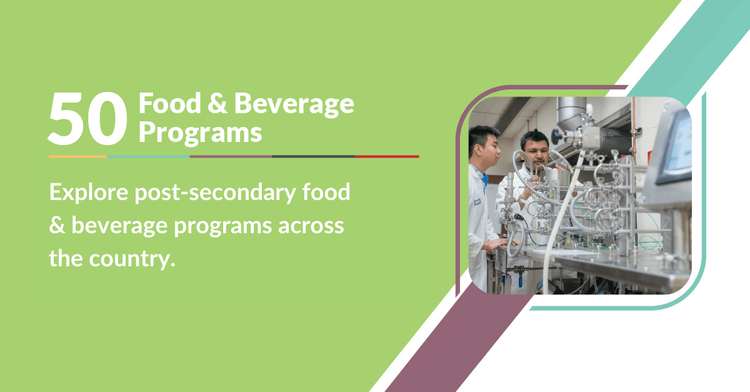
Canada is home to a diverse and dynamic food and beverage industry, supported by educational programs that train the next generation of chefs, brewers, entrepreneurs, and innovators. This roundup highlights 50 standout programs across the country, from top culinary schools and hospitality management courses to cutting-edge research initiatives and sustainability-focused training. Whether you're an aspiring professional, educator, or industry enthusiast, these programs provide valuable insights into the evolving world of food and drink in Canada. BC & Yukon Vancouver Community College UBC BCIT LaSalle College (Vancouver) UBC: Food, Nutrition, and Health Okanagan College Vancouver Island University University of Fraser Valley Northern Lights College North Island College Yukon University Selkirk College Thompson Rivers University Kwantlen Polytechnic University Prairies Saskatchewan Polytechnic University of Alberta University of Saskatchewan University of Manitoba SAIT NAIT Manitoba Institute of Trades & Technology International College of Manitoba Ontario Niagara College Humber College Le Cordon Bleu Ottawa George Brown College Fanshawe College Brock University University of Guelph Toronto Metropolitan University Loyalist College Georgian College Conestoga College Durham College Centennial College Canadore College Algonquin College Trent University St. Lawrence College St. Clair College Sault College Lambton College Confederation College Quebec McGill University LaSalle College Bishop's University Atlantic Canada University of PEI Memorial University Cape Breton University
Community Manager-
50 Food & Beverage Programs - Vancouver Island University
Crafting a Career in BC ’ s Wine Industry: VIU ’ s Wine Business Program The Wine Business program at Vancouver Island University is a comprehensive one-year certificate course designed for those passionate about pursuing a career in the BC wine industry. The program combines practical experience with academic learning in viticulture, wine business practices, marketing, and tourism. Program Highlights: As a student, you ’ ll have the chance to immerse yourself in hands-on experiences at local vineyards and wineries, gaining insights into the entire winemaking process. This practical foundation is then complemented by academic courses in viticulture, wine business practices, marketing, and tourism. A standout feature of this program is its flexibility. Whether you ’ re looking to study full-time for a year or prefer a part-time option spread over two years, VIU has you covered. Located in picturesque Nanaimo, BC, VIU provides an ideal setting for your wine education journey. With a curriculum designed to integrate viticulture essentials with business acumen, VIU ’ s Wine Business program offers a holistic understanding of the wine industry. Students can also earn credits that can be applied toward a Bachelor of Business or a Hospitality and Tourism Management program, opening doors to a wide range of future career prospects. The program includes seven courses and focuses on the broader aspects of the wine industry. In addition to viticulture and winemaking, students delve into wine marketing, exporting, and the vital role of wine tourism. C ourses cover a wide spectrum, from wine marketing and appreciation to beverage theory and the management of wine tourism. The program also offers elective courses in consumer behavio u r, entrepreneurship, and festival management . What You’ll Leave With: Upon graduation, a world of opportunities awaits you in BC ’ s wine industry. Whether you dream of managing a vineyard, excelling in wine s ales and marketing, or even opening your own restaurant, VIU ’ s Wine Business program provides the knowledge and skills to make your wine-related ambitions come true. Career options span winery/vineyard management, retail sales, wine marketing representation, hotel management, culinary arts, a gri - tourism development, and s pecial events coordination. V ideo/Social / Media : VIU YouTube Video
Community Manager-
Cellular Food in Canada
The past few years have proven how susceptible Canada’s food industry is to world events, supply chain disruptions and climate changes. New food production technology, such as cellular agriculture, has the potential to alleviate some of these challenges, while creating commercial opportunities and building a more sustainable, resilient food system. What is it? Cellular food – also known as engineering biology, synthetic biology or cell-cultivated products – is the production of food and textile products without using animals or land. Cell cultures harvested from animals, plants or micro-organisms are grown in the lab through tissue engineering or precision fermentation to produce: Cultivated proteins such as chicken, beef and seafood Fermented products like dairy, eggs, honey and chocolate Ingredients to add to products to create hybrid foods including proteins, enzymes, flavour molecules, vitamins, pigments and fats Textiles such as leather, silk and wool Why you should care As global population continues to grow, so does demand for protein, while access to land and other resource inputs become more scarce. Alternative agriculture could be an answer to food scarcity, concerns about animal and environmental welfare, cost inflation and resource challenges due to climate change. Compared to conventional agriculture, cellular agriculture production, is much less energy intensive, produces less greenhouse gas emissions, and has a much lower overall carbon footprint. With our strong food infrastructure, reputation for food safety, biotechnical expertise, and federal support for alternative protein production, Canada is well positioned to become a leader in cellular agriculture. The 2021 report Cellular Agriculture: Canada’s $12.5 Billion Opportunity in Food Innovation from Ontario Genomics and the Food and Agriculture Institute at the University of the Fraser Valley found that the international cellular agriculture market will reach US$100 billion by 2032. Canada’s food industry has the potential to take $12.5 billion that market, while creating up to 142,000 high-paying jobs. Opportunities in Canada Engineered plant proteins are already in the Canadian market, and by all estimates, precision fermented products are expected to appear before cultured meat products. Current Canadian regulations consider food produced through cellular agriculture as a novel food, and products are approved on a case-by-case basis. Here are a few Canadian start-ups making headlines: Because Animals – This Toronto-based pet food company uses cultured ingredients such as probiotics and nutritional yeast to create nutrient-rich cat and dog food designed to help digestive issues. Future Fields – Edmonton, AB-based Future Fields is a R&D producing growth media products that can be used to create commercialized cultivated proteins in a safe and sustainable manner. Cell-Ag Tech – Toronto’s Cell-Ag Tech is doing R&D on cell-cultured fish and seafood. New Harvest International non-profit research institute New Harvest , which promotes the science behind cultured meat through research, funding and a conference , now has a Canadian branch.
Community Manager-
Other Articles
50 Food & Beverage Programs - University of British Columbia
Shaping the Future of Food Sustainability: University of British Columbia's Food and Resource Economics Program University of British Columbia's Food and Resource Economics program is at the forefront of addressing global challenges in food sustainability and resource management. This program is ideal for those passionate about influencing how we feed a growing population while managing finite natural resources. Program Highlights: The program, which typically spans three years, including co-op terms, is based on the Vancouver Campus. What sets it apart is its interdisciplinary approach, seamlessly combining economics and business management with a profound focus on natural resource economics, economic development, and international trade. Students have the opportunity to choose specialized tracks within the program , and can opt for a path in applied economics or for a broader skill set that combines economics, business management, and science. Additionally, the program offers options for directed studies and a six-credit thesis, making it an ideal foundation for those considering graduate studies in the field. For those seeking an even deeper understanding of the subject, the Master of Food and Resource Economics (MFRE) program is an attractive choice. This one-year program melds elements from economics and MBA programs, with a sharp focus on environmental issues through applied economics and quantitative skills. Students can look forward to strategy-focused workshops and engaging in real-world projects that prepare them for the demands of the professional world. What You’ll Leave With: The curriculum is designed to provide a well-rounded education in the field, including core courses such as Financial & Marketing Management in Agri-food Industries, Food Market Analysis, Strategic Economic Analysis of Agri-Food Markets, and Applied Econometrics. Students also have the flexibility to choose from a variety of specialized courses and modules each year. K ey People : Faculty Leadership : Rickey Yada , Dean; Sumeet Gulati, Associate Dean; James Vercammen , Professor. C ontact Information : Master of Food and Resource Economics (MFRE) : Email mfre.lfs@ubc.ca, mfre.landfood.ubc.ca . Faculty of Land and Food Systems : Email lfs.web@ubc.ca, Tel: 604 - 822 - 1219, Fax: 604 - 822 - 6394, www.landfood.ubc.ca . V ideo/Social / Media : Explore more about the program and campus life through UBC's YouTube channel .
Community Manager-
Company Spotlight – Relocalize Inc.
This is one in a series of interviews with CFIN member companies that have successfully applied for and received funding . Relocalize Inc. is a Montreal, QC- based company that hyper-localize s packaged food manufacturing with autonomous factories that eliminate middle mile logistics (and CO 2 emissions), reduce product costs and cut waste. The company received $246,618 in funding to demonstrate the world’s first autonomous micro-factory for food and beverage, in a pilot partnership with an unnamed U.S. retailer/distributor. We spoke to Wayne McIntyre, CEO and co-founder of Relocalize , to hear more about the company and its plans. Q: What is your company’s mission? A: Our mission is to make packaged food and beverage products better, greener and more affordable. Q: W h y did you apply for this funding and how will you use it? A: This funding ma d e it possible to deploy the world’s first autonomous micro-factory for food. With CFIN’s help, we are conducting a proof of concept in partnership with a major regional retailer to demonstrate the decarbonization, cost reduction and product improvement benefits of hyper-local food. Q: What excites you most about working in this area of the food industry? A: Nothing is more important to people that the nourishment and pleasure of food. At the same time, the food industry is a root cause of some of our biggest problems, including plastic pollution and greenhouse gas emissions. For a company looking to do right by people and the planet, the food industry could not be a more ideal sector to work in. Q: Why is collaboration so important for accelerating innovation in the food industry? Is it difficult to find good collaborating partners, and what would make the process easier? A: Our food system is extremely complex. Scaling innovation and solving big problems cannot be done alone. Fortunately, we have found amazing partners who are supporting us on our transformation journey. Creating platforms for exchanging ideas, building relationships , and collaborating with partners is critical to mak ing the process easier. CFIN is a great example of how to build such a platform. Continued funding and scaling of CFIN would be helpful to make the process easier for more companies. Q: Please comment on the importance of public funding to help companies clear innovation hurdles and access leveraged funds. A: Canada is home to some of the world’s best innovators and entrepreneurs. But they simply don’t have the same kind of access to capital as U . S . -based startups . Public funding helps close that gap and give companies like Relocalize the opportunity to become leaders in Canada and beyond. Q: Looking ahead, what’s on the horizon for your company? A: We are excited to be deploying the world’s first fully autonomous food factory in partnership with CFIN. The next step is to transform our food category – packaged ice – and disrupt the North American market with better, greener , and cheaper packaged ice. Q: What are your passions or hobbies outside of work? A: Long distance canoe tripping and trekking trips , and sailing (my newest hobby) . Q: If you had to pick one person to make you a meal, who would you choose? A: As a proud member of the Canadian food community, my pick needs to be a Canuck , so Michael Smith.
Feeding the Future: Saskatchewan Polytechnic's Agriculture and Food Production Program Saskatchewan Polytechnic’s Agriculture and Food Production program offers an in-depth dive into modern agricultural practices, focusing on sustainable food production and resource management. This three-year diploma program, based in Moose Jaw, is designed to address the growing global demand for food security and sustainable farming. Program Highlights: The program, commencing every September, spans 80 weeks, including three co-op terms. What sets this program apart is its immersive and hands-on approach to learning, providing students with practical skills in agricultural technology, machinery operation, farm management, sustainable production, and land management. One of the unique features of the program is its integration of co-operative education. During their studies, students participate in three paid work terms, gaining invaluable real-world experience in various facets of agriculture and food production. This approach not only enhances their understanding of the field but also allows them to build a strong professional network. The curriculum is designed to equip students with cutting-edge knowledge, covering topics such as precision agriculture, global positioning systems, Internet of Things (IoT) devices, and artificial intelligence in crop management. These insights into modern agricultural technology prepare graduates to tackle the challenges of a rapidly evolving industry. The program structure spans three years, with the first two years focusing on core agricultural courses and co-op work terms. In the third year, students delve into advanced coursework and culminate their studies with a capstone project. What You’ll Leave With: Upon completion of this program, graduates leave with comprehensive knowledge in agriculture and food production. They are well-prepared for a multitude of roles in farm management, agri-food sector marketing, agricultural technology, and more. Key People : Bryan Sarauer : Program Head and Instructor ( LinkedIn Profile ) Lynne Roszell, PAg : Instructor ( LinkedIn Profile ) V ideo/Social / Media : Explore more about the program and campus life through Saskatchewan Polytechnic's YouTube channel and stay connected via Facebook and Instagram .
C rafting Sweet Success: The Baking and Pastry Arts Program at SAIT The Baking and Pastry Arts program at Southern Alberta Institute of Technology (SAIT) in Calgary is an ideal choice for those who are passionate about baking, possess an artistic flair, and are eager to transform their hobby into a high-level professional pursuit. Program Highlights: At the heart of SAIT ’ s program is a comprehensive curriculum that covers a wide array of baking and pastry arts. From mastering the fundamentals of baking to exploring advanced techniques in sugar artistry and artisanal chocolate production, the program is designed to push the boundaries of creativity and precision. This hands-on training, tota l ling approximately 1,400 hours, takes place in state-of-the-art bakery labs, including a specialized chocolate lab and the downtown Culinary Campus. Guiding students through their journey are world-renowned instructors, each bringing a unique blend of experience and expertise in pastry and baking arts. Their diverse backgrounds range from executive pastry chefs in top global hotels to entrepreneurial local bakers, providing students with a rich and varied learning experience. SAIT ’ s program goes beyond just baking and pastry skills. It places a strong emphasis on management training, preparing students for the real-world challenges of food regulations, customer service, and business development. This well-rounded approach ensures that graduates are not just skilled artisans but also competent managers capable of thriving in the dynamic culinary industry. For those looking to gain academic and professional credentials, the program offers the opportunity to write the journeyman baker exam. Moreover, students have options for further education and transfer opportunities to other institutions after graduation, broadening their career prospects. The program also includes a unique work-integrated learning component . Students participate in a paid internship between their first and second year, gaining invaluable real-world experience. Additionally, international study tours offer global exposure, further enriching the educational experience . What You’ll Leave With: This diploma opens doors to career opportunities in various settings, from high-end restaurants and boutique bakeries to entrepreneurial ventures in the baking industry. Graduates of this program leave not only with a profound skill set in pastry creation but also with the necessary management acumen to navigate and succeed in the culinary industry. Contact Information : School of Hospitality and Tourism Advising : Phone: 403 - 284 - 8612 Email: hospitality.info@sait.ca International Student Advising : Phone: 403 - 284 - 8852 Email: international@sait.ca Video/ Social / Media : Program Overview Video
Community Manager-
50 Food & Beverage Programs - Vancouver Community College
Crafting Delicious Creations: VCC ’ s Artisan Baking Certificate Program Vancouver Community College's Artisan Baking Certificate Program is a unique one-year program designed for aspiring bakers and pastry chefs. The curriculum focuses on traditional and modern baking techniques, emphasizing hands-on learning, creativity, and skill development in various baking disciplines. Program Highlights: This program is a gateway to unleashing your creativity and honing your skills in both traditional and modern baking techniques. With a focus on skill development in various baking disciplines, you ’ ll discover a world of possibilities within the realm of artisanal baking. VCC ’ s Artisan Baking Certificate Program is a full-time program spanning 11 months and four terms , starting in May. The program covers Introduction to Baking, Applied Baking, Artisan Baking, a s well as a c apstone project and three weeks of work placement. The program offers students the opportunity to take the ITA Level 1 certification exams . What You’ll Leave With: Graduates have career opportunities in the bakery and pastry sectors , including as an artisan baker, pastry chef, food product developer, or bakery manager . Contact Information: View the university ’s frequently asked questions page. V ideo/Social / Media : Vancouver Community College YouTube
Community Manager-
50 Food & Beverage Programs - Red River College Polytechnic
Mastering the Craft of Pharmaceutical and Food Manufacturing at Red River College Polytechnic Red River College Polytechnic in Winnipeg offers a comprehensive program in Pharmaceutical and Food Manufacturing. This program is crafted for individuals passionate about the intersection of science, technology, and the rapidly growing industries of pharmaceuticals and food production. Designed for those enthralled by the fusion of science and technology, and keen on exploring the burgeoning fields of pharmaceuticals and food production, this program is a blend of theoretical knowledge and practical application. Program Highlights: The curriculum is structured to impart profound knowledge in pharmaceutical and biotechnological product manufacturing. This encompasses a wide array of products such as over-the-counter medicines, prescription drugs, and vaccines. The program is divided into two main terms, each focusing on different, yet equally vital aspects of the field. In the first term, students delve into foundational laboratory skills. This includes mastering measurements, understanding the intricacies of quality and compliance, and honing calculation skills. These are essential competencies for any aspiring professional in this industry. The second term takes a deeper dive into the world of microbiology and bioprocessing. Students learn about advanced production processes and develop professional communication skills, crucial for navigating the complexities of the pharmaceutical and food manufacturing sectors. This program is ideal for individuals who are detail-oriented, possess a knack for problem-solving, and have an inherent interest in the manufacturing processes of food and pharmaceutical products. Essential traits for success in this field include critical thinking, effective teamwork, technical aptitude, and a robust work ethic. Key features of the program include hands-on training in pilot-scale production facilities and access to state-of-the-art manufacturing technologies. These facilities enable students to engage in small-batch fermentation and distillation processes, giving them a realistic feel of the industry ’ s operational environment. Courses in the program cover a broad spectrum, ranging from laboratory equipment skills to more advanced topics in pharmaceutical and food production processes. What Y ou’ll Leave With: Upon graduation, students will possess skills in tablet and capsule manufacturing, biopharmaceutical production, and food processing. They will be adept at functioning in various roles within the pharmaceutical and food manufacturing sectors and proficient in u sing advanced manufacturing technologies. The re are significant employment opportunities for graduates of this program. Career opportunities abound in tablet pressing, bioprocessing, and manufacturing associate positions, among others. Contact Information : Connect with Red River College Polytechnic General Contact Video/ Social / Media : Program Overview Video 1 Program Overview Video 2 Stay connected with Red River College Polytechnic on Facebook , Instagram , YouTube , LinkedIn , Flickr , and Vimeo .
Community Manager-
50 Food & Beverage Programs - University of British Columbia
The University of British Columbia (UBC) offers a Bachelor of Science in Food, Nutrition and Health specializing in Food Science at its Vancouver campus. Program Highlights: UBC’s Food Science program combines the chemistry and microbiology of food, its nutritional and sensory properties, and how it is engineered and processed for consumption. Students will explore topics such as concepts in nutrition, preventing foodborne illness, and the connection between land, food, and community. This program is ideal for individuals who are interested in a career that explores the science of food. Taught by skilled researchers and teachers , the four-year Food Science major emphasizes hands-on experience through extensive foundational science and food-specific laboratory courses. Student s will also participate in c ommunity-based learning through the Land, Food, and Community series, investigating regional, national, and global food systems that are ecologically, socially, and economically sustainable. In addition, s tudents have the opportunity to work in food industry co-op placements . The Food Science program offers has spacious chemistry and microbiology laboratories used only for undergraduate teaching . Other facilities include a teaching kitchen , sensory evaluation space, and a Pilot Plant facility, which is a modern analytical research laboratory used to develop new food products in sustainable ways. The Food Science major is approved by the Institute of Food Technologists (IFT). Student are eligible to apply for Canadian Institute of Food Science and Technology (CIFST) scholarships and other food science-specific student funding , and attend CIFST and IFT events. What You’ll Leave With: Graduates of the Food Science program are ready to work in the food industry . A recent UBC survey show ed that many areas of the industry need food scientists, including for research and development, regulation, quality control, food safety, processing, food marketing, and management. Contact Information: Faculty of Land and Food Systems Phone: 604 - 822 - 1219 Email : lfs.web@ubc.ca Video/Social/Media: UBC Faculty of Land and Food Systems on Instagram UBC Faculty of Land and Food Systems on YouTube
Community Manager-
50 Food & Beverage Programs - University of Alberta
Exploring the Synergy of Business and Food Science at the University of Alberta: Food Business Management Program The Food Business Management program at the University of Alberta offers an interdisciplinary approach to understanding the global food industry. This program, a collaboration between the Faculty of Agricultural, Life & Environmental Sciences and the Alberta School of Business, is tailored to those seeking to combine business acumen with a deep understanding of the science and sustainability of food production. Program Highlights : The hallmark of the Food Business Management program lies in its interdisciplinary approach, seamlessly integrating business theory with the intricacies of agricultural science. This equips students with a well-rounded perspective on the food industry. Students don ’ t just learn theories; they engage in hands-on learning experiences, applying their knowledge to real-world scenarios. The program also offers co-op opportunities through the Alberta School of Business Co-op Program, allowing students to gain invaluable industry exposure. Access to cutting-edge facilities, such as the Agri-Food Discovery Place and the Dairy Research and Technology Centre, enriches the academic journey. Students can choose from two majors within the program: Agricultural Business Management and Food Business Management. The program offers a diverse range of courses, including Food Microbiology, Economics of Production and Resource Management, Food Market Analysis, and Advanced Management Methods for Agri-Food Businesses. What You’ll Leave With: Upon completing the Food Business Management program, graduates possess a versatile skill set that equips them for a wide array of roles within the agri-food industry. Potential career paths include Agri-Food Sales and Marketing Manager, Agrologist, Business Development Officer, Food Manufacturing Manager, Investment Advisor, Market Research Analyst, and Policy Analyst. K ey People : Professor Sven Anders, an agricultural economist, is known for his expertise in the economics of food systems and supply chains. C ontact Information : ALES Student Services : Email questions.ales@ualberta.ca or ales.recruiting@ualberta.ca Graduate Inquiries : Email grad.ales@ualberta.ca V ideo/Social / Media : Explore the program further with YouTube videos about the University of Alberta.
Community Manager-
50 Food & Beverage Programs - Northern Lights College
Culinary Excellence and Professional Growth at Northern Lights College ’ s Advanced Culinary Arts Program Northern Lights College Advanced Certificate in Culinary Arts program spans approximately 45 weeks and is crafted for those who aim to blend their passion for cooking with a deep understanding of culinary techniques and business acumen. Situated in the scenic Dawson Creek, BC the program offers an immersive educational experience, setting a benchmark in culinary training. Program Highlights: The curriculum is strategically structured into two distinct phases. The first year, encompassing 32 weeks, dives into SkilledTradesBC Levels 1 and 2 of Professional Cook training. This phase is all about mastering the basics - from kitchen activities, food preparation, and presentation to the essentials of menu planning, safety, and sanitation. The second year, spanning 16 weeks, shifts gear to advanced culinary techniques and skills. Here, students explore the intricacies of protein cookery, regional cuisine, and the delicate art of pastries, cakes, and desserts. It ’ s a deep dive into the creative and nuanced aspects of culinary arts, preparing students for the complexities and challenges of the culinary world. A notable feature of the program is its rigorous nature, designed to mirror the fast-paced, demanding environment of professional kitchens. The hands-on training is not just about learning but about experiencing the real world of culinary arts. The comprehensive work-based training component is a testament to this, offering students a platform to apply their skills in actual culinary settings. The program culminates in a c apstone project, a dining event that serves as a showcase of the students’ culinary prowess. From meticulous menu planning to the nuances of dining setup and service, this event encapsulates the essence of the program, highlighting the students ’ journey from novices to budding culinary experts. The program ’ s admission requirements are straightforward, focusing on the completion of English and Math at specified levels and necessitating a FoodSafe Level 1 certification before commencement. What You’ll Leave With: Career opportunities post-graduation are diverse, ranging from work in family restaurants and hotels to resorts and institutional kitchens. The program’s practical exposure and focus on industry-relevant skills ensure that graduates are not just equipped with culinary expertise but also with the acumen required for contemporary culinary operations and management. Contact Information : General Inquiries : info@nlc.bc.ca (Canada) , info@international.nlc.bc.ca (International) Trades Inquiries : trades@nlc.bc.ca Admin Office : 11401 - 8th St, Dawson Creek, British Columbia, Canada, V1G 4G2 Phone : 1-866-463-6652 Video/ Social / Media : Program Overview Video
Community Manager-
An Interview with a Product Manager: 16 Volts
Editor's Note: This article was originally published on 10-03-2023. Lavina Gully , Regional Innovation Director for BC and Yukon, sits down with Jeff Epstein of North Vancouver, BC’s 16 Volts and Grants for Growth , to discuss the role of a product manager, the importance of product management, and the significant advantages it offers food and beverage companies . Following the video is a Q&A between Lavina and Jeff with details from their discussion, as well as more information on product management.
Community Manager-
50 Food & Beverage Programs - North Island College
Culinary Creativity Meets Business Acumen: North Island College ’ s Culinary Business Operations Diploma At North Island College (NIC), the Culinary Business Operations Diploma program stands as a bridge between the worlds of gastronomic artistry and business proficiency . Designed for those eyeing mid-level culinary industry positions, this program is a journey through the realms of culinary expertise and business acumen, offering a balanced mix of practical kitchen skills and essential business know-how . Program Highlights: The program is uniquely situated in NIC ’ s vibrant campus settings in Campbell River and Port Alberni , BC. These locations are not just educational spaces but gateways to hands-on experiences, mirroring real-world culinary settings. Here, students don't just learn; they immerse themselves in the dynamic environments of NIC ’ s Café and Bistro, practicing and perfecting their culinary skills. What sets this program apart is its holistic approach , blending culinary finesse with key business skills. In the first year s tudents dive into a curriculum that encompasses everything from basic cooking techniques and bakery essentials to kitchen management. The second year escalates to advanced culinary techniques and international cuisine, coupled with a robust focus on business operations. This unique blend ensures that graduates are not just skilled chefs but also savvy business professionals. Flexibility is a hallmark of the NIC experience. Students have the freedom to tailor their education through a variety of business and tourism electives, aligning their learning with personal interests and career aspirations. The program culminates in a culinary internship, providing invaluable hands-on industry experience and a chance to put classroom theories into practice. Key People: At the heart of the program is Chef Xavier Bauby, an NIC culinary instructor whose expertise and passion are integral to the student experience. With a rich background in the culinary arts, Chef Bauby is not just a teacher but a mentor, inspiring students to reach and surpass his own notable achievements in the culinary field. What You’ll Leave With: Career prospects for graduates are as diverse as the program itself. Equipped with a spectrum of culinary and business skills, alumni can venture into roles ranging from chefs to restaurant managers and culinary entrepreneurs. The program ’ s comprehensive nature opens a plethora of career paths within the food and hospitality sector, offering graduates a competitive edge in the industry. North Island College ’ s Culinary Business Operations Diploma is more than just a program; it ’ s a transformative experience where culinary passion meets business savvy, equipping students with the tools to thrive in the ever-evolving culinary landscape. Video/ Social / Media : NIC YouTube Channel Program Highlight Video Culinary Business Operations Program Overview NIC on Instagram NIC on LinkedIn NIC on Facebook